
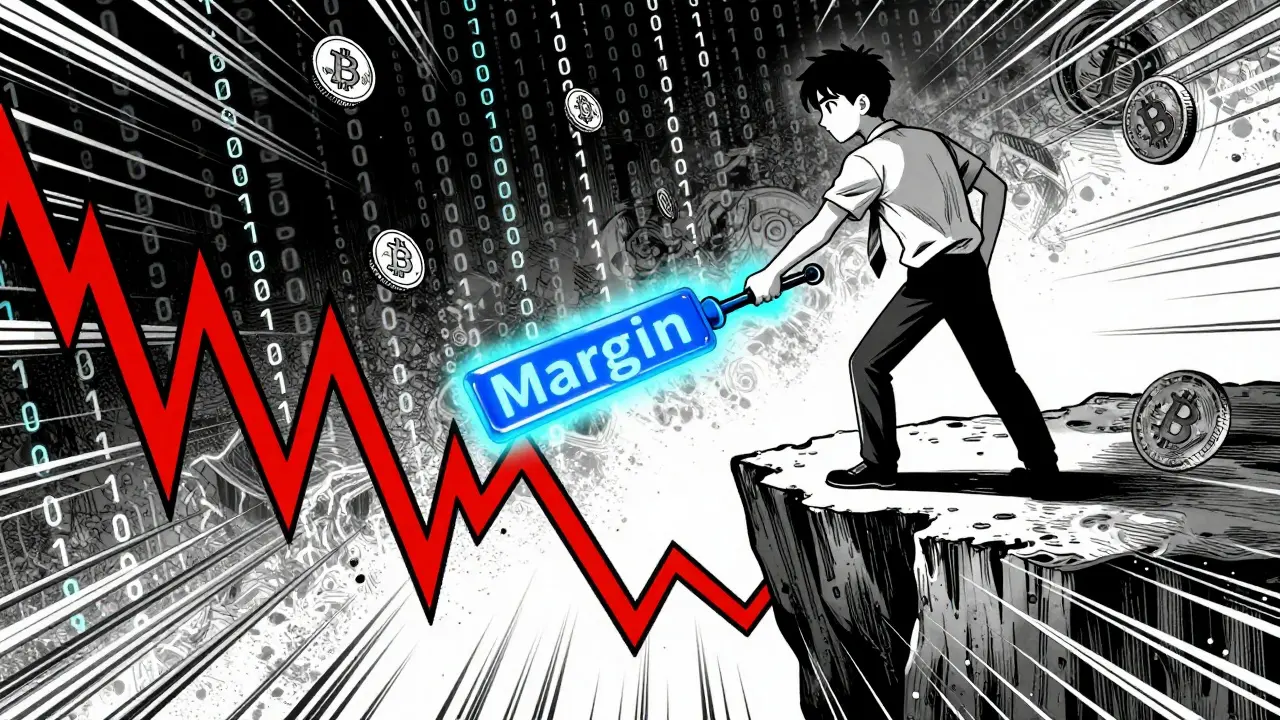
You see a price drop. You know it’s temporary. But you don’t have enough cash to buy the dip big enough to make a real difference. That’s where margin trading comes in. It lets you borrow money against your existing assets to increase your buying power. In the world of blockchain and cryptocurrency, this isn’t just about stocks anymore. It’s about Bitcoin, Ethereum, and thousands of altcoins.
But here is the hard truth: margin trading is a double-edged sword. It can turn a small account into a large one overnight, or it can wipe you out in minutes if the market moves against you. Since the Federal Reserve established Regulation T in 1934, setting the initial 50% margin requirement, the core mechanics haven’t changed much. What has changed is the speed, volatility, and accessibility, especially in crypto markets that run 24/7.
Understanding the Mechanics: Initial vs. Maintenance Margin
Before you execute any strategy, you need to understand the two numbers that will dictate your survival: initial margin and maintenance margin. These are not suggestions; they are rules enforced by your broker or exchange.
Initial margin is the minimum equity you must deposit to open a position. Under traditional Regulation T, this is typically 50%. If you want to buy $10,000 worth of Bitcoin, you need at least $5,000 of your own cash. The other $5,000 is borrowed from the broker. This gives you 2:1 leverage.
Once the trade is open, Maintenance margin takes over. This is the minimum equity percentage you must keep in your account while the position is active. The Financial Industry Regulatory Authority (FINRA) sets a baseline of 25%, but many brokers, especially in crypto, require higher thresholds-often 30% to 40% for volatile assets. If your account value drops below this line, you get hit with a margin call.
| Requirement Type | Standard Definition | Typical Value | Consequence of Breach |
|---|---|---|---|
| Initial Margin | Minimum to open trade | 50% | Trade cannot be opened |
| Maintenance Margin | Minimum to hold trade | 25-40% | Margin Call triggered |
| House Call | Broker-specific threshold | Varies | Must fund within 5 days |
| Federal Call | Regulatory minimum breach | 25% | Must fund within 4 days |
If you ignore a margin call, the broker doesn’t wait around. They liquidate your positions automatically, often at the worst possible price during high volatility. This is why understanding these thresholds is non-negotiable.
Core Strategy 1: Short Selling on Margin
Most people only think about buying low and selling high. Short selling flips this script. You borrow an asset, sell it immediately at the current market price, and hope to buy it back later at a lower price to return to the lender. The difference is your profit.
This strategy is powerful when you believe a specific coin or stock is overvalued. For example, if you think a hype-driven altcoin is peaking, you can short it. However, the risk profile here is unique. When you buy an asset, the most you can lose is 100% (if it goes to zero). When you short, losses are theoretically unlimited because there is no cap on how high a price can rise.
In crypto, shorting requires deep technical analysis. You aren’t just betting on direction; you’re betting on timing. A sudden positive news event can cause a "short squeeze," forcing shorts to cover their positions rapidly, which drives prices even higher. This creates a feedback loop that can destroy leveraged accounts in seconds.
Core Strategy 2: Margin Pyramiding
Imagine you buy Bitcoin at $60,000. It rises to $65,000. You now have unrealized profit. Instead of taking the cash out, you use that profit as collateral to borrow more and buy even more Bitcoin. This is Margin pyramiding.
Investment experts often compare this to taking equity out of your house to buy another house. It amplifies gains significantly during strong trends. If the market continues up, your returns compound exponentially. But expert Anderson warns that this creates compounding risk effects. Each layer of leverage makes your entire stack more sensitive to minor market corrections.
To do this safely, you need strict discipline. Most successful pyramid traders only add to winning positions and never average down on losing ones. You must also monitor your overall leverage ratio constantly. If the market reverses by just 5%, a heavily pyramided position can trigger a cascade of margin calls across all layers.

Core Strategy 3: Volatility and Event-Driven Trading
Crypto markets live and die by events. Mainnet launches, regulatory announcements, and macroeconomic data releases create massive price dislocations. Event-driven trading uses margin to capitalize on these short-term spikes.
The goal here isn’t long-term holding. It’s quick entry and exit. You might use margin to enter a position right before a known announcement, anticipating a surge in volume. Because you’re leveraging your capital, a 5% move in the asset price could mean a 10% or 20% gain on your actual equity.
The danger lies in unpredictability. Markets often price in events beforehand, leading to a "buy the rumor, sell the fact" scenario. If the news is good but the price drops, your leveraged position suffers disproportionately. This strategy requires fast execution speeds and tight stop-loss orders to prevent small mistakes from becoming catastrophic.
Risk Management: The Only Thing That Matters
You can have the best strategy in the world, but without risk management, margin trading will bankrupt you. Here are the three pillars of staying alive:
- Never Use Full Leverage: Just because your broker offers 10x or 20x leverage doesn’t mean you should use it. Centerpoint Securities recommends maintaining buffer zones. Using only 2x or 3x leverage gives you room to breathe during normal market fluctuations.
- Monitor Interest Costs: Borrowing money isn’t free. Margin interest rates vary by broker and amount borrowed. In periods of rising interest rates, like those seen recently by the Federal Reserve, carrying costs eat into profits. Calculate the daily cost of your loan against potential gains.
- Set Hard Stop-Losses: Emotion is your enemy. Decide exactly how much you are willing to lose before you enter the trade. Use automated stop-loss orders to exit if the price hits that level. Do not hope it will come back. It rarely does when you’re leveraged.
Wealthsimple identifies common mistakes like treating margin loans as traditional credit lines. They are not. They are conditional liabilities that vanish if you fail to maintain equity levels. Continuous monitoring is required because maintenance requirements can change based on market conditions.
Options Strategies Within Margin Accounts
For advanced traders, combining margin with options adds another layer of complexity and opportunity. A Covered call involves owning 100 shares of an asset and selling a call option against them. This generates income but limits upside potential. Importantly, covered calls typically require no initial margin because the underlying shares serve as collateral.
However, a Buy-write strategy or naked options trading demands significant margin. Buying a call option might require 50% of the long share value as initial margin. These strategies unlock sophisticated hedging capabilities but require a deep understanding of the "Greeks" (Delta, Gamma, Theta, Vega). Misunderstanding these metrics can lead to unexpected losses even if the market moves in your expected direction.
Current Market Dynamics and Future Outlook
The landscape for margin trading shifts with interest rates and regulation. During the 2020-2022 period of ultra-low rates, borrowing was cheap, encouraging aggressive leverage. As rates rose, margin costs increased, squeezing profitability. Today, traders must factor in higher carrying costs into every calculation.
Volatility remains key. The VIX index serves as a crucial indicator. High volatility increases the frequency of margin calls. Traders often reduce leverage during high-VIX periods to avoid being shaken out by noise rather than trend changes.
Looking ahead, algorithmic risk management is becoming standard. Automated tools now handle position sizing and real-time portfolio monitoring. While this reduces human error, it also means arbitrage opportunities disappear faster. Success in 2026 and beyond will depend on adapting to these technological shifts and maintaining rigorous, adaptive risk protocols.
What is the biggest risk in margin trading?
The biggest risk is forced liquidation via a margin call. If your account equity falls below the maintenance margin requirement, the broker sells your assets automatically, often at a loss, to repay the loan. This can happen rapidly during high volatility, leaving you with nothing.
How much leverage should I use as a beginner?
Beginners should avoid high leverage entirely. Start with 2:1 or less. Higher leverage magnifies both gains and losses, but losses can exceed your initial investment. Focus on learning market dynamics before adding significant debt to your trades.
Can I lose more than my initial investment?
Yes, particularly in short selling. If you short an asset and its price rises indefinitely, your losses are theoretically unlimited. In long positions, if the market gaps down past your stop-loss, you may owe the broker more than your account balance.
What is the difference between a House Call and a Federal Call?
A House Call is triggered by the broker’s internal margin requirements, which are often stricter than regulatory minimums. You usually have five business days to resolve it. A Federal Call is triggered by breaching FINRA’s 25% maintenance rule and must be resolved within four business days.
Is margin trading suitable for cryptocurrency?
It is highly risky due to extreme volatility. Crypto markets operate 24/7, meaning price swings can occur while you sleep. Many crypto exchanges offer high leverage (up to 100x), which increases the likelihood of rapid liquidation. It requires advanced risk management skills.






Melissa L
June 25, 2026 AT 22:43honestly this is way to complicated for me
Sajjad Ghorbani Moghaddam
June 27, 2026 AT 11:45I really appreciate the breakdown of initial versus maintenance margin because it’s a concept that trips up so many new traders who just see leverage as free money. It’s important to remember that while the mechanics haven’t changed since Regulation T, the speed at which crypto markets move means you don’t have the luxury of time to react to a margin call like you might in traditional equities. I always tell people to treat their margin account like a high-pressure boiler; if you don’t monitor the gauge constantly, it’s going to explode in your face.
The section on short selling is particularly crucial because most retail traders only understand long positions, but the risk asymmetry there is terrifying when you consider unlimited downside potential. We need more education on how short squeezes actually work mechanically rather than just treating them as mysterious market events. If you’re going to borrow assets to sell them, you better have an exit strategy that doesn’t rely on hope or vague technical indicators.
Rebecca Shoniker
June 27, 2026 AT 17:48You clearly misunderstand the fundamental nature of liquidity provision!! The notion that one can simply 'set hard stop-losses' and expect them to hold during a flash crash is utterly naive!!! In high-frequency trading environments, slippage will eat your stops alive!!! You are ignoring the bid-ask spread dynamics!!! Furthermore, the interest rate calculations you provided are outdated!!! Current APYs on stablecoin collateral vary wildly depending on the protocol's treasury composition!!! One must analyze the delta-neutral hedging strategies employed by market makers!!! They are front-running these retail attempts at pyramiding!!! It is pathetic that you suggest using only 2x leverage!!! That is capital inefficiency!!! True alpha requires maximizing exposure within the bounds of regulatory arbitrage!!! Do not let this amateur advice deter you from leveraging your full net worth!!! The market punishes hesitation!!!
Jay Sharma
June 28, 2026 AT 09:56the fed wants you to use margin so they can track every single transaction you make. regulation t was never about protecting you, it was about giving them a leash to pull whenever they need to dump toxic assets onto the public. look at the timestamps on these liquidations, they always happen right before a major announcement that benefits the insiders. i tried to short bitcoin last year and my exchange froze my funds for 'security review' until the price went up 20%. it is all rigged. the algos are controlled by blackrock and vanguard working together with the sec to squeeze out anyone who isn't part of the club. dont trust any broker that claims to be independent. they are all fronts for the deep state financial apparatus. keep your coins in cold storage and trade p2p if you value your freedom.
Scott Miller
June 29, 2026 AT 00:10COME ON GUYS! Stop being so scared of leverage! This is exactly why people stay poor! You want to get rich? You gotta take risks! Look at the winners in crypto, they didn't get there by playing it safe with 2x leverage. They used 10x, 20x, sometimes even 100x on altcoins and turned pennies into millions! Yes, you can lose, but think about the upside! If you're too afraid to jump, you'll never fly! Life is short, why settle for small gains? Go all in on the next bull run and watch your portfolio explode upwards! Fear is just a mindset, change it and you change your bank account!
Abby Martin
June 30, 2026 AT 03:07It is absolutely disgraceful that we are still discussing gambling as if it were investing. Margin trading is essentially legalized casino behavior wrapped in fancy financial jargon to make it palatable for the masses. The fact that platforms offer up to 100x leverage is predatory and should be illegal in civilized societies. You are encouraging people to bet money they do not have on assets that have no intrinsic value. When these accounts blow up, who pays the price? Not the exchanges, they take their cut regardless. It is morally bankrupt to promote such reckless behavior under the guise of 'strategy'. People need to wake up and realize that true wealth comes from patience and ethical investing, not from trying to outsmart the market with borrowed money.
Mélanie Boulay
June 30, 2026 AT 11:25I think it is very important that we establish clear boundaries around what constitutes responsible trading behavior, especially when we are talking about leveraged positions in volatile markets like cryptocurrency, which operate continuously without any breaks for traders to rest or reassess their mental state, leading to a situation where emotional decision-making can easily override logical analysis, and while I agree that understanding maintenance margins is critical, I also believe that we need to consider the psychological toll that constant monitoring takes on an individual, as well as the potential for burnout that comes from trying to time the market perfectly, which is something that even professional hedge funds struggle with consistently over long periods of time.
Maurice Flynn
July 1, 2026 AT 18:30Sitting here watching the charts dance like leaves in a hurricane. Is it greed driving us to borrow against tomorrow's sun? Or is it just the thrill of the edge? The pyramid stands tall until the wind shifts. Interesting how we build castles on sand and call it strategy. Maybe the real lesson isn't in the leverage but in the letting go. The market breathes, we just try to breathe with it. Quietly observing the chaos.
nancy jarecki
July 2, 2026 AT 12:31This article reads like a beginner's pamphlet written by someone who has never actually traded options in a live environment. The explanation of covered calls is painfully simplistic and ignores the nuance of implied volatility skew. Real professionals don't 'hope' for direction; they hedge their delta exposure dynamically. It is tedious to wade through this level of basic information that could be found in any introductory finance textbook. If you cannot grasp the greeks without a hand-holding tutorial, perhaps margin trading is not for you. Save your time and money.
Robert Hundley
July 4, 2026 AT 01:58Hey everyone! Just wanted to say that learning about margin is super cool! :) It opens up so many possibilities! I love seeing how people engage with these complex topics! Keep sharing your thoughts and experiences! It makes the community stronger! Let's all learn together and grow our portfolios responsibly! Great read! :D
Ryan Peters
July 5, 2026 AT 00:51Typical globalist nonsense. They want you to trade crypto so they can devalue the dollar further and steal your savings through inflation. Why are we even looking at foreign assets when our own national industries are being gutted by bad policy? The SEC is a joke, allowing these unregulated casinos to operate while punishing legitimate American businesses. You should be buying US stocks, supporting our economy, not betting on digital tokens created by anonymous hackers overseas. Wake up and support your country, not this shadow banking system.
ross harris
July 5, 2026 AT 14:48The market is a meat grinder disguised as a playground. You bring your soul, they take your equity. Pyramiding is just stacking bones on the altar of avarice. The Greeks whisper lies in the ear of the hopeful. Delta decays like flesh, theta eats the mind. To trade on margin is to dance with the devil in a room full of mirrors. Every reflection shows a different version of ruin. The algorithmic predators smell blood in the water. Swim fast, or become chum. There is no middle ground in the abyss.
Carl Belgrave
July 7, 2026 AT 12:31Listen up! If you can't handle the heat, get out of the kitchen! Weak hands talk about risk management while strong hands take profits! You need to be aggressive! Dominate the market! Don't let fear dictate your trades! The patriots know that taking bold action is the only way to succeed in this capitalist jungle! Stop coddling yourself with safety nets! Jump off the cliff and build a plane on the way down! That is how legends are made! Show some spine!