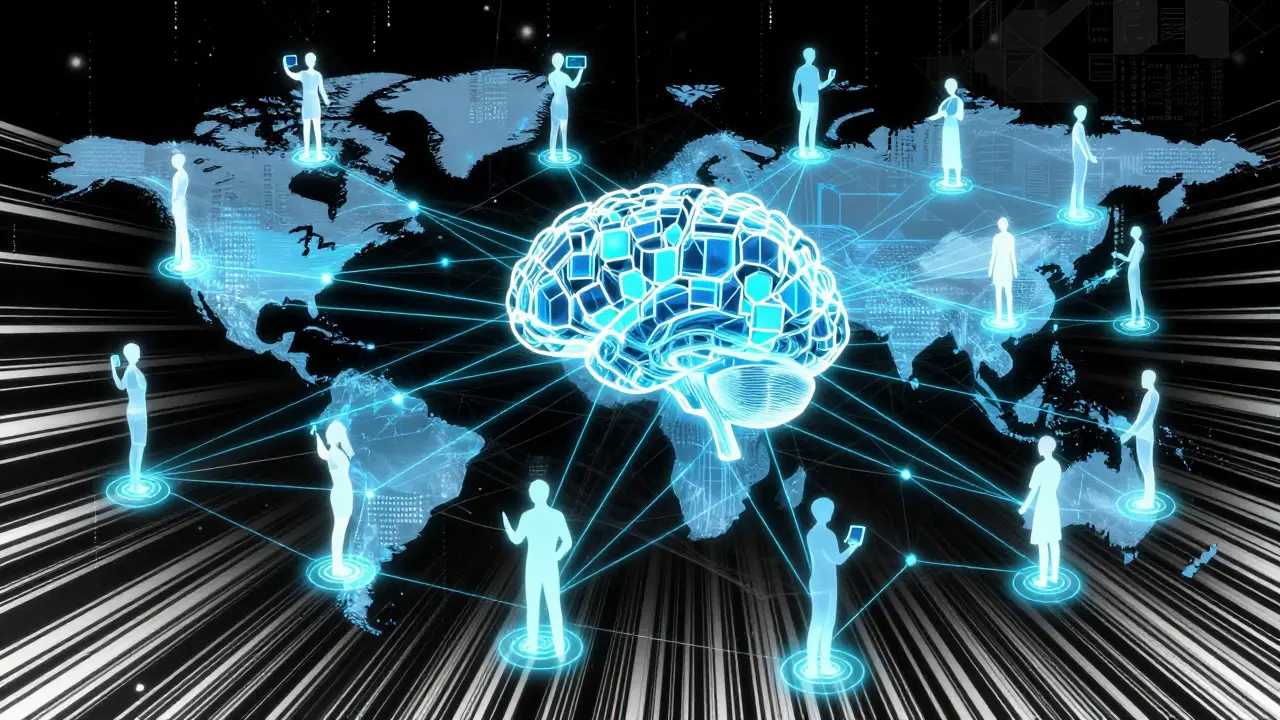
Imagine a world where your medical records are completely private, yet instantly accessible to any doctor who needs them, verified by an unchangeable ledger. Or picture a supply chain where every product’s journey is tracked in real-time, with artificial intelligence predicting delays before they happen. This isn’t science fiction anymore. It’s the reality of AI and blockchain use cases, which are practical applications that combine machine learning's analytical power with blockchain's secure, transparent ledger system. As we move through 2026, this technological marriage is solving problems neither could handle alone.
For years, AI struggled with trust. How do you know an algorithm didn’t cheat? Blockchain struggled with speed and efficiency. How do you process millions of transactions without clogging the network? Together, they create a self-correcting ecosystem. Blockchain provides the verifiable data integrity AI craves, while AI optimizes blockchain’s operational inefficiencies. The result? A system that is smarter, faster, and significantly more secure.
The Core Problem Each Technology Solves for the Other
To understand why these two technologies are such a perfect match, you have to look at their individual weaknesses. Artificial Intelligence operates like a "black box." You feed it data, it spits out a decision, but often you can’t see exactly how it got there. This lack of transparency is a nightmare for industries like finance or healthcare, where accountability is mandatory. Blockchain is a decentralized digital ledger that records transactions across many computers so that the record cannot be altered retroactively. By logging every step of an AI’s decision-making process on a blockchain, you create an immutable audit trail. You can prove exactly why a loan was denied or a diagnosis was made.
On the flip side, blockchains are notoriously inefficient. They require massive computational power to verify transactions, leading to slow speeds and high costs (often called gas fees). Enter AI. Machine learning algorithms can predict network traffic patterns, optimizing when and how transactions are processed. According to recent analyses, AI-optimized networks process transactions up to 2.3 times faster than traditional setups. They also reduce transaction costs by up to 37% by intelligently routing data. It’s a symbiotic relationship: blockchain gives AI trust, and AI gives blockchain speed.
Top Industries Transforming Through Integration
The convergence of these technologies isn’t just theoretical; it’s happening right now in specific sectors. Here is where you will see the most significant impact in 2026 and beyond.
| Industry | Primary Challenge | AI + Blockchain Solution | Measurable Impact |
|---|---|---|---|
| Healthcare | Patient privacy vs. data sharing | Secure patient data analysis with AI-driven diagnostics on a private ledger | Reduced data breaches by 68% |
| Finance | Fraud detection and compliance | Real-time anomaly detection with immutable audit trails for regulatory compliance | 45% greater efficiency in complex transactions |
| Supply Chain | Fake products and logistical delays | AI predicts delays; blockchain verifies authenticity of every shipment step | 52% reduction in fraud incidents |
| Government | Bureaucracy and corruption | Automated, transparent public service delivery via smart contracts | Increased citizen trust and reduced administrative overhead |
Healthcare: Securing the Future of Medicine
In healthcare, the stakes are literally life and death. Hospitals generate terabytes of sensitive patient data daily. Traditionally, this data is siloed, making it hard for researchers to find patterns for new treatments. But sharing it risks privacy violations. With Hyperledger Fabric, a modular enterprise blockchain architecture designed for privacy and permissioned access, hospitals can create private networks. AI models can analyze this encrypted data to spot disease trends or personalize treatments without ever seeing the raw, identifiable information. The blockchain ensures that no one tampered with the results, giving doctors and patients confidence in the AI’s recommendations.
Finance: Ending Fraud Before It Starts
The financial sector was an early adopter because money moves fast, and mistakes are expensive. Banks use AI to detect fraudulent transactions in milliseconds. However, bad actors are getting smarter, using deepfakes and sophisticated spoofing techniques. By anchoring these AI decisions to a blockchain, banks create a permanent record of every flagged transaction. If a dispute arises, the bank can show the exact chain of evidence that led to the freeze. Furthermore, AI-enhanced smart contracts execute trades automatically only when predefined conditions are met, reducing human error and settlement times from days to seconds.
Supply Chain: From Farm to Fork Transparency
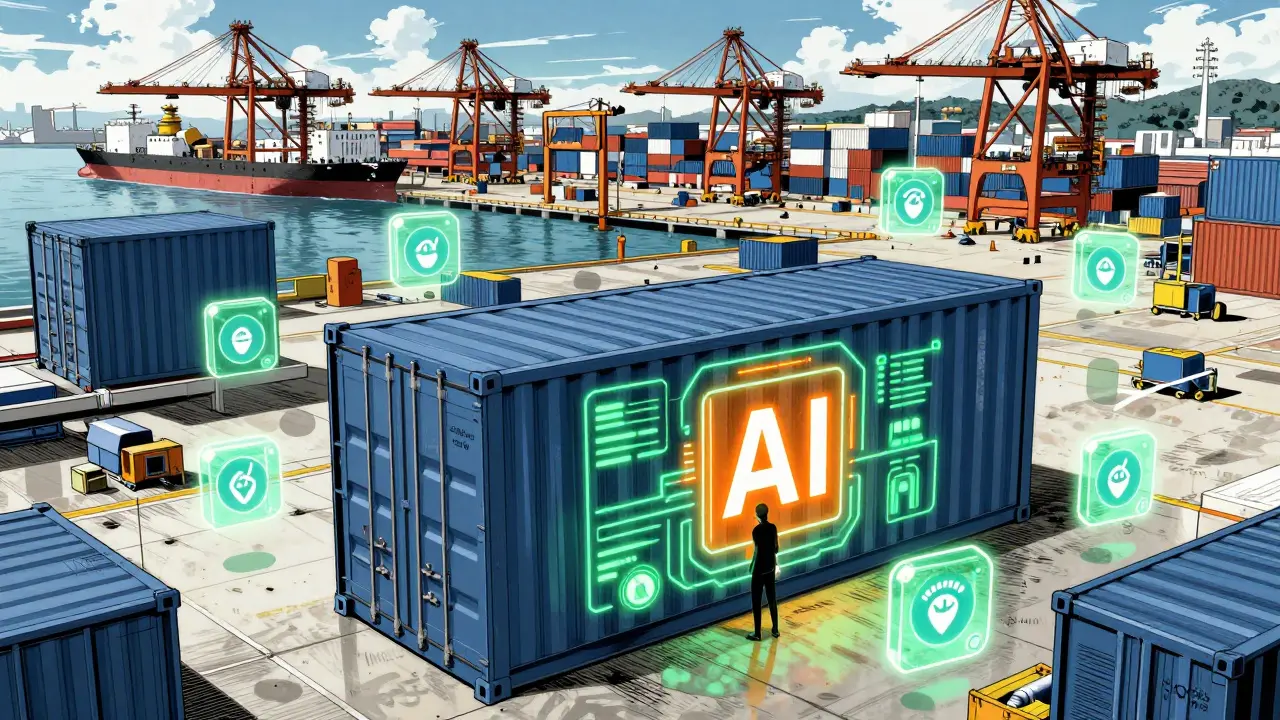
You’ve probably seen QR codes on food packaging that trace its origin. That’s basic blockchain. Now, add AI. Imagine a global shipping container carrying pharmaceuticals. Sensors track temperature and humidity in real-time. If the temperature spikes, an AI model predicts potential spoilage and suggests rerouting the shipment to a closer facility. Simultaneously, blockchain records this event immutably. If the drugs arrive slightly delayed, the receiver knows exactly why and can verify that the quality wasn’t compromised. This level of transparency has cut fraud incidents by over 50% in pilot programs.
Technical Foundations: How It Actually Works
Under the hood, integrating these systems requires careful architectural planning. Most successful implementations use a hybrid approach. You don’t run heavy AI computations directly on the blockchain-it’s too slow and expensive. Instead, AI processes data off-chain (on powerful servers or cloud infrastructure) and then sends the critical results or hashes to the blockchain for verification.
Ethereum is the leading public blockchain platform for decentralized applications, known for its flexibility and extensive developer community remains the go-to choice for public integrations due to its robust smart contract capabilities. Its recent upgrades have specifically optimized for AI workloads, reducing gas fees for machine learning computations by nearly 30%. For enterprises requiring strict privacy, Hyperledger Fabric is preferred. It allows organizations to control who sees what data, which is crucial for complying with regulations like GDPR and HIPAA.
A key component in this ecosystem is the Oracle, which is a bridge that connects smart contracts on the blockchain with real-world external data sources. AI-driven oracles, like those provided by Chainlink, fetch live data (weather reports, stock prices, sensor readings), validate it using machine learning to ensure accuracy, and then deliver it securely to the blockchain. This prevents the "garbage in, garbage out" problem that plagues many automated systems.

Challenges and Barriers to Entry
Despite the hype, implementing AI-blockchain solutions is not plug-and-play. It is complex, expensive, and requires rare skill sets. The average enterprise implementation costs between $250,000 and $500,000 initially. Why? Because you need developers who are proficient in both Solidity (for Ethereum smart contracts) and Python or TensorFlow (for AI models). These professionals are scarce.
There is also the issue of scalability. While AI helps optimize transactions, adding a blockchain layer still introduces latency-typically 200 to 500 milliseconds per transaction. For high-frequency trading or ultra-low-latency applications, this delay might be unacceptable. Additionally, there are new attack vectors. Combining two sophisticated technologies creates complex security landscapes. If an AI model is poisoned with bad data, and that bad data is recorded on an immutable blockchain, you have a permanent, corrupted truth. This requires specialized security protocols and constant monitoring.
Future Trends: What Comes Next?
We are just scratching the surface. Look out for three major trends shaping the next few years:
- Zero-Knowledge Machine Learning (zkML): This emerging technology allows AI models to prove they performed a computation correctly without revealing the model itself or the input data. This solves the biggest hurdle for companies wanting to use AI on blockchain: protecting intellectual property. Projects like Modulus Labs are targeting production deployment later this year.
- Decentralized Autonomous Organizations (DAOs) with AI Governance: DAOs are community-run organizations governed by smart contracts. Currently, voting is manual and prone to manipulation. Soon, AI will scan proposals, identify potential scams or conflicts of interest, and present unbiased summaries to voters, making decentralized governance more efficient and secure.
- Sustainable Blockchain-AI Hybrids: Energy consumption remains a concern, especially for Proof-of-Work chains. New sustainable blockchain solutions are being developed that focus on reducing carbon footprints without compromising security, aligning with global ESG goals.
The integration of AI and blockchain is moving from experimental pilots to core business infrastructure. Companies that master this combination today will define the standards for trust and efficiency tomorrow. It’s not about choosing between AI and blockchain anymore; it’s about leveraging their combined power to build a more transparent, intelligent, and secure digital world.
What is the main benefit of combining AI and blockchain?
The primary benefit is mutual reinforcement: blockchain provides verifiable, tamper-proof data integrity for AI systems, solving the "black box" trust issue, while AI optimizes blockchain’s performance by predicting network traffic and reducing transaction costs, addressing scalability issues.
Which blockchain platforms are best for AI integration?
Ethereum is the leading choice for public integrations due to its mature ecosystem and recent AI-specific optimizations. For private, enterprise-grade solutions requiring strict privacy and compliance, Hyperledger Fabric is widely preferred.
How much does it cost to implement AI-blockchain solutions?
Enterprise implementations typically range from $250,000 to $500,000 initially. Costs are driven by the need for specialized talent proficient in both machine learning and blockchain development, as well as infrastructure setup and security audits.
Can AI and blockchain improve healthcare data privacy?
Yes. By using private blockchains like Hyperledger, hospitals can share encrypted patient data for AI analysis without exposing identifiable information. The blockchain ensures an immutable audit trail of who accessed what data, enhancing both privacy and security.
What is Zero-Knowledge Machine Learning (zkML)?
zkML is an emerging technology that allows AI models to verify their computations on a blockchain without revealing the underlying model or input data. This protects intellectual property and sensitive data while maintaining transparency and trust in the AI’s output.