

Bitcoin doesn’t have banks, cops, or CEOs watching over it. So how does it stop people from cheating? The answer is Proof of Work - a system that turns computing power into trust. It’s not magic. It’s math, electricity, and economics working together to make fraud too expensive to even try.
How Proof of Work Stops Double-Spending
Imagine you try to spend the same Bitcoin twice. One copy goes to a coffee shop. The other goes to a friend. Without Proof of Work, there’s no way to know which one is real. But Bitcoin’s network doesn’t just guess. It forces everyone to prove they’ve done real work to confirm the transaction. Every ten minutes, miners compete to solve a math puzzle. This isn’t a simple calculation. It’s a hash function - specifically SHA-256 - that takes the block’s data and shuffles it through 64 rounds of complex operations. The goal? Find a hash that starts with a certain number of zeros. Right now, that means finding a number with 19 leading zeros in hexadecimal. The odds of guessing it on the first try? About one in 83 trillion. Miners use specialized machines called ASICs, each pushing hundreds of terahashes per second. They’re not just guessing randomly. They’re changing a small piece of data called a nonce, tweaking transaction order, and trying billions of combinations per second. The first one to find the right answer broadcasts it to the network. Everyone else checks it. If it’s correct, the block is added. The miner gets 6.25 BTC plus fees. That’s the reward. But more importantly, it’s the incentive to play fair.The Cost of Attack Is Higher Than the Reward
Here’s the key insight: Bitcoin’s security doesn’t come from code. It comes from cost. The network currently has a hashrate of over 600 exahashes per second. That’s 600 quintillion calculations every second. To take over the network, you’d need to control more than half of that power - a so-called 51% attack. How much would that cost? According to River Financial’s 2023 analysis, sustaining a 51% attack on Bitcoin would cost about $15.8 billion per month. That’s not just buying hardware. It’s powering it. The Bitcoin network uses roughly 121 terawatt-hours of electricity each year - more than entire countries like Argentina or the Netherlands. You’d need to outspend every legitimate miner on the planet, just to rewrite a few blocks. And even if you did, what’s the point? The moment you try to reverse a transaction, the market notices. Bitcoin’s price would crash. Your investment in hardware and electricity would be worthless. Meanwhile, honest miners keep earning rewards. The system is designed so that playing by the rules is always more profitable than breaking it.Why SHA-256 and Block Chaining Matter
Each block in Bitcoin contains the hash of the previous block. That’s what makes it a chain. If someone tries to change a transaction from six months ago - say, to fake a payment they never made - they’d have to redo every single block after that. Not just one. Not ten. Hundreds of thousands. And each one requires solving the same impossible puzzle again. This isn’t theoretical. Since Bitcoin launched in 2009, no one has ever successfully altered the blockchain. Even when GHash.io briefly controlled over 50% of the network’s mining power in 2014, they voluntarily stepped back after backlash from the community. The system didn’t need a CEO to say “don’t be evil.” It just made evil too expensive. The SHA-256 algorithm itself is also critical. It’s been tested for decades. It’s used by governments, banks, and military systems. It’s not perfect - but it’s predictable. And in security, predictability beats novelty. You don’t want your money protected by a new, untested algorithm. You want something that’s been hammered by millions of computers for over a decade.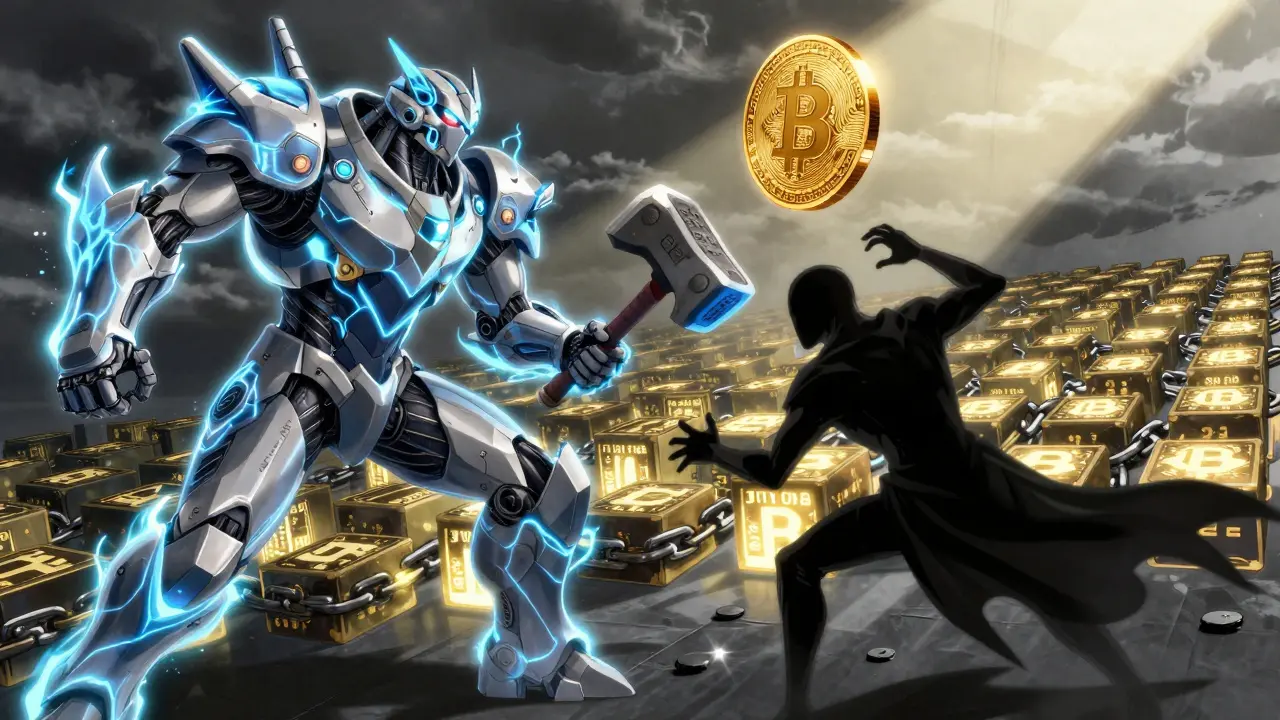
Proof of Work vs. Proof of Stake
Ethereum switched to Proof of Stake in 2022. It cut energy use by 99.99%. But it also changed the nature of security. In PoS, you don’t need to spend electricity. You just need to lock up your coins. The more ETH you stake, the more influence you have. That sounds efficient. But it creates a different kind of risk. If a single entity controls 31% of all staked ETH - like Lido does - they have enormous sway. In PoW, you can’t just buy influence. You have to buy hardware, build data centers, and pay for power. You can’t hide behind a wallet. You have to show up with real-world assets. Bitcoin’s Nakamoto coefficient - the minimum number of entities needed to control 51% of the network - is 3. That’s AntPool, F2Pool, and Foundry USA. Not one. Three. That’s decentralization by design. Ethereum’s PoS has a coefficient of 19. It’s more spread out, but it’s also easier to manipulate because it’s all digital. PoW’s strength is that it’s physical. You can’t fake electricity. You can’t fake hardware. You can’t fake the cost. That’s why Bitcoin remains the most secure blockchain in existence.The Energy Debate - And Why It’s Misunderstood
Critics say Bitcoin mining is wasteful. But they’re missing the point. The energy isn’t wasted. It’s the price of security. Think of it like gold mining. You dig up dirt, crush rocks, and use tons of fuel to get a few ounces of gold. Nobody calls that wasteful. Why? Because gold has value. Bitcoin’s energy use is the same. It’s the cost of producing digital scarcity. And here’s the twist: nearly half of Bitcoin mining now runs on renewable energy. According to the Bitcoin Mining Council, 48.1% of mining power comes from sustainable sources - hydro, wind, solar, and even flared gas that would’ve been burned off in oil fields. In Texas, miners use excess wind power at night. In Iceland, they use geothermal. In Kazakhstan, they tap surplus hydropower. Bitcoin isn’t creating demand for fossil fuels. It’s using energy that would’ve gone unused.
What Happens After the Next Halving?
In April 2024, the block reward drops from 6.25 BTC to 3.125 BTC. That means miners earn half as much in new coins. Transaction fees will need to pick up the slack. Right now, fees make up about 5% of miner income. They’ll need to rise - maybe to 20%, 30%, or more. This is where Bitcoin’s design shines. Miners aren’t just chasing rewards. They’re betting on long-term value. If Bitcoin’s price holds, fees will rise. If the price crashes, miners will shut down. That’s the self-correcting mechanism. The network automatically adjusts its security budget based on real economic signals. No central authority decides how much security Bitcoin needs. The market does. And so far, it’s worked for 14 years - through crashes, bans, hacks, and geopolitical chaos.Why No One Has Ever Broken It
Since 2009, over $3.8 billion has been stolen from exchanges. Not one of those hacks touched the Bitcoin blockchain itself. Why? Because you can’t hack what isn’t centralized. You can’t brute-force a network that’s spread across 127 countries, powered by millions of machines, and secured by physics, not passwords. Bitcoin’s security isn’t about being unbreakable. It’s about being uneconomical to break. And that’s exactly what Proof of Work delivers.Can Proof of Work be hacked?
Technically, yes - if someone controls more than half the network’s mining power, they could reverse recent transactions. But doing so would cost billions and destroy Bitcoin’s value. No one has ever succeeded, and the economic incentive to stay honest is stronger than the incentive to attack.
Why not use Proof of Stake instead?
Proof of Stake is more energy-efficient, but it relies on token ownership, not real-world resources. That makes it easier to centralize control. Bitcoin’s Proof of Work forces attackers to spend physical assets - electricity, hardware, land - which can’t be created or copied. This creates a higher, more verifiable barrier to attack.
Does Bitcoin’s energy use make it unsustainable?
No - because Bitcoin mining increasingly uses stranded, renewable, or otherwise wasted energy. Over 48% of its power comes from renewable sources, and miners often operate where energy is cheap and underused - like during off-peak wind hours or in regions with excess hydropower. The energy isn’t wasted; it’s being put to work securing a global asset.
What happens if mining becomes unprofitable?
If mining stops being profitable, less powerful miners shut down. The network automatically adjusts the difficulty every two weeks to keep block times at 10 minutes. This ensures that even with fewer miners, the remaining ones still earn enough to keep the network secure. It’s a self-regulating system.
Is Proof of Work the only way to secure Bitcoin?
No - but every alternative has trade-offs. Proof of Stake, Proof of Authority, or other models might be faster or greener, but none have proven as resistant to attack over time. Bitcoin’s 14-year track record with Proof of Work is unmatched. Changing it would risk the very security that makes Bitcoin valuable.








Mara Alves Mariano
March 15, 2026 AT 01:06Meanwhile, real people are getting evicted because energy prices are skyrocketing from this nonsense. But hey, at least my Bitcoin's secure. I guess that's what matters.
Adam Ashworth
March 16, 2026 AT 07:22Allison Davis
March 16, 2026 AT 09:33Sherry Kirkham
March 16, 2026 AT 12:08Jennifer Pilot
March 17, 2026 AT 00:10Sharon Tuck
March 17, 2026 AT 12:22karan narware
March 19, 2026 AT 04:22Michael Suttle
March 19, 2026 AT 12:57Jenni James
March 19, 2026 AT 21:20Alex Thorn
March 20, 2026 AT 05:29Brandon Kaufman
March 21, 2026 AT 09:28Zephora Zonum
March 22, 2026 AT 23:38Anthony Marshall
March 23, 2026 AT 03:56Douglas Anderson
March 24, 2026 AT 23:25Tina Keller
March 26, 2026 AT 18:59vasantharaj Rajagopal
March 27, 2026 AT 03:24William Montgomery
March 28, 2026 AT 08:06Chelsea Boonstra
March 29, 2026 AT 12:48Howard Headlee
March 29, 2026 AT 14:38Julie Tomek
March 29, 2026 AT 21:18Craig Gregory
March 31, 2026 AT 16:36Anshita Koul
April 2, 2026 AT 04:11PIYUSH KOTANGALE
April 2, 2026 AT 13:35vishnu mr
April 4, 2026 AT 11:41Tom Jewell
April 5, 2026 AT 19:28ann neumann
April 7, 2026 AT 07:45