
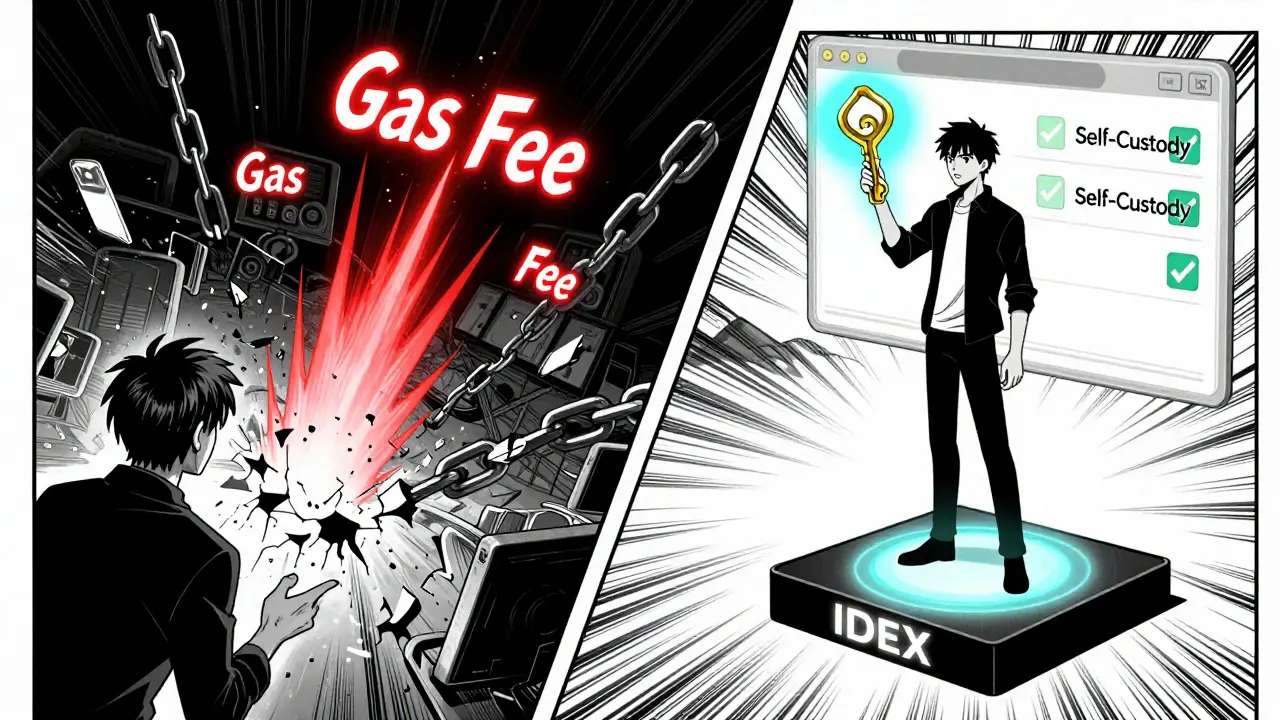
Have you ever placed a trade on a decentralized exchange only to watch it fail because the gas fees spiked or the transaction got stuck in mempool hell? It is a frustrating experience that costs time and money. Now imagine a platform that gives you the speed of a centralized exchange but keeps your keys in your own wallet. That is exactly what IDEX is a hybrid liquidity decentralized exchange designed to combine the performance of centralized platforms with the security of non-custodial trading. Launched as a pioneer in this space, IDEX attempts to solve the biggest problem in DeFi: the trade-off between security and usability.
In this review, we break down how IDEX works, whether its hybrid model actually delivers on its promises, and if it is worth adding to your trading toolkit in 2026. We will look at the technology under the hood, the fee structure, security features, and how it stacks up against giants like Uniswap and Binance.
What Is IDEX and How Does the Hybrid Model Work?
To understand IDEX, you first need to understand the two worlds it tries to bridge. On one side, you have Centralized Exchanges (CEXs) like Binance. They are fast, have deep liquidity, and offer advanced order types, but you do not control your funds. If the exchange gets hacked or goes bankrupt, your money is gone. On the other side, you have Decentralized Exchanges (DEXs) like Uniswap. You keep custody of your assets, which is great for security, but they often suffer from slow execution, high slippage, and failed transactions during network congestion.
IDEX sits right in the middle. It uses an off-chain trading engine to match orders instantly, just like a CEX. However, the settlement happens on-chain, ensuring that no central authority holds your funds. This architecture allows for guaranteed trade execution without the risk of front-running or sandwich attacks that plague standard AMM-based DEXs. The result is a platform where you can place limit orders, see real-time price updates, and execute trades with millisecond latency, all while your assets remain in your self-custody wallet until the moment of settlement.
Technical Infrastructure: Speed Meets Security
The core innovation of IDEX lies in its technical infrastructure. Most DEXs rely entirely on Layer-1 blockchains like Ethereum for every step of the trade process. This creates bottlenecks. When the network is busy, transactions queue up, and miners (or validators) can pick and choose which transactions to include, leading to non-deterministic ordering. This is where malicious actors exploit users by front-running their trades.
IDEX solves this by processing tens of thousands of orders per second off-chain. The matching engine operates with latency under 1 millisecond. Once a trade is matched, it is settled on-chain using Layer-2 Optimistic Rollups. This scaling solution batches multiple transactions together and posts them to the mainnet, drastically reducing costs and increasing speed. Currently, IDEX supports Ethereum and Binance Smart Chain (BSC), with plans to expand to Polkadot and other networks. This multi-chain approach ensures that traders are not locked into a single ecosystem and can access liquidity across different networks seamlessly.
- Off-Chain Matching: Orders are matched instantly without waiting for block confirmations.
- On-Chain Settlement: Finality is secured by the blockchain, ensuring immutability.
- Guaranteed Execution: No failed trades due to insufficient gas or network congestion.
- Front-Running Protection: Orders are executed in the exact sequence they were placed.
User Experience and Trading Features
If you are coming from a traditional exchange, the user interface of IDEX will feel familiar. Unlike many DEXs that require complex interactions with smart contracts for every action, IDEX offers a clean dashboard with real-time charts, order books, and trade history. You can connect popular wallets like MetaMask or WalletConnect and start trading immediately.
One of the standout features is the support for advanced order types. In most AMM-based DEXs, you can only swap tokens at the current market price. With IDEX, you can set limit orders, stop-losses, and take-profit levels. This opens up possibilities for more sophisticated trading strategies, such as arbitrage, where you buy a token on one exchange and sell it on another for a profit. Without limit orders, executing these strategies manually is nearly impossible due to the speed of market changes.
The platform also integrates an Automated Market Maker (AMM) alongside its order book. This dual approach means that even if there is no direct counterparty for your order, the AMM provides liquidity to ensure your trade goes through. This hybrid liquidity model reduces slippage significantly compared to pure order-book DEXs that suffer from thin liquidity.
Security: Who Holds Your Keys?
Security is the primary reason many traders stick to CEXs despite the risks. Hacks of centralized exchanges have resulted in billions of dollars lost. IDEX addresses this by being non-custodial. When you trade on IDEX, the exchange never touches your assets. Your private keys remain in your wallet. Even if the IDEX servers were compromised, hackers would not be able to steal your funds because they do not hold them.
Furthermore, the decentralized nature of the backend infrastructure adds another layer of resilience. Servers are distributed globally, reducing the risk of downtime or single points of failure. This is a significant advantage over centralized exchanges that rely on a few data centers. However, it is important to note that while the exchange itself is secure, you are responsible for securing your own wallet. If you lose your seed phrase, there is no customer support team that can recover your funds.
IDEX Token Utility and Economics
The IDEX Token is not just a speculative asset; it plays a functional role in the ecosystem. Holding IDEX tokens allows users to participate in governance, vote on proposals, and stake for rewards. Additionally, token holders who possess at least 10,000 IDEX can operate lightweight nodes, contributing to the network's decentralization and earning additional incentives.
Staking IDEX tokens also provides benefits such as reduced trading fees and access to exclusive features. The token serves as a hedge against inflation and aligns the interests of the platform developers with the community. As the platform grows and more users adopt the hybrid model, the demand for the token could increase, potentially driving up its value. However, like all cryptocurrencies, the price is subject to market volatility and should be approached with caution.
| Feature | IDEX | Uniswap | Binance |
|---|---|---|---|
| Custody | Non-Custodial (User) | Non-Custodial (User) | Custodial (Exchange) |
| Order Types | Limit, Stop-Loss, Market | Market Swap Only | Limit, Stop-Loss, Market, OCO |
| Execution Speed | <1ms (Off-Chain Matching) | Block Time Dependent (12-30s) | <1ms (Centralized Engine) |
| Fees | Low (Layer-2 Settlement) | Variable (Gas Fees + Protocol Fee) | Low (Maker/Taker Fees) |
| Front-Running Risk | None (Guaranteed Sequencing) | High (MEV Vulnerable) | None (Internal Control) |
| Supported Chains | Ethereum, BSC, Polkadot (Planned) | Ethereum, Polygon, Arbitrum, etc. | Multi-Chain (CEX Aggregator) |

Pricing and Fee Structure
Cost is a critical factor for any trader. IDEX aims to keep fees competitive by leveraging Layer-2 solutions. While traditional Ethereum swaps can cost $50 or more in gas fees during peak times, IDEX settlements are significantly cheaper. The platform charges a small trading fee, which varies depending on whether you are a maker or taker. Additionally, holding IDEX tokens can reduce these fees further, incentivizing long-term participation in the ecosystem.
It is also worth noting that IDEX does not charge withdrawal fees since you are withdrawing to your own wallet, not sending funds out of the exchange's custody. This eliminates the hidden costs often associated with moving large amounts of capital off centralized platforms.
Pros and Cons of Using IDEX
Like any financial tool, IDEX has strengths and weaknesses. Understanding these will help you decide if it fits your trading style.
Pros:
- Self-Custody: You always control your private keys.
- Advanced Trading: Access to limit orders and professional tools.
- Speed: Near-instant execution without network congestion delays.
- Security: Immune to exchange hacks and front-running attacks.
- Multi-Chain: Supports multiple blockchains for broader liquidity.
Cons:
- Complexity: Requires understanding of wallets and gas mechanics.
- Liquidity Depth: May not match the deepest pools of major CEXs for exotic pairs.
- Token Volatility: The IDEX token price can be highly volatile.
- Learning Curve: Interface may be less intuitive for complete beginners.
Is IDEX Right for You?
IDEX is ideal for traders who want the best of both worlds: the security of DeFi and the functionality of CeFi. If you are tired of losing money to failed transactions, high gas fees, or the anxiety of leaving your funds on a centralized exchange, IDEX offers a compelling alternative. It is particularly useful for active traders who rely on limit orders and need precise entry and exit points.
However, if you are a casual investor who just wants to buy Bitcoin once a month, a simple CEX might be easier to use. For those deeply embedded in the DeFi ecosystem, IDEX provides a seamless way to trade without sacrificing control. As the platform expands to more chains and adds leverage trading, its utility will likely grow, making it a key player in the next generation of cryptocurrency exchanges.
Is IDEX safe to use?
Yes, IDEX is considered very safe because it is non-custodial. This means you retain full control of your private keys and assets at all times. Unlike centralized exchanges, IDEX does not hold your funds, so even if the platform were hacked, your assets would remain secure in your personal wallet. Additionally, its off-chain matching engine prevents common DeFi attacks like front-running.
How does IDEX compare to Uniswap?
While both are decentralized exchanges, IDEX offers a superior trading experience for active traders. Uniswap relies solely on an Automated Market Maker (AMM) model, which means you can only swap at market prices and face higher slippage and gas fees. IDEX combines an order book with an AMM, allowing for limit orders, faster execution, and lower fees through Layer-2 settlement. IDEX also provides guaranteed trade execution, whereas Uniswap trades can fail if gas prices spike.
Can I use IDEX on mobile devices?
Yes, IDEX is accessible via web browsers on mobile devices. Since it is a non-custodial platform, you do not need to download a specific app. You simply connect your mobile wallet (like MetaMask or Trust Wallet) to the IDEX website through a browser. The interface is responsive and optimized for smaller screens, though some advanced charting features may be better viewed on desktop.
What blockchains does IDEX support?
As of 2026, IDEX primarily supports Ethereum and Binance Smart Chain (BSC). It utilizes Layer-2 Optimistic Rollups on Ethereum to reduce costs and increase speed. The platform has announced plans to expand to Polkadot and other major blockchains in the future, aiming to provide cross-chain liquidity and broader asset support.
Do I need to buy IDEX tokens to trade?
No, you do not need to buy IDEX tokens to use the exchange. You can connect your wallet and trade supported assets immediately. However, holding IDEX tokens provides benefits such as reduced trading fees, staking rewards, and governance rights. If you plan to trade frequently, holding the token can save you money on fees over time.






Jesse Alston
May 6, 2026 AT 13:36Hey everyone, just wanted to chime in on this because I've been testing IDEX for about three months now and the off-chain matching is genuinely a game changer if you hate waiting for block confirmations. It feels weird at first trusting an off-chain engine but once you realize your keys never leave your wallet it clicks. The limit orders are actually usable which is rare for DEXs.
Tobias Gjerlufsen
May 7, 2026 AT 20:59you think its safe because they say so? lol typical marketing fluff. every hybrid exchange is basically a honeypot waiting for the rug pull or the smart contract bug that drains everything. i stick to pure AMMs because at least the code is public and not hidden behind some proprietary matching engine black box. dont be naive.
Bianca Vilas Boas Lourenço
May 7, 2026 AT 22:49Ugh why does everyone have to make crypto sound like rocket science? 😩 I just want to buy tokens without my head exploding from gas fees. If this thing works as advertised maybe I'll try it but honestly I'm terrified of losing my seed phrase anyway. So much drama for digital beans 🙄
Sudarshan Anbazhagan
May 8, 2026 AT 05:08the premise of hybrid exchanges is fundamentally flawed in its execution because one must consider the centralization vector introduced by the off-chain order book which inherently creates a single point of failure despite the on-chain settlement layer being robust and immutable therefore the security model is compromised by the very mechanism designed to enhance usability which is a paradoxical outcome of modern DeFi engineering trends.
Mike S
May 9, 2026 AT 11:50another 'revolutionary' platform that's just Binance with a fancy coat of paint. the liquidity depth is garbage compared to real CEXs and the 'low fees' are a joke when you factor in the slippage on smaller pairs. save your time and money folks.
Sarah C
May 10, 2026 AT 13:27I really appreciate how detailed this review is! It helps to understand the trade-offs between speed and custody. I’ve been using Uniswap but the failed transactions during high traffic times are so frustrating. Maybe giving IDEX a small test run would be worth it to see if the experience is smoother.
Jan Gilmore
May 12, 2026 AT 04:53Let me tell you something about Layer-2 rollups. They are great for scaling but they introduce new attack vectors like fraud proofs that can take weeks to resolve if there is an issue. You are trading immediate finality for cheaper costs. Know what you are getting into. Most retail users don't even understand the difference between optimistic and zk-rollups.
John Gonzalez Bentham
May 12, 2026 AT 05:34i mean sure it works but do you really trust their servers? who knows what data they are logging. privacy is dead anyway. might as well use binance where they already know everything about you. at least then you dont have to worry about losing your private key because you forgot to write it down on a piece of paper.
Ellie Riddell
May 13, 2026 AT 09:22Sarcasm aside, the concept is interesting. We keep chasing the holy grail of 'fast and secure' while ignoring that these two properties are often mutually exclusive in decentralized systems. It’s like trying to have your cake and eat it too. But hey, if it saves me $50 in gas fees, I’ll take it. 😏
Gavin Wonnacott
May 14, 2026 AT 15:15You Americans are so gullible. This is clearly a pump-and-dump scheme for their native token. Look at the utility section-it’s all about staking rewards to keep you locked in. Classic exit liquidity play. Don’t fall for it.
Jesse Alston
May 15, 2026 AT 10:38@Tobias Gjerlufsen I get the skepticism but IDEX has been around since the early days of Ethereum. They aren't a new meme coin project. The open-source nature of their contracts allows for audits. That said, always DYOR. I wouldn't put my life savings on any single platform though.
Tobias Gjerlufsen
May 17, 2026 AT 05:40audits are meaningless if the business logic is centralized. anyone can audit a smart contract but if the matching engine is closed source you are blind. blind faith is not a strategy.
Destiny Kilby
May 17, 2026 AT 16:12I find the interface quite clean compared to other dexes i have used. the lack of withdrawal fees is a nice touch since you are just moving assets back to your wallet. however the learning curve for setting up the wallet connection was a bit steep for me initially.
Sheldon Friesen
May 19, 2026 AT 08:20Look!!! It's another hybrid exchange review!! Are we surprised?! No!!! Because innovation is slow!!! But seriously, the limit order feature is the only reason I bother with DEXs anymore. Market swaps are for degens who don't care about entry price. Use the tool properly!
Shelby Cantu
May 19, 2026 AT 10:51Just tried it out. Fast.
H F
May 20, 2026 AT 10:56Brilliant analysis! The comparison table is spot on. I've been frustrated by Uniswap's slippage for ages. If IDEX truly offers guaranteed execution without front-running, that's a massive win for active traders. Let's hope the liquidity grows as they expand to Polkadot.
Tricia Alach
May 20, 2026 AT 22:05i feel like the whole decentralization thing is just a vibe tbh. if it works and makes money who cares if its technically centralized? also typos happen when you type fast lol. just buy the dip on idex token and wait for the moon.
Bradley Geldenhuys
May 22, 2026 AT 18:11folks need to wake up and smell the coffee. this is the future of trading. stop clinging to your old habits and embrace the tech. yes there are risks but staying in fiat is the biggest risk of all. get on board or get left behind. simple as that.
Kimberly Herbstritt
May 23, 2026 AT 00:06I have to disagree with the hype here. While the tech sounds cool, I found the UI a bit cluttered compared to Binance. Also, the fact that you still need to manage your own gas for the L2 settlement means you're not completely free from Ethereum's volatility. It's a step forward but not the revolution they claim it is.
Ruben Michel
May 24, 2026 AT 18:51The architectural design is commendable, yet the reliance on Optimistic Rollups introduces a period of uncertainty regarding finality. For institutional-grade trading, this latency in dispute resolution is unacceptable. Retail may tolerate it, but sophisticated players will remain on centralized venues until ZK-proofs achieve parity in speed.
Michael Berggren
May 25, 2026 AT 16:40Great read! 🌟 I love that they support multiple chains. Being able to trade across Ethereum and BSC seamlessly is huge. Plus, the non-custodial aspect gives me peace of mind. Just remember to backup your seed phrase securely! 🔐