

When you trade crypto in Thailand, you’re not just using an app-you’re operating under one of the strictest regulatory systems in Southeast Asia. Since April 2025, the Thailand SEC has forced foreign exchanges like Bybit and OKX out of the local market. If you’re a Thai trader, you now only have nine licensed platforms to choose from. And if you’re a foreign exchange trying to reach Thai users? You need to jump through a series of legal hoops-or get blocked entirely.
How Thailand Defines a Crypto Exchange Serving Thai Users
It’s not enough to just have Thai customers. The Thailand SEC uses seven specific criteria to decide if a foreign crypto platform is targeting Thai users and must get licensed. If your platform meets even one of these, you’re legally required to apply:- Your website is partially or fully in Thai language
- You use a .th or .ไทย domain
- You accept payments in Thai baht or through Thai bank/e-wallet accounts
- You say Thai law governs your terms or Thai courts handle disputes
- You pay for ads targeting Thai users on Google or Facebook
- You have offices, staff, or customer support in Thailand
- Any other factor the SEC officially designates
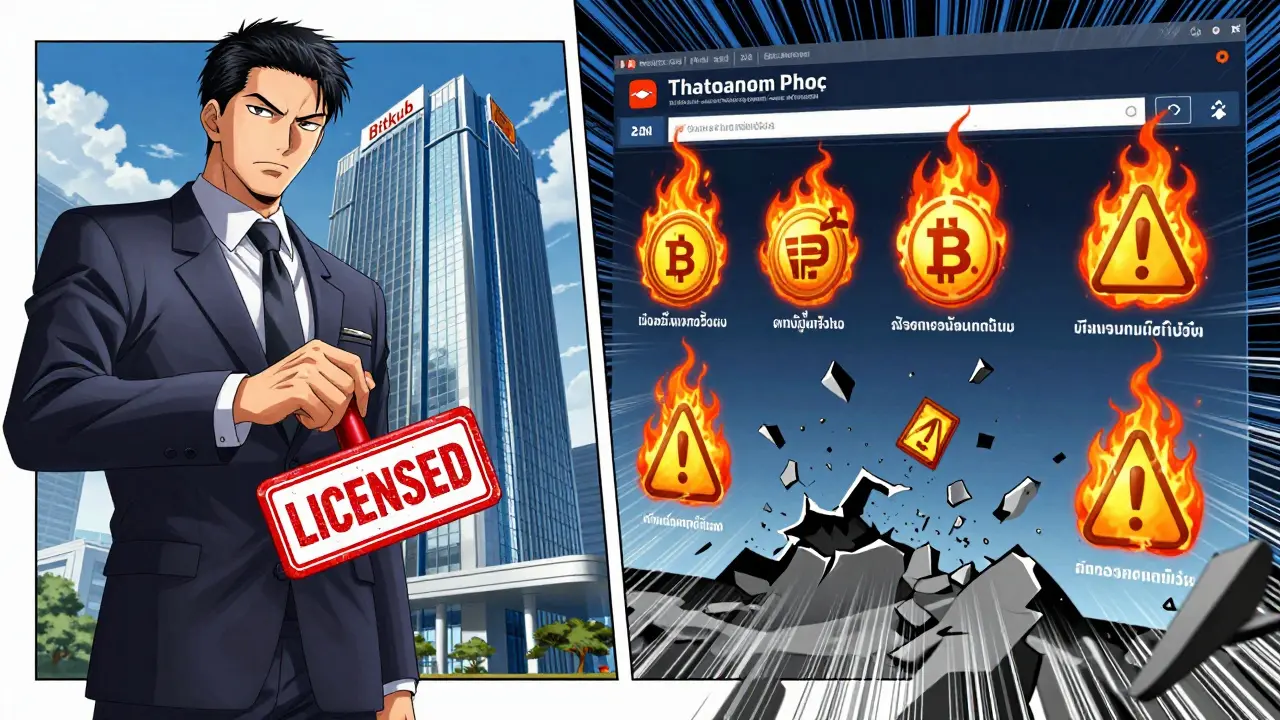
This isn’t vague. It’s precise. And it’s enforced. The Ministry of Digital Economy and Society can block unlicensed sites within hours-no court order needed. In 2025, over 120 foreign crypto sites were cut off overnight. Many didn’t even realize they were breaking the law until their Thai users couldn’t log in.
Licensed Exchanges in Thailand: Only Nine Exist
As of February 2025, only nine entities hold full licenses from the Thailand SEC. The biggest is Bitkub, which handles over 60% of local trading volume. Others include Zipmex, DigiFinex, and Binance Thailand (which restructured its operations to comply). All nine are Thai-registered companies with local management teams.Foreign exchanges can’t just set up a Thai subsidiary and call it a day. They need to prove they have:
- Minimum capital of ฿50 million ($1.37 million)
- AML/CFT systems that meet FATF standards
- Source code audited by SEC-approved firms
- A 30-day window to submit paperwork after targeting Thai users
The application fee is ฿1 million ($27,400), and annual renewal costs ฿500,000 ($13,700). The approval process takes 90 to 120 days on average. Most foreign firms gave up before even starting.
What You Can’t Trade on Thai Exchanges
Even if you’re on a licensed platform, your options are limited. The SEC has banned:- Meme coins (like Dogecoin, Shiba Inu)
- Fan tokens (like those from soccer clubs)
- Non-fungible tokens (NFTs)
- Privacy coins (Monero, Zcash, Dash)
Only 35 digital assets are approved for trading as of June 2025-mostly Bitcoin and Ethereum, with a few stablecoins and blue-chip altcoins. That’s down from over 350 coins available on foreign platforms before the crackdown.
Staking is allowed-but only if it’s non-promotional and doesn’t promise fixed returns. Any platform offering “earn 10% APY” is violating the rules. The SEC treats staking as a security-like activity and demands full transparency.
Trading Restrictions and Fees
Thai licensed exchanges have strict limits:- Daily withdrawal caps: ฿500,000 ($13,700) per user
- Transaction fees: average 0.25% (vs. 0.1% on Bybit or Binance Global)
- No wallet services offered by exchanges
- No advertising of crypto as payment for goods or services
- No lending, borrowing, or deposit-taking with promised returns
These rules are designed to prevent fraud, but they also hurt liquidity. Traders report wider spreads and slower order fills. On Reddit’s r/CryptoThailand, users complain that even major trades now take hours to execute because there’s less depth on local exchanges.
Why the Rules Were Made
The crackdown didn’t come out of nowhere. In early 2025, crypto fraud reports in Thailand spiked 200% year-over-year. Scammers ran fake platforms, impersonated customer support, and disappeared with users’ funds. The SEC said its goal wasn’t to kill innovation-it was to stop criminals.The results are clear. Crypto-related fraud dropped 37% in Q2 2025 compared to Q1. The Royal Thai Police Cybercrime Division confirmed fewer scams, fewer fake apps, and fewer victims. Thai investors now trust licensed exchanges more than ever.
But there’s a trade-off. A survey of 2,300 Thai crypto users on Pantip.com showed 87% felt safer-but 68% said they lost access to coins they liked. Many now use VPNs to access foreign platforms. Chainalysis estimates 35% of Thai crypto activity has moved offshore since April 2025.

How Thailand Compares to Other Countries
Thailand’s rules are tighter than Singapore’s. MAS lets foreign exchanges operate with fewer restrictions as long as they don’t target locals. Japan’s FSA requires licensing too, but doesn’t block foreign sites based on language or domain. China outright bans all exchanges.Thailand’s biggest strength? Speed. The SEC can shut down a site in hours. Its biggest weakness? Rigidity. Unlike the EU’s MiCA framework, Thailand doesn’t allow cross-border license recognition. A license from Japan or South Korea doesn’t help you trade in Thailand.
Thailand also has no clear rules for stablecoins beyond tethering them to fiat. DeFi protocols? Still unregulated. The SEC plans to tackle these in late 2025.
What’s Next for Thailand’s Crypto Market
The market is still growing. In Q1 2025, Thailand’s crypto market hit $1.2 billion in value with 4.7 million active users-23% of the adult population. Licensed exchanges now control 78% of trading volume, up from 15% in late 2024.Looking ahead:
- Bitcoin and Ethereum ETFs are approved and trading
- Altcoin ETFs (like Solana, Cardano) are expected in 2026
- A CBDC pilot with licensed exchanges launches in Q2 2026
- The National Blockchain Policy Office is spending ฿2.1 billion ($57.6 million) on blockchain infrastructure through 2027
But the biggest question remains: Can Thailand keep users inside its regulated system? With withdrawal limits, higher fees, and fewer coins, many are leaving. The SEC knows this. They’re working on relaxing some caps in 2026-but only for institutional traders.
What Traders Should Do Now
If you’re in Thailand:- Only use the nine SEC-licensed exchanges
- Check the official license database at market.sec.or.th before depositing
- Avoid platforms promising high yields or offering privacy coins
- Be aware of daily withdrawal limits
If you’re a foreign exchange:
- Don’t assume you’re safe just because you’re not based in Thailand
- If your site is in Thai, accepts baht, or targets Thai users-you’re already in violation
- Apply for a license only if you can meet the $1.37 million capital requirement
- Expect a 4-month approval process and heavy compliance costs
There’s no middle ground. Either you comply fully-or you’re blocked.





Mike Pontillo
January 5, 2026 AT 14:09Joydeep Malati Das
January 6, 2026 AT 00:56rachael deal
January 7, 2026 AT 11:53Elisabeth Rigo Andrews
January 9, 2026 AT 09:31Andrew Prince
January 9, 2026 AT 09:42Jordan Fowles
January 10, 2026 AT 21:17Steve Williams
January 11, 2026 AT 08:57nayan keshari
January 11, 2026 AT 10:48Johnny Delirious
January 12, 2026 AT 21:42Bianca Martins
January 13, 2026 AT 08:33alvin mislang
January 13, 2026 AT 18:36Monty Burn
January 15, 2026 AT 12:11Kenneth Mclaren
January 15, 2026 AT 12:40Alexandra Wright
January 17, 2026 AT 05:15Jack and Christine Smith
January 19, 2026 AT 04:49Jackson Storm
January 21, 2026 AT 01:19Raja Oleholeh
January 21, 2026 AT 19:33Prateek Chitransh
January 23, 2026 AT 01:57Michelle Slayden
January 24, 2026 AT 19:30Vernon Hughes
January 26, 2026 AT 06:36Alison Hall
January 27, 2026 AT 03:11