

When a single wallet moves 300 BTC-worth over $33 million-onto an exchange after 13 years of silence, the whole crypto market takes notice. That’s not just a transaction. It’s a signal. And it’s not rare. These massive movements, called whale deposits and withdrawals, are one of the most reliable ways to read the market’s hidden mood. You won’t find them in news headlines, but they’re shaping price swings right now.
What Exactly Is a Crypto Whale?
A crypto whale isn’t a person. It’s a wallet. Specifically, one holding enough cryptocurrency to move markets on its own. For Bitcoin, that means 1,000 BTC or more. At today’s prices, that’s around $68 million. For Ethereum, it’s 10,000 ETH-roughly $28 million. These aren’t random addresses. They’re tied to institutions, early adopters, or even long-dormant wallets like the ones from Mt. Gox.There are over 100 such wallets controlling about 15% of all Bitcoin in circulation. That’s not a small fraction. It’s a choke point. When these wallets move coins onto exchanges, it’s usually a sign they’re getting ready to sell. When they pull coins off exchanges and into cold storage, it’s often a sign they’re holding-or even buying more.
Why Whale Movements Matter
Think of an exchange like a grocery store. If 10 people walk in and buy all the apples, the shelves go empty. If 10 more people show up wanting apples but there are none left, prices shoot up. That’s what happens with crypto.When whales deposit large amounts onto exchanges, they’re adding sell pressure. More coins available for trading means lower prices. When they withdraw, they’re removing supply from the market. That’s why prices often rise after big withdrawals. It’s not magic. It’s basic supply and demand.
Look at what happened in July 2023. A wallet tied to Mt. Gox-dormant since 2014-moved 300 BTC to Binance. Those coins were bought for less than $10 each. Now they were worth over $110,000 each. The market didn’t panic. It watched. Traders knew: this wasn’t a sell-off. It was a redistribution. But if that same wallet had split the 300 BTC across 10 different exchanges within 24 hours? That would’ve been a red flag. Pattern matters.
How to Track Whale Activity
You don’t need a degree in blockchain to track whales. Tools like Glassnode, Lookonchain, and Nansen do the heavy lifting. They monitor every transaction on the Bitcoin and Ethereum blockchains. Here’s what to look for:- Exchange Inflow vs. Outflow: If deposits are 3x higher than withdrawals, whales are likely preparing to sell. If withdrawals are dominant, they’re probably accumulating.
- Whale Deposit Size: Average deposit sizes jumping from 0.7 BTC to over 6 BTC in a week? That’s not normal. It’s a warning sign of coordinated selling.
- Accumulation Trend Score: Glassnode’s metric that tracks whether whales are net buying (score near 1) or net selling (score near 0). In Q3 2023, it hit 0.87-the highest in two years.
- Wallet Clusters: Are multiple whale wallets moving at once? That’s a signal. A single wallet moving 500 BTC? Maybe a personal transfer. Ten wallets moving 50 BTC each? That’s a strategy.
Platforms like Santiment now send real-time alerts when any wallet moves over $10 million. You can set up notifications for specific addresses. Some traders even track the wallets of known whales-like the ones linked to institutional ETF applicants.
The Paradox: Withdrawals Can Mean Sell-Offs Too
Here’s where it gets messy. Some experts say whale withdrawals mean buyers are stepping in. Others say it means whales are moving coins to cold wallets to prepare for a massive dump later. Both can be true.OneSafe.io calls this “the paradox of market signals.” If a whale pulls 1,000 ETH off Kraken and sends it to a DeFi staking protocol, that’s not selling. That’s locking up value to earn yield. The price might rise because less ETH is available for trading. But if that same whale moves 1,000 ETH to Binance, Coinbase, and OKX within hours? That’s a sell-off.
Context is everything. You need to know:
- Where are the coins going? (Exchange? DeFi? Another wallet?)
- How fast are they moving?
- Are other whales doing the same thing?
Without this, you’re guessing. And in crypto, guessing costs money.

Real Examples That Shook the Market
- Mt. Gox to Binance (July 2023): 300 BTC moved after 13 years. Price dipped 2% on the news-then rebounded. Why? Because traders realized the coins were being moved, not sold.
- Q4 2021 Bull Run Peak: Whale deposits hit 185,000 BTC in a single month. Within weeks, Bitcoin crashed 50%.
- June-December 2022 Bear Market: Whales withdrew over 500,000 BTC from exchanges. Prices bottomed out shortly after.
Notice the pattern? Deposits before crashes. Withdrawals before rallies. It’s not perfect-but it’s repeatable.
What Institutions Are Doing Differently
Big players like BlackRock and Fidelity don’t buy Bitcoin by dumping $100 million onto Coinbase. They use OTC desks. That means they buy directly from other institutions, off-exchange. Their wallet balances on exchanges stay steady. That’s why you can’t just look at exchange balances and assume institutions are buying or selling.Whales aren’t all the same. There’s a difference between:
- Individual whales: Early adopters, long-term holders, sometimes panic sellers.
- Institutional whales: ETF issuers, hedge funds, corporate treasuries. They move slowly, quietly, and avoid public exchanges.
So if you see a big deposit on Binance, it’s probably not BlackRock. It’s probably someone else-maybe a retail trader who got lucky.
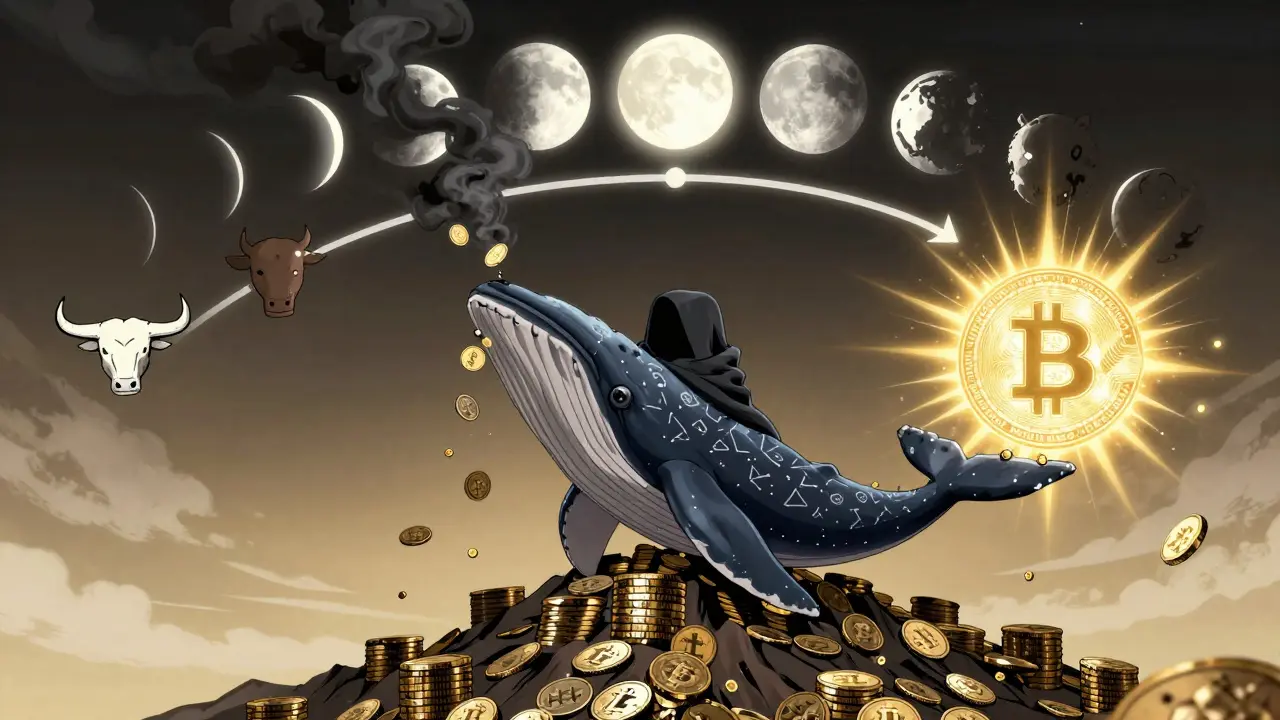
How Whale Behavior Changes With Market Cycles
Whales adapt. In bull markets, they accumulate quietly. In bear markets, they sell aggressively. But they’re not dumb. They watch regulation, macro trends, and news.In 2023, whale accumulation hit a multi-year high. Why? Anticipation of Bitcoin ETFs and the 2024 halving. They knew the supply would tighten. So they bought. And they moved their coins off exchanges to avoid the risk of exchange hacks or regulatory seizures.
Meanwhile, DeFi is changing the game. Instead of moving coins to exchanges, whales now stake them on Uniswap, lend them on Aave, or lock them in Lido. That means fewer coins on exchanges-but still active market participation. So a withdrawal from Kraken doesn’t always mean “buy.” It might mean “stake.”
Limitations and Risks
Whale tracking isn’t foolproof. Here’s why:- You can’t tell if a whale is an institution or a private investor.
- Some whales use mixers or bridges to obscure their movements.
- 12% of whale activity now happens across multiple blockchains-making tracking harder.
- Regulators like the SEC are watching. Coordinated whale moves could be classified as market manipulation.
And there’s a bigger problem: confirmation bias. You see a withdrawal. You think, “Bullish!” But what if it’s a trap? What if the whale is moving coins to a new exchange to dump them later? You can’t know for sure. That’s why whale tracking works best as a confirmation tool, not a standalone signal.
What to Do With This Info
Don’t trade based on whale movements alone. But do use them to:- Confirm your existing analysis. If your technical chart says “buy,” and whale deposits are falling? That’s a green flag.
- Spot potential traps. If everyone’s cheering a whale withdrawal, but the price is falling? That’s a warning.
- Time your entries. Big withdrawals followed by low volume? That’s often a bottom.
- Protect your portfolio. If whale deposits spike, reduce your exposure. Don’t panic-but be ready.
Whale activity doesn’t predict the future. But it reveals what the smartest players are doing right now. And in crypto, that’s half the battle.
Tools to Start Tracking Today
You don’t need to build your own blockchain explorer. Here are free tools to get started:- Lookonchain: Free alerts for large wallet movements. Best for Bitcoin and Ethereum.
- Glassnode: Free dashboard with Accumulation Trend Score and exchange inflow/outflow data.
- Nansen: Tracks wallet behavior. Shows if a whale is an exchange, institution, or DeFi user.
- Santiment: Real-time alerts for $10M+ moves. Good for quick notifications.
Set up alerts for 3-5 major whale wallets. Watch them for a week. You’ll start seeing patterns.
Are whale deposits always bearish?
Not always. Whale deposits can mean selling pressure, but they can also mean institutional rebalancing or tax events. For example, a whale might deposit coins to pay fees or move assets between exchanges. Always check the context: how much, how fast, and where are the coins going?
Can whale movements predict Bitcoin’s next price surge?
They can hint at it. Historically, major price rallies have followed periods of heavy whale withdrawals and low exchange balances. For example, before the 2021 bull run, whales withdrew over 400,000 BTC from exchanges. But prediction isn’t guaranteed. Whale activity is one of many signals-combine it with on-chain volume, funding rates, and macro trends for better accuracy.
Why do whales move coins to DeFi instead of exchanges?
Because they can earn yield without selling. Staking ETH on Lido or locking BTC in wrapped form on DeFi protocols lets whales earn interest, participate in governance, or hedge positions-all without touching centralized exchanges. This reduces exposure to exchange risks and regulatory scrutiny, while keeping their assets active in the market.
Do all whales have the same strategy?
No. Glassnode’s data shows whales with 1,000-10,000 BTC are mostly accumulating, while those with over 10,000 BTC are distributing. Smaller whales might be retail investors cashing out. Larger ones are institutions or funds rebalancing portfolios. The behavior isn’t uniform-it’s layered.
Is whale tracking legal?
Yes. Tracking public blockchain data is legal everywhere. But coordinated whale movements-where multiple large wallets act together to manipulate price-could violate market manipulation laws under SEC guidelines. The line between smart strategy and illegal activity is blurry, and regulators are still catching up.







McKenna Becker
February 24, 2026 AT 22:10Samantha Stultz
February 26, 2026 AT 06:43precious Ncube
February 27, 2026 AT 14:19Jan Czuchaj
February 28, 2026 AT 00:57Tracy Peterson
March 1, 2026 AT 09:55George Suggs
March 2, 2026 AT 01:59KingDesigners &Co
March 3, 2026 AT 00:40Felicia Eriksson
March 3, 2026 AT 23:52aaron marp
March 4, 2026 AT 02:33Patrick Streeb
March 6, 2026 AT 00:19Tracy Whetsel
March 7, 2026 AT 02:26Sony Sebastian
March 7, 2026 AT 04:09Brian Lemke
March 8, 2026 AT 16:56Michael Teague
March 10, 2026 AT 08:19Michelle Mitchell
March 11, 2026 AT 19:34Kaitlyn Clark
March 13, 2026 AT 15:18christopher luke
March 15, 2026 AT 02:51Mary Scott
March 16, 2026 AT 21:24Shannon Holliday
March 18, 2026 AT 08:06Jeremy buttoncollector
March 18, 2026 AT 12:50Michelle Xu
March 20, 2026 AT 12:13Ryan Burk
March 21, 2026 AT 19:03Amanda Markwick
March 22, 2026 AT 02:16