

Imagine getting paid for a delayed flight in under an hour-no forms, no calls, no waiting for an adjuster. That’s not science fiction. It’s happening right now with blockchain insurance applications. While most people think of crypto wallets and NFTs when they hear blockchain, the real game-changer might be in how we insure things-cars, homes, flights, even crops. And it’s not just a tech experiment anymore. Major insurers, reinsurance giants, and decentralized startups are already using it to cut costs, stop fraud, and serve people who’ve been left out of the system for decades.
How Blockchain Insurance Actually Works
Traditional insurance is slow. You file a claim, wait weeks for paperwork to shuffle between departments, get asked for the same documents three times, and then-maybe-you get paid. Blockchain flips that. Instead of a central company holding all the data, everything lives on a shared, tamper-proof digital ledger. Every step-from buying a policy to paying out a claim-is recorded and verified by multiple parties, not just one insurer.
The magic happens through smart contracts. These are self-executing pieces of code that run on blockchains like Ethereum. They don’t need humans to trigger them. If a condition is met, the payout happens automatically. For example, if a flight is delayed by more than three hours, and the flight data comes from an official airline feed (via an “oracle”), the smart contract sees it, confirms it’s real, and sends the money straight to your wallet. No claims department. No delays.
This isn’t theoretical. AXA’s Fizzy program has been paying out flight delay claims since 2019. By 2024, it covered over 500 routes across 15 airlines. In one case, a traveler got $200 within 47 minutes after their flight was canceled. That’s faster than most refund processes for online shopping.
Where Blockchain Insurance Shines
Not every insurance claim is a good fit for automation. Complex liability cases-like a car accident with multiple parties and disputed fault-still need human judgment. But for simple, objective events? Blockchain is unbeatable.
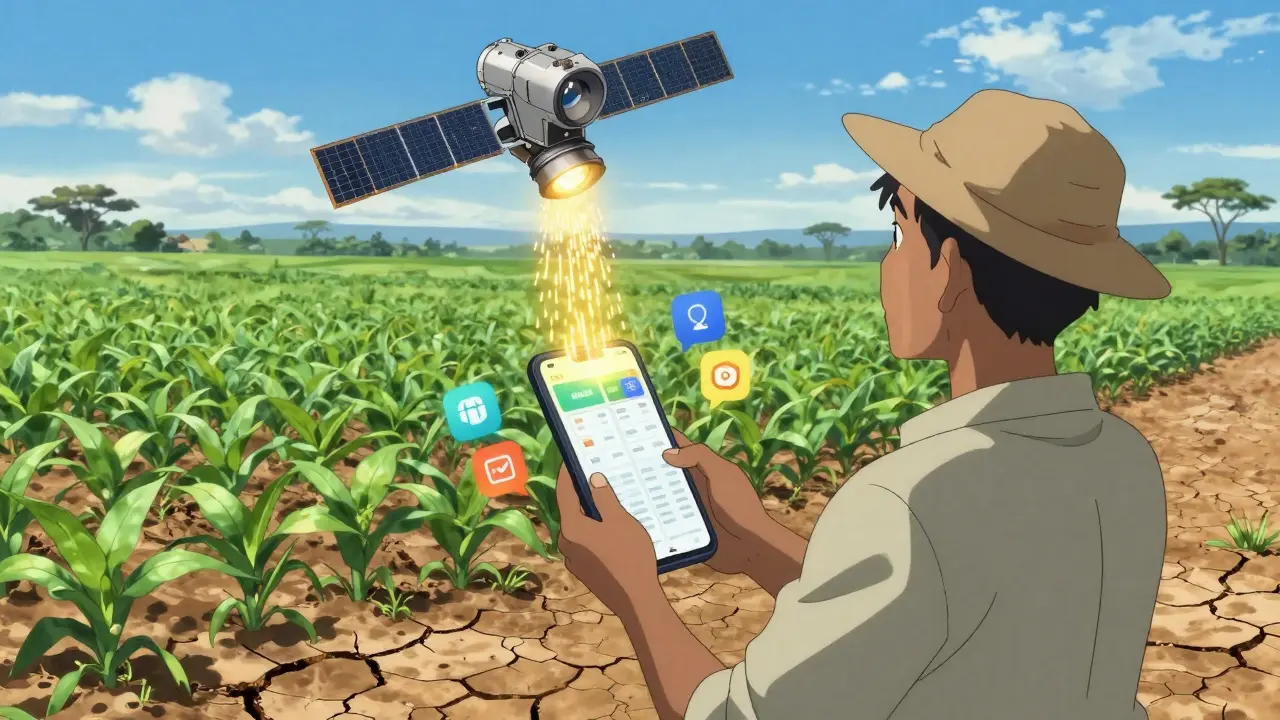
- Parametric insurance: This is the biggest success story. Instead of paying based on actual damage (which requires assessors and inspections), it pays when a measurable event happens. Think earthquakes above 5.0 magnitude, rainfall below 100mm in a growing season, or wind speeds over 80 km/h. In Ethiopia, the World Food Programme used blockchain to insure 100,000 small farmers. When drought data from satellites hit the trigger, payouts went out in days-not months. Farmers got cash when they needed it most.
- Crypto asset protection: Nexus Mutual, a decentralized platform, lets users insure their crypto wallets, exchanges, and DeFi holdings. If your wallet gets hacked and you’ve bought coverage, the smart contract verifies the breach on-chain and pays out in ETH. As of 2023, they’d issued over 8,000 policies and processed more than 150 claims. One Reddit user got $15,000 for a stolen ETH stash in under an hour.
- Reinsurance: Reinsurers help insurers manage big risks. But reconciling claims between dozens of companies used to take weeks. B3i, a consortium of Allianz, Munich Re, and Swiss Re, built a blockchain network that cuts reconciliation time from 14 days to 2 hours. Errors dropped by 90%. That’s billions in savings.
The Dark Side: Where It Falls Short
Blockchain isn’t a magic fix. It’s a tool-and like any tool, it breaks if you misuse it.
First, oracles-the data feeds that tell smart contracts what’s happening in the real world-are a weak link. In Kenya, a blockchain crop insurance program denied claims during a 2022 drought because the weather station data was faulty. Farmers lost out, even though their crops died. No one can fix a smart contract once it’s live. If the data’s wrong, the payout stays wrong.
Second, integration is brutal. Most insurers still run on 30-year-old software. Connecting that to a blockchain system costs between $500,000 and $2 million. And it takes 12 to 18 months. Many companies start with a pilot, get excited, then hit a wall when legal, claims, and IT teams can’t agree on data formats.
Third, regulation is a mess. Only 22% of countries have clear rules for blockchain insurance. In the U.S., 56% of states just apply old insurance laws to new tech. That creates uncertainty. What if a smart contract pays out incorrectly? Who’s liable? Can you sue a piece of code? Courts don’t have answers yet.
And then there’s privacy. Health insurance is a prime example. Patient data is sensitive. Even if it’s encrypted on a blockchain, once it’s there, it’s permanent. A 2023 Deloitte survey found 67% of health insurers were scared of violating HIPAA. You can’t delete medical records on a blockchain. That’s a dealbreaker for many.
Who’s Using It-and Who’s Not
Right now, blockchain insurance isn’t for everyone. It’s mostly used by:
- Big insurers: Allianz, AXA, Munich Re-they’re not replacing their whole business. They’re using blockchain for specific, high-friction areas like reinsurance and parametric policies.
- DeFi startups: Nexus Mutual, Etherisc, and others target niche markets crypto users already trust. They don’t need legacy systems. They build from scratch.
- Emerging markets: In places like India, Nigeria, and Indonesia, where traditional insurance is expensive or unavailable, blockchain microinsurance is filling gaps. A farmer in rural Kenya can buy a $2 crop policy with a mobile phone and get paid via mobile money when the rain fails.
But the average person? Most still buy car or home insurance the old way. Blockchain insurance covers less than 0.5% of the global $6.3 trillion market. But that’s changing fast. BCG predicts it could hit 5% by 2028.
The Future: CBDCs, Metaverse, and What’s Next
The next wave isn’t just about faster claims. It’s about new kinds of risk.
Central Bank Digital Currencies (CBDCs) are coming. The European Central Bank, Bank of England, and others are testing them. Imagine paying your insurance premium in digital euros-and getting your claim paid in the same currency, instantly. No banks. No delays. No fees.
Then there’s the metaverse. People are spending billions on virtual land, skins, and digital items. But if your rare NFT gets stolen from a virtual world, who covers it? Right now, almost no one. BCG projects a $50 billion market for metaverse insurance by 2030. But legal frameworks? Only 11% of countries have even started thinking about it.
And sustainability? Ethereum’s switch to proof-of-stake in 2022 cut its energy use by 99.95%. That killed the biggest criticism of blockchain: that it’s an environmental disaster. Now, insurers can use it without guilt.

How to Get Started (If You’re an Insurer or Developer)
If you’re in insurance and thinking about blockchain, don’t try to boil the ocean. Start small.
- Pick one high-friction process: claims for flight delays, crop insurance, or crypto theft.
- Use a consortium blockchain-not public, not private. It gives you control without sacrificing trust.
- Partner with a tech firm like Consensys or IBM. Don’t build your own chain from scratch.
- Test with real data. Don’t rely on simulations. Real weather, real flight logs, real wallet breaches.
- Work with legal and compliance early. Don’t wait until the code is done.
And if you’re a developer? Learn Solidity (the language for Ethereum smart contracts). Understand insurance basics: deductibles, premiums, underwriting. Most blockchain devs don’t know how insurance works. And most insurers don’t know how code works. The winners will be the ones who speak both languages.
Final Thought: It’s Not About Replacing Insurance. It’s About Reinventing It.
Blockchain won’t kill the insurance industry. It’ll expose its weaknesses-and fix them where it matters. The slow claims. The fraud. The exclusion of millions who can’t afford or access coverage.
For the first time, insurance can be fast, fair, and transparent. Not perfect. Not always reliable. But radically better than what we had before. The tech is here. The data is there. The only thing missing is the will to change.
Can blockchain insurance replace traditional insurance companies?
No, not entirely. Blockchain excels at automating simple, objective claims like flight delays or crop failures. But complex cases-like car accidents with disputed liability or long-term health conditions-still require human judgment, legal expertise, and negotiation. Traditional insurers bring risk modeling, regulatory compliance, and customer service that blockchain can’t replicate yet. The future is hybrid: blockchain handles the routine, humans handle the complicated.
Is blockchain insurance safe from hacking?
The blockchain itself is extremely hard to hack-it’s decentralized and cryptographically secured. But the weak points are elsewhere: smart contract code can have bugs, oracles can be manipulated, and wallets can be stolen. In 2023, a $500,000 error in a smart contract had to be manually reversed because the code couldn’t be changed after deployment. Security depends on how well the system is built, not just the blockchain underneath.
Can I buy blockchain insurance as a regular consumer?
Yes, but options are limited. If you own crypto, you can get wallet insurance through Nexus Mutual. If you fly often, AXA’s Fizzy covers flight delays on select airlines. For farmers or travelers in emerging markets, there are pilot programs for crop or trip insurance. But you won’t find blockchain options for home or auto insurance yet. Most are still in testing or niche markets.
Why is blockchain insurance so expensive to implement?
It’s not the blockchain that’s expensive-it’s the integration. Insurers use decades-old systems that don’t talk to modern tech. Connecting them requires custom APIs, data mapping, staff training, legal reviews, and compliance checks. Many companies underestimate how much time and money it takes to align IT, underwriting, claims, and legal teams. The average extra cost? 30% above initial estimates, according to industry surveys.
What happens if a smart contract pays out incorrectly?
That’s one of the biggest legal challenges. Smart contracts are immutable-once they run, they can’t be undone. If faulty data triggers a $1 million payout, the money is gone. Some platforms use multi-signature wallets or governance tokens to allow community votes to reverse errors, but this is still experimental. In one case, a $500,000 payout error required manual intervention and legal arbitration. The system isn’t foolproof, and courts aren’t ready for this kind of dispute.
Will blockchain insurance work in countries with weak infrastructure?
Actually, it often works better there. In places without reliable banks, paper records, or insurance networks, blockchain offers a leapfrog opportunity. Farmers in Kenya or small business owners in India can use mobile phones to buy policies and receive payouts via mobile money. No need for physical offices or agents. The barrier to entry is lower. The real challenge isn’t infrastructure-it’s digital literacy and access to smartphones.
Blockchain insurance isn’t here to replace your car policy tomorrow. But for the next generation of risks-digital assets, climate events, global supply chains-it’s already the best tool we have. The question isn’t whether it will grow. It’s whether you’re ready to use it.






Rishav Ranjan
December 19, 2025 AT 06:23Tyler Porter
December 19, 2025 AT 15:33It's not magic-it's just smart tech finally catching up.
Mmathapelo Ndlovu
December 21, 2025 AT 08:15Imagine a farmer in Limpopo getting cash within days instead of waiting months. That’s not just tech-that’s dignity.
Sophia Wade
December 22, 2025 AT 07:12It redefines trust-not as institutional authority, but as algorithmic reliability.
Brian Martitsch
December 23, 2025 AT 14:38Most folks can’t even file a claim on their phone without crying. 🤦♂️
Dustin Bright
December 25, 2025 AT 00:32Earlene Dollie
December 25, 2025 AT 09:01It’s not just inefficient-it’s cruel.
Naman Modi
December 26, 2025 AT 14:49Dusty Rogers
December 27, 2025 AT 07:30If this worked, I’d never buy insurance the old way again.
Kevin Karpiak
December 27, 2025 AT 17:21Real people need real human help, not code.
Amit Kumar
December 28, 2025 AT 13:35Imagine a rickshaw driver buying a ₹50 policy that pays out if his bike breaks down. No paperwork. No middlemen. Just code and trust.
That’s not innovation-it’s revolution.
Helen Pieracacos
December 29, 2025 AT 22:29chris yusunas
December 31, 2025 AT 04:46People don’t care about the tech. They care about getting paid when they need it.
This? This just works.
Melissa Black
December 31, 2025 AT 10:04Legacy insurers are operating on a 19th-century infrastructure stack while this tech is already deploying 21st-century resilience architectures.
Rachel McDonald
December 31, 2025 AT 16:00It’s just corporate greed with a blockchain logo.
Vijay n
January 1, 2026 AT 09:29They want you dependent on invisible code controlled by faceless devs.
Wake up.
Alison Fenske
January 2, 2026 AT 22:55But what if you don’t have a smartphone? Or internet? Or know what a wallet is?
This isn’t inclusion-it’s exclusion with a fancy name.
Grace Simmons
January 4, 2026 AT 18:27It’s a legal minefield.
Collin Crawford
January 5, 2026 AT 17:27Have you heard of the Parity wallet bug? Or the $600M Poly Network hack?
Smart contracts aren’t holy. They’re just code written by people who can’t spell ‘buffer overflow’.
Jayakanth Kesan
January 7, 2026 AT 07:37Even if it’s not perfect yet, it’s moving in the right direction.
Let’s build it better, not just tear it down.
Aaron Heaps
January 8, 2026 AT 15:2490% of this ‘innovation’ is just outsourcing fraud to oracles.
And the people who need it most? They’ll never get access.
Tristan Bertles
January 10, 2026 AT 09:20This isn’t about replacing humans-it’s about freeing them from the paperwork so they can actually help people.
That’s the real win.
Megan O'Brien
January 10, 2026 AT 09:55They’re just gambling on weather data and calling it a product.
Steve B
January 11, 2026 AT 17:19The algorithm does not feel hunger. It does not weep when a child’s school fees are unpaid.
Yet it pays out-or it does not-with the cold precision of a god who has forgotten mercy.
Rachel McDonald
January 13, 2026 AT 01:14Being told you’re not eligible because a satellite said it didn’t rain… but your field was flooded.
That’s not innovation. That’s cruelty with a blockchain.