
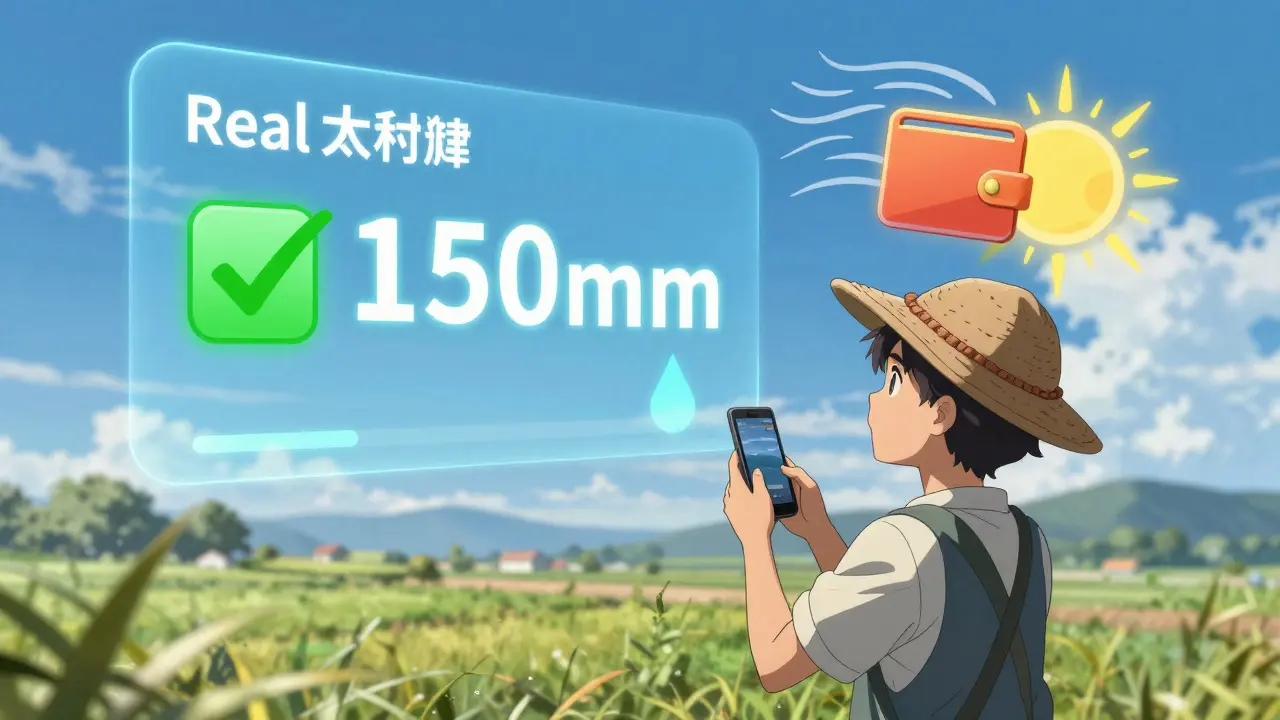
Imagine your crop fails because of a drought. You’ve paid your insurance premium every month. But instead of filling out forms, waiting weeks for an adjuster to visit your field, and arguing over how much damage was done-you get a payout within hours. No paperwork. No delays. No guesswork. That’s not science fiction. It’s parametric insurance on blockchain-and it’s already happening.
What Is Parametric Insurance?
Traditional insurance pays you back for what you lost. If your house burns down, they send someone to inspect the damage, estimate repairs, and then pay you based on the cost. It’s slow. It’s messy. And it’s expensive. Parametric insurance is different. It doesn’t care how much you lost. It only cares if a specific event happened. If it did, you get paid. Full stop. Think of it like this: You buy a policy that says, "If an earthquake hits with a magnitude of 6.5 or higher in my region, I get $5,000." When that quake happens-no matter how much your house is damaged-you get the money. No inspection. No claim adjuster. Just a trigger and a payout. The key? The trigger has to be objective. It can’t be "I think my crop died." It has to be "Rainfall dropped below 100mm over 30 days in Zone 7B." That data comes from trusted sources like weather stations, satellite feeds, or seismic networks. No room for debate.How Blockchain Makes It Work
Now add blockchain into the mix. Blockchain isn’t just about Bitcoin. It’s a digital ledger that records transactions in a way that’s public, unchangeable, and doesn’t need a central authority to verify them. In parametric insurance, blockchain stores the policy as a smart contract. A smart contract is just code. But this code doesn’t sit on a server somewhere-it runs across thousands of computers worldwide. Once the contract is created, no one can change it. Not the insurer. Not the policyholder. Not even a hacker. Here’s how it all comes together:- You sign up for coverage using your phone. The policy terms are written into a smart contract and saved on the blockchain.
- The contract links to a real-world data source-like a government weather station or a satellite monitoring system.
- When the event happens (say, a hurricane hits with wind speeds over 120 mph), the data source automatically sends the signal to the blockchain.
- The smart contract checks: "Did the trigger happen?" If yes, it instantly sends the payout to your digital wallet.
Why This Is a Game-Changer
This isn’t just faster. It’s transformative. First, it cuts costs. Traditional insurance relies on adjusters, lawyers, claims departments, and paperwork. All of that costs money-and that cost gets passed on to you in higher premiums. With blockchain-based parametric insurance, those middlemen vanish. The system runs itself. Second, it makes insurance affordable for people who’ve never had access. In rural Kenya, a farmer can’t afford a $500 policy because the insurer needs to send someone to verify losses. But with parametric insurance, the trigger is rainfall. Satellites measure it. The payout happens automatically. A $20 policy now covers their whole season. Third, it removes distrust. People in developing countries often don’t trust big insurers. They’ve seen claims denied, payments delayed, or policies canceled. With blockchain, the rules are public. The payout is automatic. You can verify the contract yourself. No one can lie. Take Etherisc, a platform built for this. A tea farmer in India can create a custom policy for drought. He picks the trigger: "If rainfall in my district falls below 150mm in June." He pays a few dollars. The contract goes live. When the data confirms the drought, his wallet gets funded. No one else needed.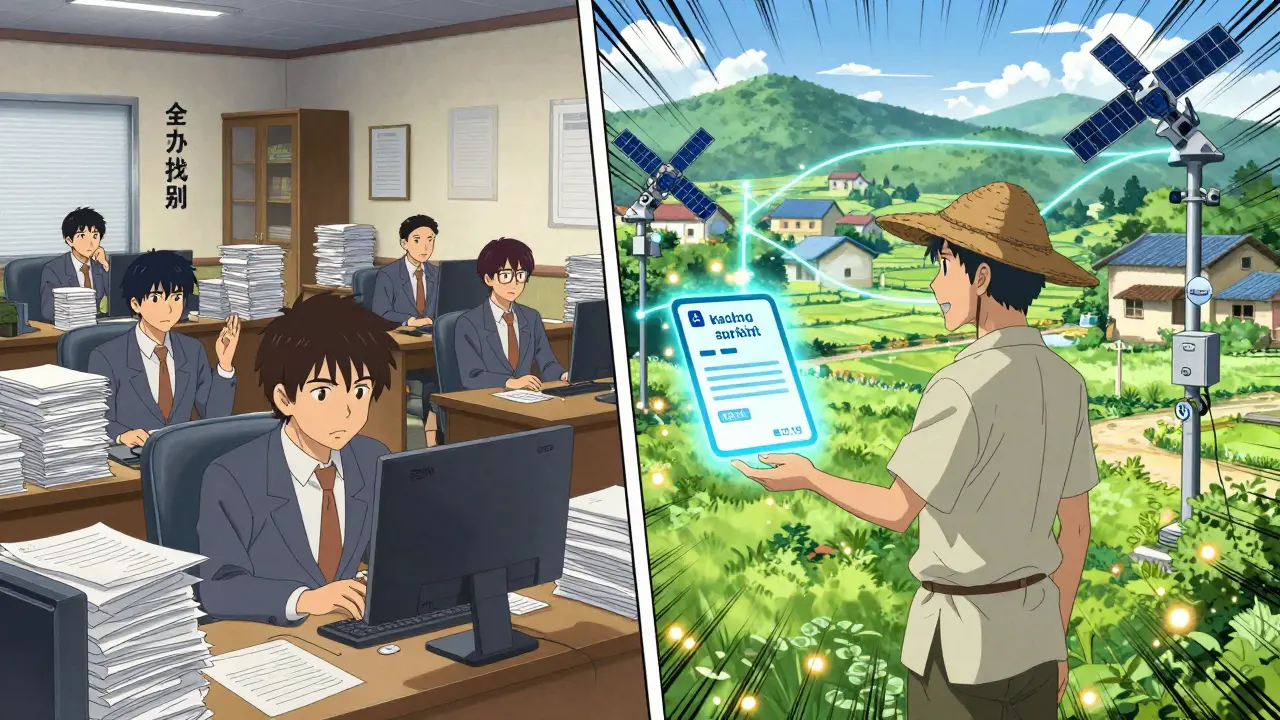
Real-World Use Cases
This isn’t theoretical. It’s already in use.- Crop Insurance: In the Philippines, farmers use blockchain-based parametric policies to protect against typhoons. Payouts happen within 48 hours of storm data confirmation.
- Flight Delay Insurance: Airlines in Europe now offer policies that pay you $100 if your flight is delayed over 3 hours. The data comes from official air traffic systems. No claim form needed.
- Disaster Relief: After Hurricane Maria in 2017, a pilot project in Puerto Rico used blockchain to deliver $500 payments to 500 households within days-instead of months. The trigger? Wind speed readings from government sensors.
- Travel Insurance: A startup in Singapore offers coverage that pays out if your destination cancels flights due to volcanic ash. Data comes from aviation authorities. Payouts are instant.
The Tech Behind the Scenes
You don’t need to be a coder to use this. But understanding what’s underneath helps you trust it. The system relies on three key pieces:- Smart Contracts: These are the rules written in code. They live on the blockchain and execute automatically.
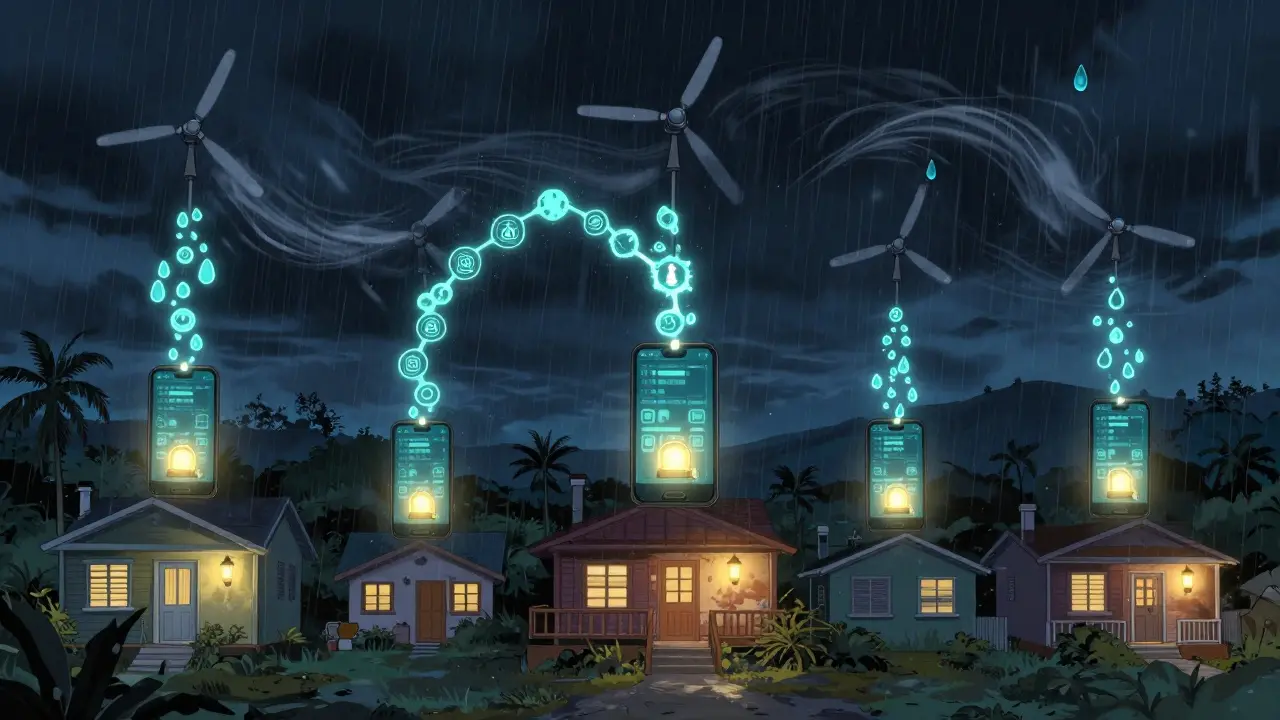
- Oracles: These are bridges between the blockchain and the real world. They pull in data from weather stations, seismic sensors, or flight databases. Chainlink is one of the most trusted oracle networks.
- Immutable Ledger: Every policy, every payout, every data point is recorded permanently. No one can delete or alter it.
Who Benefits Most?
The biggest winners? People left out of the traditional system. In the U.S. or Germany, you can get insurance easily. But in parts of Africa, Southeast Asia, or Latin America, insurance is either unavailable or too expensive. Why? Because insurers can’t afford to send teams to verify claims. Parametric insurance removes that barrier. A smallholder farmer in Malawi doesn’t need a bank account. He needs a smartphone. He doesn’t need a claims agent. He needs a weather index. With blockchain, he gets both. It’s not just about money. It’s about dignity. It’s about not having to beg for help after a disaster. It’s about knowing you’re covered-and that the system won’t let you down.Challenges and Limits
It’s not perfect. One issue: data reliability. If the weather station breaks, or the satellite feed glitches, the payout might not trigger-even if the farmer lost everything. That’s why multiple data sources are used. Some systems cross-check satellite, ground sensors, and even drone imagery. Another: regulatory gray zones. Many countries haven’t figured out how to treat blockchain insurance. Is it a financial product? A contract? A digital asset? Clarity is coming-but slowly. And then there’s adoption. Most people still don’t know what blockchain is. Educating them takes time. But apps are getting simpler. Soon, you won’t even know you’re using blockchain. You’ll just know you got paid fast.The Future Is Automated
Parametric insurance on blockchain is just the beginning. Once insurers see how cheap and fast this model is, they’ll start using it for more than just weather or earthquakes. Imagine auto insurance that pays you if traffic sensors detect a crash in your area. Or health insurance that triggers a payout if your wearable detects abnormal heart rhythms. Or home insurance that pays if your smart meter shows a sudden power outage. The common thread? Objective triggers. Automated payouts. No middlemen. This is how insurance will evolve-not by making policies more complex, but by making them simpler, faster, and fairer. The old system relied on trust. The new one relies on code. And code, when built right, doesn’t lie.How is parametric insurance different from traditional insurance?
Traditional insurance pays you based on the actual loss you suffered-like repairing your damaged house. Parametric insurance pays a fixed amount when a specific event happens, like an earthquake reaching a certain magnitude. No inspections. No estimates. Just a trigger and a payout.
Can I buy parametric insurance on blockchain right now?
Yes. Platforms like Etherisc, Arbol, and Dovu offer parametric policies for weather, crop, and flight risks. You can buy them through mobile apps using cryptocurrency or fiat. Some are available in over 40 countries, especially in regions where traditional insurance is hard to access.
What happens if the data source is wrong?
Good parametric systems use multiple data sources. For example, a drought policy might check satellite rainfall data, ground sensor readings, and government weather reports. If two out of three confirm the trigger, the payout happens. This reduces the risk of a single faulty sensor causing a problem.
Do I need cryptocurrency to use blockchain insurance?
Not necessarily. Many platforms let you pay with credit cards or bank transfers. The payout might go to a crypto wallet, but some services convert it to cash automatically. You don’t need to understand crypto to use the service.
Is this technology safe from hackers?
The smart contracts themselves are very secure-they run on decentralized networks that are nearly impossible to hack. But the data sources (like weather stations) can be vulnerable. That’s why top platforms use verified oracles and multi-source validation to reduce risk. Overall, it’s more secure than paper-based systems.



Megan Lutz
March 7, 2026 AT 22:00So let me get this straight - we’re replacing human judgment with code that reads satellite data? That’s either genius or terrifying. I love how it cuts out the middlemen, but what happens when the weather station glitches and your entire harvest dies? You get $500 and a pat on the back. Meanwhile, your kid’s school supplies are still unpaid. Automation isn’t justice. It’s just faster injustice.
jack carr
March 7, 2026 AT 23:44This is actually kind of beautiful. No more waiting months for a check after a storm. Just code doing what it’s supposed to. I’ve seen farmers in Texas cry because their claim got denied over a 2-inch discrepancy. This fixes that. Simple. Clean. Human.
Jesse VanDerPol
March 9, 2026 AT 06:02Interesting. I wonder how many people actually read the smart contract before they sign up. Most just tap ‘agree’ without knowing what ‘Zone 7B’ means. The tech works, but the education doesn’t. We’re building a system that’s foolproof - for people who already know how it works.
nalini jeyapalan
March 9, 2026 AT 12:58Oracles are the weakest link. One corrupted sensor and the whole system pays out to someone who didn’t lose anything. This isn’t innovation. It’s a gamble with other people’s livelihoods.
Jackson Dambz
March 9, 2026 AT 18:11While the theoretical framework is intriguing, one must acknowledge the profound epistemological vulnerabilities inherent in algorithmic decision-making. The reliance upon immutable ledgers does not inherently confer moral legitimacy. One might posit that the commodification of meteorological data into binary payout conditions represents a neo-liberal erosion of social solidarity.
Julie Potter
March 11, 2026 AT 14:57Oh my god. So now we’re trusting satellites to decide if a farmer gets money? What if the satellite thinks it’s raining but the farmer’s field is still dry? That’s not insurance - that’s a cruel joke. I’m not even mad. I’m just disappointed in humanity.
Jonathan Chretien
March 13, 2026 AT 14:18Imagine if your life insurance policy paid out only if you died on a Tuesday. That’s basically what this is. We’re reducing human suffering to a data point. Cool tech. Deeply unsettling. 😔
Steven Lefebvre
March 15, 2026 AT 05:52This is the future. Seriously. People in rural Kenya are getting payouts in minutes, not months. That’s not just efficiency - that’s dignity. We’re talking about families who can feed their kids because a system didn’t make them beg. This isn’t tech for tech’s sake. It’s tech for humanity.
Nancy Jewer
March 17, 2026 AT 02:03The convergence of decentralized ledgers with verifiable oracles creates a trust-minimized ecosystem for risk transfer. The immutability of on-chain events ensures auditability, while multi-source validation mitigates single-point-of-failure risks. This paradigm shift enables micro-insurance at scale - particularly in underbanked economies where transactional opacity has historically excluded populations from formal risk pools.
Ken Kemp
March 18, 2026 AT 08:14Hey, I tried this for my farm last year. Got paid in like 3 hours after a hailstorm. But the app glitched and sent me 2x the payout. I called them. They said ‘thanks for the feedback’ and kept the extra. 😅 Maybe the blockchain’s perfect… but the UI? Not so much.
Jane Darrah
March 18, 2026 AT 20:52Okay, but let’s be real - this isn’t about fairness. It’s about corporations cutting costs and calling it innovation. You think a farmer in Malawi really understands what a ‘smart contract’ is? No. He just sees a phone app that says ‘if rain drops below 150mm, you get $20.’ He clicks ‘yes’ because he’s desperate. And then when the satellite says ‘no rain’ but his crops are still dead because the wind blew the soil away? Too bad. The code doesn’t care. The system doesn’t care. And the company? They saved $2 million in adjuster salaries. Win-win.
Nick Greening
March 19, 2026 AT 17:47Wait, so if I live in a place where the weather station is broken and I lose everything - I get nothing? That’s not insurance. That’s a lottery with terrible odds. And they call this progress? Please. This is just capitalism with a blockchain sticker on it.
Issack Vaid
March 21, 2026 AT 00:42While I appreciate the efficiency gains, I must note that the cultural context of risk perception varies significantly across geographies. In collectivist societies, the notion of ‘individual payout triggers’ may undermine communal resilience networks. One must question whether technological efficiency, divorced from social context, truly serves the vulnerable - or merely automates their marginalization.
Denise Folituu
March 21, 2026 AT 21:08They’re letting satellites decide who lives and who starves? That’s not insurance - that’s a dystopian horror movie. And the worst part? People are cheering for it. We’re so desperate for ‘easy’ solutions that we’re giving up our humanity. This isn’t progress. It’s surrender.
Ian Thomas
March 23, 2026 AT 13:07So we replaced a slow, corrupt system with a fast, unfeeling one. Congrats. You automated the bureaucracy. Didn’t fix it. Just made it invisible. Now the farmer doesn’t get to yell at an adjuster - he just gets a silent notification. Progress?
nalini jeyapalan
March 24, 2026 AT 09:42And if the oracle is hacked? Or the satellite is spoofed? You’re not just risking money - you’re risking lives. This isn’t innovation. It’s negligence dressed in whitepaper.
Shawn Warren
March 24, 2026 AT 12:09The structural efficiency of blockchain-enabled parametric insurance represents a paradigmatic advancement in risk mitigation architecture. By eliminating discretionary adjudication and anchoring payout triggers to immutable external data sources, the system achieves unprecedented operational transparency. The reduction in administrative overhead enables scalability to previously unviable micro-markets. This is not merely a technological upgrade - it is a redefinition of contractual obligation in the digital age.