
Key Takeaways
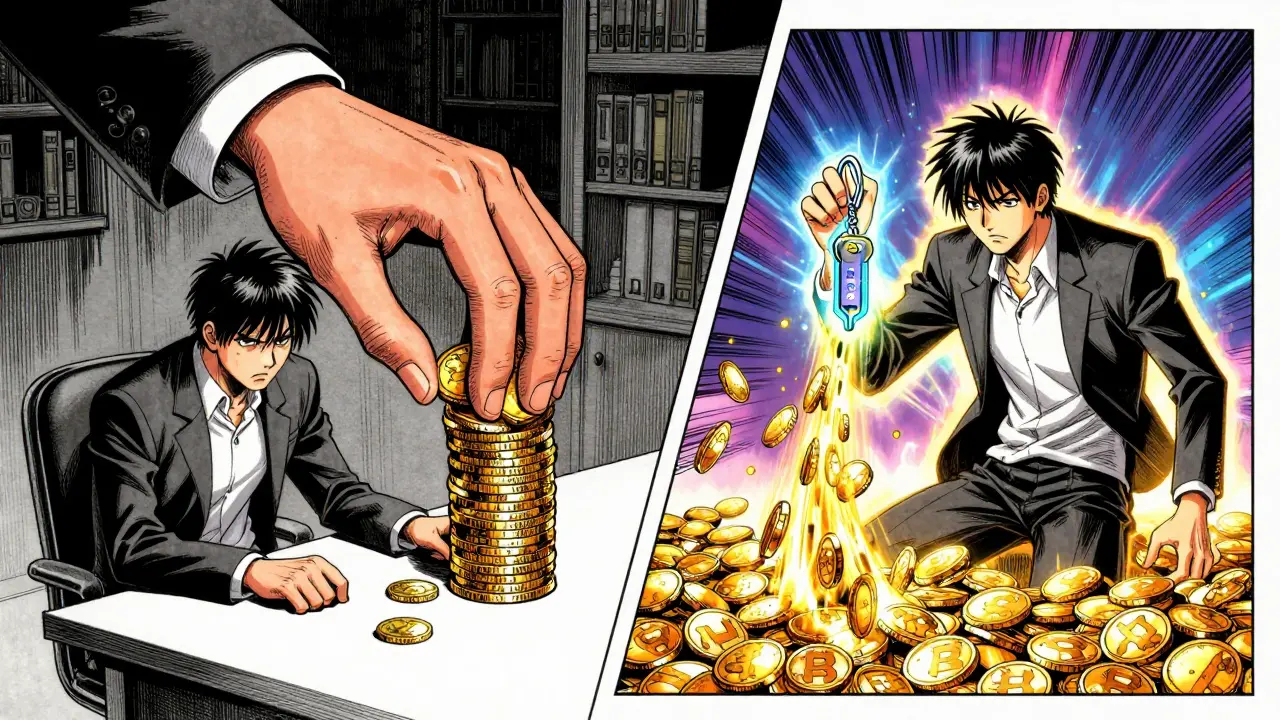
- Platform fees drop from 30-50% on traditional apps to just 1-2.5% on blockchain networks.
- Smart contracts enable automated royalties on secondary sales, which are impossible on legacy platforms.
- The Global South is seeing explosive growth, with the creator economy projected to hit $30 billion by 2032.
- AI integration is creating new ways for creators to monetize their training data.
- Regulatory clarity (like the EU's MiCA) is slowly paving the way for mainstream adoption.
Breaking the Middleman Cycle
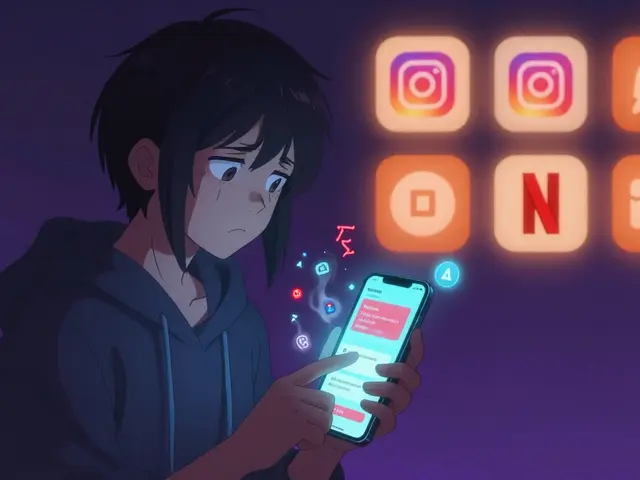
For years, the "creator economy" has been a bit of a misnomer. While the industry was valued at $250 billion in 2023, nearly half of full-time creators were scraping by on less than $15,000 a year. Why? Because the platforms-the giants of social media and streaming-take a massive cut. We're talking about 30-50% of earnings disappearing into corporate pockets before a creator sees a dime.
Enter the decentralized model. By using Blockchain is a distributed ledger technology that allows for peer-to-peer transactions without the need for a central authority. This shift allows creators to maintain full ownership of their data and content. Instead of begging a platform for a payout, creators use direct monetization tools. Fees plummet to between 1% and 2.5%, meaning the money goes where it belongs: to the artist.
The Magic of Smart Contracts and NFTs
The real game-changer here isn't just the payment; it's the automation. In the old world, if you sold a painting and it later sold for a million dollars at an auction, you saw zero percent of that profit. Blockchain fixes this with Smart Contracts is self-executing contracts with the terms of the agreement directly written into lines of code. These contracts handle royalty distribution with 100% transparency.
When a creator mints their work as NFTs (Non-Fungible Tokens), they can bake a royalty fee-typically 5-10%-directly into the asset. Every time that piece of art or music is resold on a secondary market, the original creator gets a cut instantly. This transforms digital content from a one-time sale into a lifelong revenue stream.
| Feature | Traditional (YouTube, Patreon, Spotify) | Blockchain (Mirror, Audius, Foundation) |
|---|---|---|
| Platform Fees | 30% - 50% | 1% - 2.5% |
| Secondary Royalties | None | 5% - 10% (Automated) |
| Payment Speed | 3 - 5 Business Days | 15 - 30 Seconds |
| Ownership | Platform-controlled | Creator-owned (Non-custodial) |
Infrastructure: Where the Work Happens
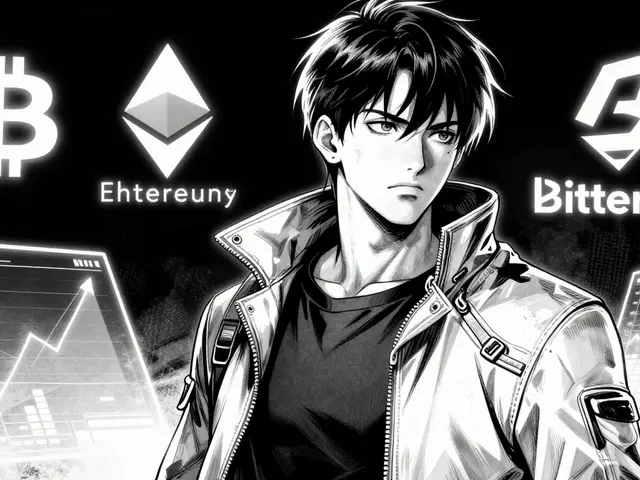
You can't just "do" blockchain; you need a place for it to live. Most creators today rely on a few key networks. Ethereum remains the gold standard for high-value art, though its "gas fees" (transaction costs) can be a headache. To solve this, many have moved to Layer-2 solutions like Polygon, which reduces fees by roughly 98% compared to the Ethereum mainnet. For those prioritizing speed, Solana provides the rapid throughput necessary for high-frequency interactions.
To avoid the wild price swings of cryptocurrencies, the industry has pivoted toward Stablecoins, such as USDC and DAI. These are pegged to the US dollar, ensuring that a creator's rent money doesn't evaporate overnight due to a market crash. For creators in the Global South, this is a lifeline. A blogger in Nairobi recently shared that after waiting three months for a $500 payment from France via a bank, they switched to USDC and received the funds in just 22 minutes.
The AI Intersection: A New Frontier
The biggest trend on the horizon is the marriage of AI and blockchain. Many creators are terrified that AI will steal their style or replace their jobs. However, blockchain provides a way to fight back. By using tools like Ocean Protocol, creators can actually monetize the data used to train AI models. Instead of AI companies scraping the web for free, they can pay creators for the right to use their specific datasets.
We're also seeing the rise of zero-knowledge proofs through platforms like Deepfake Passport. This allows creators to prove their content is authentic and human-made, or to verify the origin of AI-generated work, creating a layer of trust in an era of deepfakes. In this sense, blockchain acts as the essential infrastructure for creator autonomy in the age of artificial intelligence.
The Hard Truths: Barriers to Entry
It's not all sunshine and rainbows. The learning curve is steep. Research shows that about 68% of new creators take two to three weeks just to feel proficient with these tools. The most common complaints? Wallet recovery complexity and unpredictable gas fees. If you lose your seed phrase for a non-custodial wallet like MetaMask or Phantom, your funds are gone forever. In fact, 14% of creators have reported total asset loss due to phishing attacks.
Then there's the "regulatory fog." While the EU's MiCA (Markets in Crypto-Assets) regulation gave the industry some much-needed clarity in early 2025, the US is still a fragmented mess of state-by-state rules. Until there's a global standard, some creators are hesitant to move their entire business on-chain.
How to Get Started (Without Getting Scammed)
If you're looking to move into this space, don't just dive in blindly. You'll need about 15 to 20 hours of focused learning to master the basics. Here is the typical path to getting your first piece of content on-chain:
- Secure Your Gateway: Set up a non-custodial wallet. Use a hardware wallet if you're dealing with significant sums to avoid the phishing attacks mentioned earlier.
- Choose Your Platform: Depending on your medium, connect to platforms like Mirror (for writers), Audius (for musicians), or Foundation (for visual artists).
- Mint Your Content: Convert your work into an NFT. Be mindful of the network you use; Polygon is usually better for smaller, more frequent releases due to lower costs.
- Automate Your Tax: Crypto taxes are a nightmare. Use a tool like Koinly from day one to track your gains and avoid a surprise audit.
Is the blockchain creator economy only for digital artists?
Not at all. While NFTs started with art, the ecosystem now covers music (where artists earn significantly more than on streaming), journalism (using tokenized subscriptions), and even educational content. Any creator who produces a digital asset can use these tools to control their distribution and pricing.
What are the biggest risks for a creator moving to blockchain?
The primary risks are technical and regulatory. Specifically, losing access to a non-custodial wallet (lost seed phrases) and falling victim to phishing scams. There is also the risk of regulatory changes in your specific country that could affect how you report cryptocurrency income.
How do I handle the volatility of crypto payments?
The best way to manage volatility is to use stablecoins like USDC or DAI. These are pegged to the US dollar, allowing you to receive a stable amount of money that doesn't fluctuate with the market. You can then use fintech bridges like MoonPay or Coinbase Commerce to convert these to your local fiat currency.
Will AI replace the need for blockchain in the creator economy?
Actually, it's the opposite. AI makes blockchain *more* necessary. As AI-generated content floods the internet, blockchain provides the "proof of authenticity" and ownership records needed to distinguish human work from AI work and ensure creators are paid when AI uses their data for training.
Are blockchain platforms more expensive to use than Patreon or YouTube?
In terms of platform fees, they are drastically cheaper (1-2.5% vs 30-50%). However, you do have to pay "gas fees" to the network to mint content or send transactions. By using Layer-2 solutions like Polygon, these costs are kept very low, often just a few cents per transaction.
What Comes Next?
We are currently moving toward a period of consolidation. Experts predict that about 40% of the current flurry of blockchain creator platforms will merge or disappear by 2027. The survivors will be the ones that hide the complexity of the blockchain-making it feel as easy as uploading a photo to Instagram while keeping the financial benefits of decentralization.
If you're a creator, the move isn't just about the money; it's about the power. For the first time, the person who creates the art is also the person who owns the distribution. Whether you're a writer in New Zealand or a musician in Lagos, the tools to reclaim your value are finally here.





Robert Smith
April 29, 2026 AT 06:47This is the way 🚀💎
Felix Eduardo Velasquez
April 29, 2026 AT 07:29The shift toward non-custodial ownership is fundamentally about a transition from permissioned to permissionless value capture. While the technical barriers are real, the ontological shift in how we perceive a digital asset-from a rented service to a sovereign property-is the true revolution here. Most people miss that the real value isn't the token, but the programmable trust encoded into the smart contract.
Emily A
April 30, 2026 AT 00:24It is quite naive to suggest that a few hours of "focused learning" will suffice for the average creator to avoid total asset loss. The current UX of non-custodial wallets is abysmal, and until the abstraction layer is fully implemented, most users will continue to be preyed upon by phishing schemes.
Alex Mazonowicz
April 30, 2026 AT 18:15This is so exciting!!! The potential for artists is just endless!!! We are finally seeing a world where talent wins over corporate greed!!! Let's gooooo!!!
Arti Jain
May 2, 2026 AT 02:14India is leading this charge. The West is just catching up to our digital infrastructure. Pathetic.
VIVEK SINGH
May 2, 2026 AT 09:12Oh, wonderful. Another "revolutionary" technology that promises freedom but replaces a corporate middleman with a mathematical one that doesn't care if you lose your keys. Truly a masterstroke of human progress, isn't it? I'm sure the "decentralization" will be perfectly equitable for everyone involved while we all pretend the electricity bill for mining isn't a thing.
Lloyd I
May 3, 2026 AT 00:24I'd love to see a community guide on how to transition a Patreon to Mirror! We could probably team up and build a template for others to follow. Let's make this accessible for everyone!
Harvey Alford
May 4, 2026 AT 12:23Tell me your wallet address. I want to see if you're actually doing it.
Jimmy vasquez
May 6, 2026 AT 01:58If you're just starting out, I highly recommend looking into Polygon for your first few mints. The gas fees on Ethereum can be a real shock if you aren't prepared, and losing $50 on a transaction fee is a great way to kill your motivation early on.
Carli Bates
May 7, 2026 AT 11:02imagine thinking a jpg is a lifelong revenue stream lol. the delusion is real
Ryan Nakielny
May 8, 2026 AT 12:45Wait, so we're replacing a CEO with a piece of code that can't be sued when it malfunctions. Absolute genius move by everyone involved.
Sri Astuti
May 9, 2026 AT 12:33The analysis here is far too optimistic because it completely ignores the predatory nature of early adopters who pump and dump these "creator tokens" before the actual artists even know how to use a seed phrase, which is honestly just another layer of the same capitalist exploitation we see in the traditional music industry but with more buzzwords and less actual oversight 🙄.
Elle Kharitou
May 9, 2026 AT 16:55It feels like we are standing at the precipice of a new Renaissance where the digital and physical worlds finally merge in a way that honors the soul of the creator ✨. I've spent a lot of time thinking about how the concept of "ownership" evolves when we move from tangible objects to digital signatures, and I truly believe this is the path toward a more empathetic global economy where we value the human effort behind the art rather than just the commodity itself 🌸🌿.
Nitin Gupta
May 9, 2026 AT 18:19I can definitely help anyone struggling with the setup process. It's a bit daunting at first, but once you get the hang of the bridge between L1 and L2, it becomes second nature. Just reach out if you're stuck!
Veronica Bago
May 10, 2026 AT 04:15Pretty cool stuff. Just vibing with the idea of artists getting paid more. Hope it works out for them.
Gabby Puche
May 10, 2026 AT 14:42You got this!! Just take it one step at a time 🌈. The learning curve is just a part of the journey! 💖
Lynne Teperman
May 11, 2026 AT 18:43wild colors in the new tech space. just gliding through the noise and keeping my peace
Rachel S
May 13, 2026 AT 05:01One must acknowledge that the volatility of cryptocurrency is simply catastrophic for those living paycheck to paycheck! 😱 The implementation of stablecoins is not merely a convenience but an absolute necessity for survival in this ecosystem! 💸
Rushell Perry
May 15, 2026 AT 02:36it is totally okay to feel overwhelmed by the tech. just start with a small amount of funds and explore the platforms slowly. no need to rush the process
its me
May 16, 2026 AT 16:57We all strive for autonomy, yet we forget that the true chain is the one we forge in our own minds by chasing digital gold. Perhaps the real NFT is the friends we made along the way to financial ruin.
Ipsita Seal
May 16, 2026 AT 22:46too long. tl;dr is it a scam?
Jan Conrad
May 17, 2026 AT 05:35The mention of Ocean Protocol is a critical point. The current LLM training paradigm is essentially a massive copyright heist. If blockchain can actually create a verifiable audit trail for training data, it would fundamentally change the legal landscape of AI. I wonder how the current giants will react when they're forced to pay micro-royalties for every token generated based on human art.
Andrew Todd
May 18, 2026 AT 03:57US banks are the only real way to handle money. This crypto stuff is just a playground for people who don't understand how a real economy works. Get a real job.