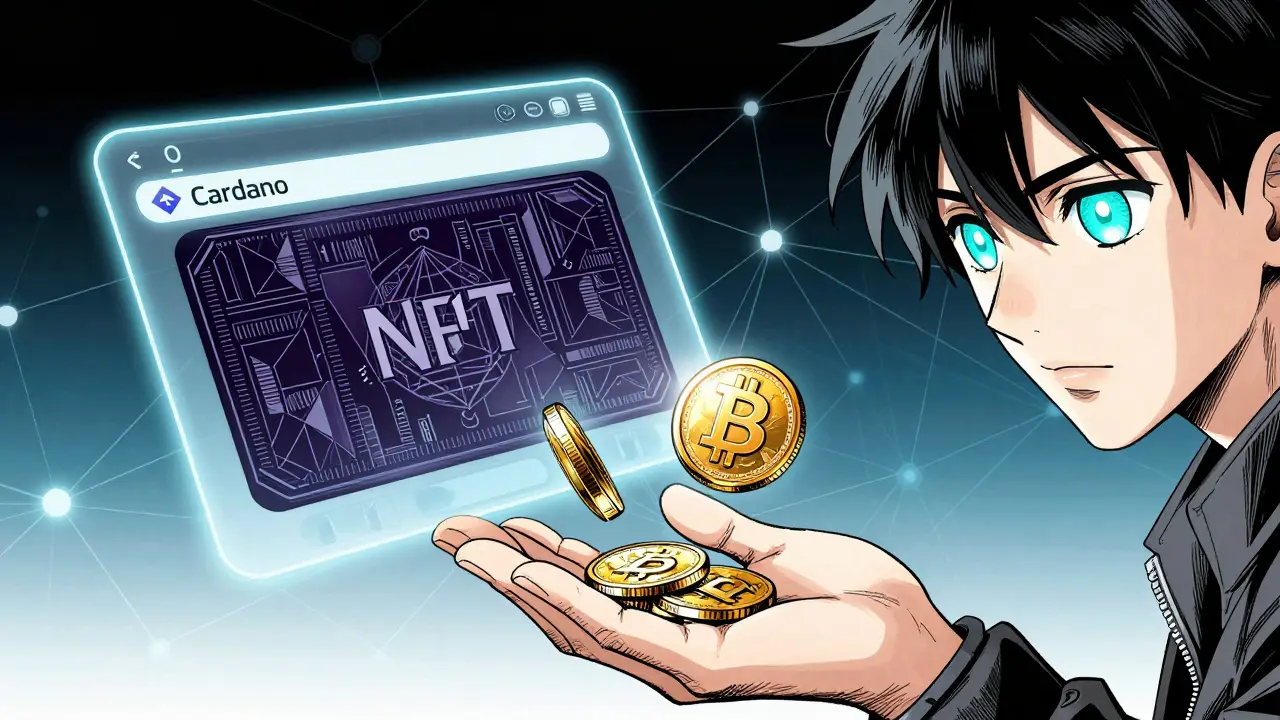
Imagine sending money to a friend without them knowing the exact amount until they open it. That sounds like a digital gift card, right? Well, that is exactly what ENCOINS is a privacy-focused protocol on the Cardano blockchain that lets users hide transaction amounts using encrypted NFTs. If you have been watching the Cardano ecosystem, you know it has always prioritized security and transparency. But for many users, total transparency can feel like walking around with an open wallet in public. ENCOINS aims to fix that by adding a layer of privacy directly into the system.
You might be wondering why this matters or if it is just another hype-driven token. Let’s break down what ENCOINS actually does, how it works under the hood, and whether it has real utility beyond its price chart.
How ENCOINS Works: The Core Mechanism
To understand ENCOINS, you first need to understand the problem it solves. On most blockchains, including Cardano is a proof-of-stake blockchain platform known for its academic approach and sustainability, every transaction is visible. Anyone can look up your wallet address and see exactly how much ADA you hold and who you sent it to. While this ensures accountability, it kills financial privacy.
ENCOINS changes this dynamic by turning your ADA into non-fungible tokens (NFTs). Here is the simple process:
- Minting: You send ADA into the ENCOINS smart contract. The system converts your ADA into lovelace (the smallest unit of ADA, where 1 ADA = 1,000,000 lovelace) and encrypts the value.
- Encryption: This encrypted value is locked inside an NFT bundle. Only you, holding the private decryption key, know what the actual value is.
- Transfer: You send these NFTs to someone else. To the outside world, it looks like a standard NFT transfer. No one sees the monetary value attached to it.
- Redemption: When the recipient wants to use the funds, they burn the ENCOINS NFTs to get their original ADA back.
The beauty here is that the total redeeming value equals the ADA provided at minting. It is not a speculative asset in itself; it is a wrapper for your existing assets. This means ENCOINS functions as a privacy tool rather than just a currency you trade for profit.
From Version 1 to Version 2: A Major Upgrade
When ENCOINS launched in 2023, it was functional but limited. Version 1 required off-chain proof verification, which meant some trust assumptions were necessary. It also only supported ADA. If you wanted to hide the balance of other tokens, you couldn’t do it with v1. Furthermore, the minting policy was restrictive, making it hard to integrate with other decentralized applications (dApps) in a single transaction.
Enter ENCOINS v2 is an upgraded protocol featuring on-chain zero-knowledge proofs and multi-asset support. This update, funded through Project Catalyst Fund 11, addresses those early limitations head-on. The biggest change? Zero-knowledge (ZK) protocols are now executed directly on-chain. This removes the need for off-chain verification, making the system more secure and trustless.
But the real game-changer is native asset support. In v2, a single ENCOINS NFT can represent a bundle of different Cardano-native assets, not just ADA. Imagine hiding the fact that you hold both ADA and several governance tokens from a specific DAO. With v2, you can wrap all of them into one encrypted package. This opens the door for complex DeFi operations where privacy is critical, such as private voting or confidential fund management.
Ledger Mode and Conditional Burning
One feature that often gets overlooked is Ledger Mode. This allows users to send and receive payments directly in encoins using a specialized script. Why does this matter? Because when you receive an encoin and immediately send it on without withdrawing it to plain ADA, the chain of privacy remains unbroken. The amount stays encrypted throughout multiple transfers. This creates a network effect where privacy becomes easier to maintain the more people use the protocol.
v2 also introduces conditional burning. This is a technical term, but the concept is straightforward. Developers can create encoins that can only be redeemed when specific scripts execute. Think about escrow services. Usually, escrow requires a third party to release funds when conditions are met. With conditional burning, you can build private escrow arrangements where the release of funds is verified on-chain, but the amounts remain hidden from public view. This enables atomic swaps and vesting schedules that are indistinguishable from simple transactions to outsiders.

Market Performance and Pricing Reality
Let’s talk numbers, because that is what most people care about. As of March 2025, the pricing data for ENCS token is the governance and utility token associated with the ENCOINS protocol shows significant volatility and discrepancy across exchanges.
| Exchange | Price per ENCS | 24h Volume | All-Time High (ATH) |
|---|---|---|---|
| Coinbase | $0.0803 | $0.00 | $2.75 |
| Binance | $0.0244 | $0.00 | $3.25 |
| Official DAO | 1.73 ADA | N/A | N/A |
Notice the $0.00 trading volume on major exchanges. This suggests that while ENCS is listed, there is very little retail trading activity. Most of the action happens within the Cardano ecosystem, specifically in liquidity pools on platforms like Minswap is a decentralized exchange on Cardano hosting ENCOINS liquidity pools.. The DAO reports a pool containing approximately 280,000 ADA and 163,000 ENCS tokens. This indicates that the token retains value within the utility context, even if fiat prices have dropped significantly from their all-time highs.
The drop from ~$3.00 to ~$0.08 represents a decline of over 97%. However, looking at the circulating supply, many exchanges report 0 ENCS in circulation despite a total supply of 15,000,000. This discrepancy likely means most tokens are locked in staking, liquidity pools, or held by long-term investors rather than being actively traded on spot markets. For a privacy tool, low trading volume isn’t necessarily a red flag-it might just mean people are using it for its intended purpose: holding and transacting privately, not flipping for quick gains.
Who Is ENCOINS For?
If you are a casual investor looking for the next 100x meme coin, ENCOINS probably isn’t for you. It is a infrastructure play. It targets developers, privacy-conscious individuals, and enterprises operating on Cardano.
Consider these scenarios:
- Developers: Building dApps that require user privacy, such as anonymous voting systems or private lending protocols.
- High-Net-Worth Individuals: Users who want to move large amounts of ADA without broadcasting their wealth to the entire network.
- Enterprises: Companies needing audit-proof records that still protect sensitive transaction details from competitors or the public.
ENCOINS fills a gap in the Cardano ecosystem. Unlike Bitcoin, which relies on mixing services for privacy, or Monero, which is entirely private, Cardano has historically been fully transparent. ENCOINS brings a middle ground-privacy by choice, built on top of a secure, scalable base layer.
Risks and Considerations
No technology is perfect, and privacy tools come with inherent risks. First, regulatory scrutiny. Governments worldwide are cracking down on privacy coins and mixers due to concerns about illicit finance. While ENCOINS offers "privacy by choice" rather than mandatory anonymity, regulators may still view it skeptically. Users should be aware of local laws regarding privacy-enhancing technologies.
Second, complexity. Using ENCOINS requires understanding encryption keys and smart contracts. If you lose your private decryption key, you lose access to the value inside your encoins. There is no customer support team to reset your password. This is true for all crypto, but especially critical for privacy tools where recovery mechanisms could compromise the very privacy you are trying to achieve.
Finally, adoption. For a privacy protocol to work well, you need enough users to provide liquidity and ensure smooth transactions. While Minswap supports ENCOINS, the broader integration into everyday wallets and exchanges is still growing. Until then, friction remains high for average users.
Future Outlook: Beyond ADA
The vision for ENCOINS extends far beyond wrapping ADA. With v2’s multi-asset support, the protocol positions itself as a foundational privacy layer for the entire Cardano DeFi ecosystem. Imagine private yield farming, where your returns aren’t publicly visible. Or private NFT marketplaces, where bids remain secret until the auction ends. These use cases are becoming possible thanks to the zero-knowledge advancements in v2.
The project’s reliance on Project Catalyst funding also signals a commitment to community-driven development. Governance proposals, such as allocating 120,000 ENCS for specific initiatives, show active stewardship. If the team continues to integrate with major Cardano dApps, ENCOINS could become the default privacy standard for the network.
In a world where data breaches and surveillance are constant threats, having a way to control who sees your financial activity is valuable. ENCOINS doesn’t promise invisibility, but it offers discretion. Whether that is enough to drive mass adoption remains to be seen, but the technology is undeniably robust.
Is ENCOINS safe to use?
ENCOINS utilizes advanced cryptographic methods and operates on the secure Cardano blockchain. However, safety depends on user behavior. You must safeguard your private decryption keys. If lost, funds are unrecoverable. Additionally, as with any smart contract, there is residual risk of code vulnerabilities, though v2 improvements have strengthened security by moving proof verification on-chain.
Can I buy ENCS on Coinbase or Binance?
Yes, ENCS is listed on major exchanges like Coinbase and Binance. However, trading volumes are currently very low, leading to price discrepancies between platforms. For better liquidity and utility, many users interact with ENCS through Cardano-native decentralized exchanges like Minswap.
What is the difference between ENCOINS v1 and v2?
v1 required off-chain proof verification and only supported ADA. v2 introduces on-chain zero-knowledge proofs, supports multiple native assets within a single NFT bundle, and enables conditional burning for complex smart contracts like private escrow.
Does ENCOINS hide my identity?
ENCOINS hides the amount of ADA or assets being transferred. It does not hide your wallet address itself. To maintain full anonymity, you would need to combine ENCOINS with other privacy practices, such as using new wallet addresses for each transaction.
Why is the trading volume for ENCS so low?
Low volume suggests that ENCS is primarily used for its utility (privacy wrapping) rather than speculation. Many tokens are likely locked in liquidity pools or held by long-term investors. This is common for infrastructure projects that prioritize function over frequent trading.
How do I convert ENCOINS back to ADA?
You burn your ENCOINS NFTs through the official ENCOINS interface. The smart contract verifies your ownership via your private key and releases the equivalent ADA value back to your wallet. Only the holder of the minting key can perform this redemption.