

There’s no such thing as a cryptocurrency called "Wonderful Memories (WMEMO)"-at least not as a standalone project. What you’re likely seeing is a confusion between the name and the actual token: Wrapped MEMO (wMEMO). This is a wrapped version of the original MEMO token from Olympus DAO, designed to work across different blockchains. It’s not a new coin with its own story or purpose. It’s a technical tool, built for a very specific job: letting MEMO holders vote on Olympus DAO’s future without having to move their tokens back and forth between networks.
What is Wrapped MEMO (wMEMO)?
Wrapped MEMO isn’t mined or minted like Bitcoin or Ethereum. It’s created when someone takes their native MEMO token-issued by Olympus DAO-and locks it in a smart contract on Ethereum, then issues an equivalent amount of wMEMO on another chain, like Avalanche or Fantom. Think of it like exchanging a U.S. dollar bill for a voucher you can use in another country. The voucher isn’t money on its own, but it represents the same value and lets you do things where the original currency doesn’t work. The original MEMO token is the governance token of Olympus DAO, a decentralized protocol that tries to create a reserve currency backed by crypto assets like DAI, FRAX, and liquidity pool tokens. Holders of MEMO vote on treasury decisions, interest rates, and protocol upgrades. But if you want to use your MEMO on Avalanche instead of Ethereum, you can’t just send it there-it won’t work. That’s where wMEMO comes in. It lets you keep your governance power on a different chain without moving your original tokens.How does it work in practice?
To get wMEMO, you need to:- Have native MEMO tokens in your Web3 wallet (like MetaMask).
- Connect to Olympus DAO’s official wrapper contract.
- Choose which blockchain you want to wrap it for-usually Avalanche or Fantom.
- Confirm the transaction and pay gas fees on the original chain.
- Wait a few minutes while the contract locks your MEMO and mints wMEMO on the target chain.
Market status and liquidity
As of September 2023, wMEMO had a 24-hour trading volume of less than $10 across all exchanges. CoinGecko listed it at $51.50, Bybit at $52.19, and Crypto.com at $6.00 volume with a -2.16% price change. These numbers aren’t mistakes-they reflect reality. There’s almost no trading activity. The token’s market cap isn’t even tracked by most platforms because there’s simply not enough movement. One alarming anomaly appeared on CoinDesk: a listing showing wMEMO priced at $29,653.71 with $0 volume. That’s not real. It’s a data glitch or a mislabeled token. Don’t trust that number. The real value of wMEMO is tied directly to the price of native MEMO. If MEMO drops 10%, wMEMO should drop 10% too. But because liquidity is so thin, price gaps of over 5% happen regularly. That creates arbitrage opportunities-but also risks. If you’re trying to vote on a proposal and your wMEMO price is off by 8%, you might accidentally vote with less power than you think.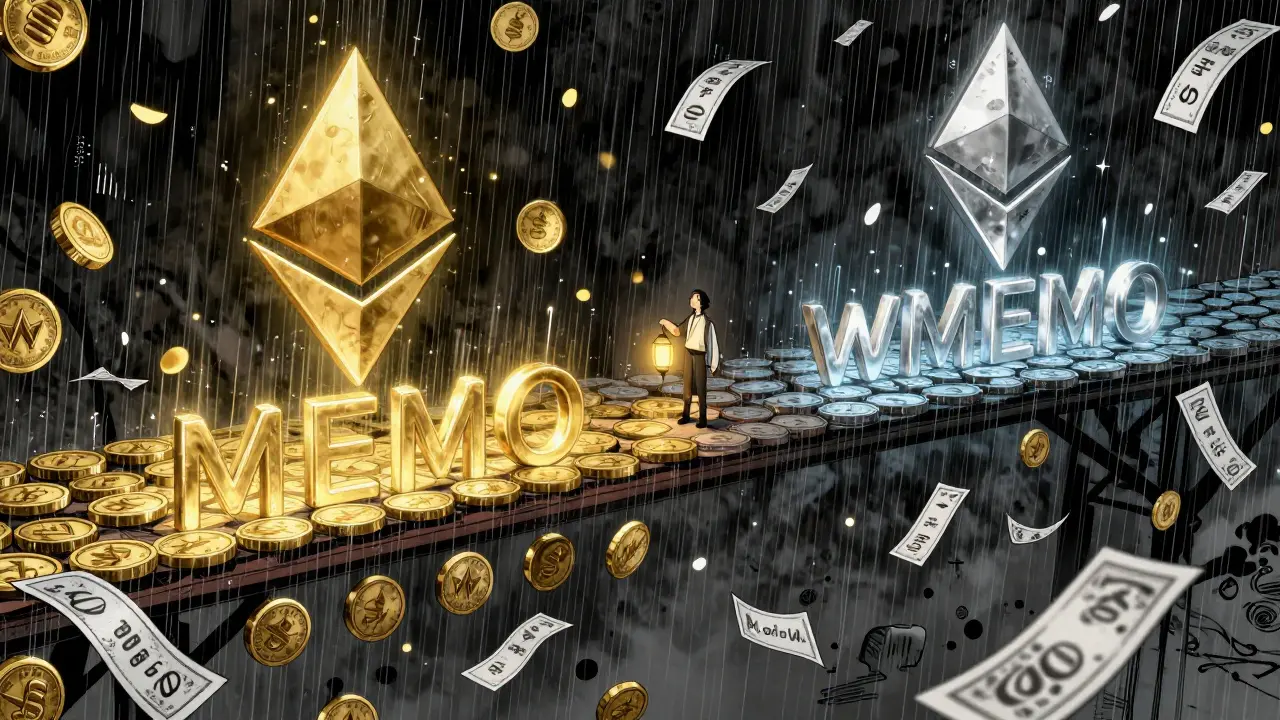
Why does it exist if no one uses it?
Olympus DAO’s team says wMEMO is "critical infrastructure" for their multi-chain vision. They want MEMO holders to participate in governance no matter which blockchain they’re on. But in practice, very few people do. As of September 2023, only 0.37% of the total MEMO supply was wrapped as wMEMO across all chains. Reddit threads show users switching back to native MEMO because it’s easier, cheaper, and more liquid. One user wrote: "Tried using WMEMO for governance on Avalanche but switched back to native MEMO due to better liquidity and no wrapping fees." Compare that to wOHM (Wrapped OHM), another wrapped governance token from the same ecosystem. wOHM had $1.2 million in daily volume. wMEMO? Under $10. That’s not a small difference-it’s a chasm. Most users don’t care about cross-chain governance enough to jump through these hoops. The demand simply isn’t there.Risks and downsides
Using wMEMO isn’t just low-activity-it’s risky. Here’s what you need to know:- Price slippage: With less than $50 in liquidity on most exchanges, buying or selling even a small amount can move the price by 10% or more.
- Wrapping fees: You pay gas fees twice-once to lock MEMO, once to claim wMEMO. If the network is congested, you could lose hundreds of dollars in fees for nothing.
- Governance vulnerability: If 90% of voting power is still on Ethereum, but 10% is on Avalanche via wMEMO, the system becomes unbalanced. A small group could swing votes on a minor chain.
- Regulatory gray zone: The U.S. SEC’s 2023 framework flagged wrapped tokens as potentially subject to securities laws if the underlying asset is a security. MEMO already walks that line. wMEMO might make it worse.







Anandaraj Br
February 19, 2026 AT 07:19Why do people think crypto is a lottery when it's clearly just a tech manual with a price tag
AJITH AERO
February 21, 2026 AT 02:19Next they'll release 'Nostalgia Coin' that lets you relive your first kiss on-chain
Lauren Brookes
February 22, 2026 AT 20:58It's like spending months designing a custom key for a door that nobody owns
The ambition is beautiful but the execution feels like a cathedral built on a parking lot
Maybe the real innovation isn't the token but the quiet realization that most users just want simplicity
Not complexity wrapped in whitepaper poetry
Chris Thomas
February 24, 2026 AT 17:51There's zero reason a governance token should require a wrapping protocol
This isn't DeFi this is blockchain bureaucracy with gas fees
And the 5% price slippage on $10 volume isn't a market inefficiency it's a systemic failure
If your token can't survive a 1000x liquidity gap you shouldn't be in the game
James Breithaupt
February 26, 2026 AT 17:15WEMO was built for a theoretical user who cares about cross-chain governance
But the actual user base wants yield staking and simple swaps
The engineers optimized for sovereignty not usability
And that's why wMEMO sits there like a lonely robot at a gas station no one visits
It's not broken it's just irrelevant
Alex Williams
February 27, 2026 AT 15:42It's not hard once you do it once
Use the official Olympus wrapper dont trust third party sites
And always check the gas fees on Ethereum before you hit confirm
It's literally just 4 steps and your governance power moves with you
But if you're not already in Olympus DAO voting on treasury proposals
Then yeah don't even bother this token isn't for you
Sarah Shergold
February 28, 2026 AT 13:52Who even came up with this name
Its like naming a tool 'The Thing That Does The Thing'
Dominica Anderson
March 1, 2026 AT 10:06But this? This is what happens when Indians and Africans try to play crypto with no real infrastructure
It's not innovation its just noise
And now we have to clean up this mess
Lisa Parker
March 1, 2026 AT 11:56And then I found out the price was off by 15%
I just cried
Why does this happen to me
Sasha Wynnters
March 1, 2026 AT 18:58A spectral key that unlocks a door no one remembers
It's not useless it's post-useful
Like a typewriter in the age of AI
It exists because someone once believed in a world where governance could travel
And now we're just haunting the architecture of that dream
It's beautiful in its irrelevance
Charrie VanVleet
March 3, 2026 AT 16:59You don't need wMEMO unless you're already deep in Olympus DAO
Just hold native MEMO on Ethereum and you're golden
And if you're curious just watch a 5-min tutorial on their site
You got this 💪
Scott McCrossan
March 4, 2026 AT 21:13Someone spent 18 months building a monument to a community that never showed up
And now we're all supposed to pretend it's a feature not a failure
Wake up
It's not multi-chain it's multi-dead
Rajib Hossaim
March 5, 2026 AT 21:28However, the market dynamics reveal a deeper issue: governance token utility must align with user behavior, not theoretical architecture.
It is evident that liquidity and accessibility remain primary concerns in decentralized systems.
Therefore, while wMEMO serves a niche function, its adoption is inherently constrained by practical barriers.
This underscores the necessity for protocol design to prioritize usability over technical elegance.
Beth Erickson
March 6, 2026 AT 02:13Its like trying to drive a tesla with a horse
And now they made a key that only works in a garage no one owns
LMFAO
Ruby Ababio-Fernandez
March 8, 2026 AT 01:37