

When you trade crypto on Ethereum, you know the drill: gas fees spike to $50, your transaction sits in a queue for minutes, and by the time it confirms, the price has moved twice. That’s why so many traders have moved to SushiSwap V3 on Arbitrum. It’s not magic, but it’s one of the few places where you can swap tokens without paying a fortune or waiting forever.
What Is SushiSwap V3 on Arbitrum?
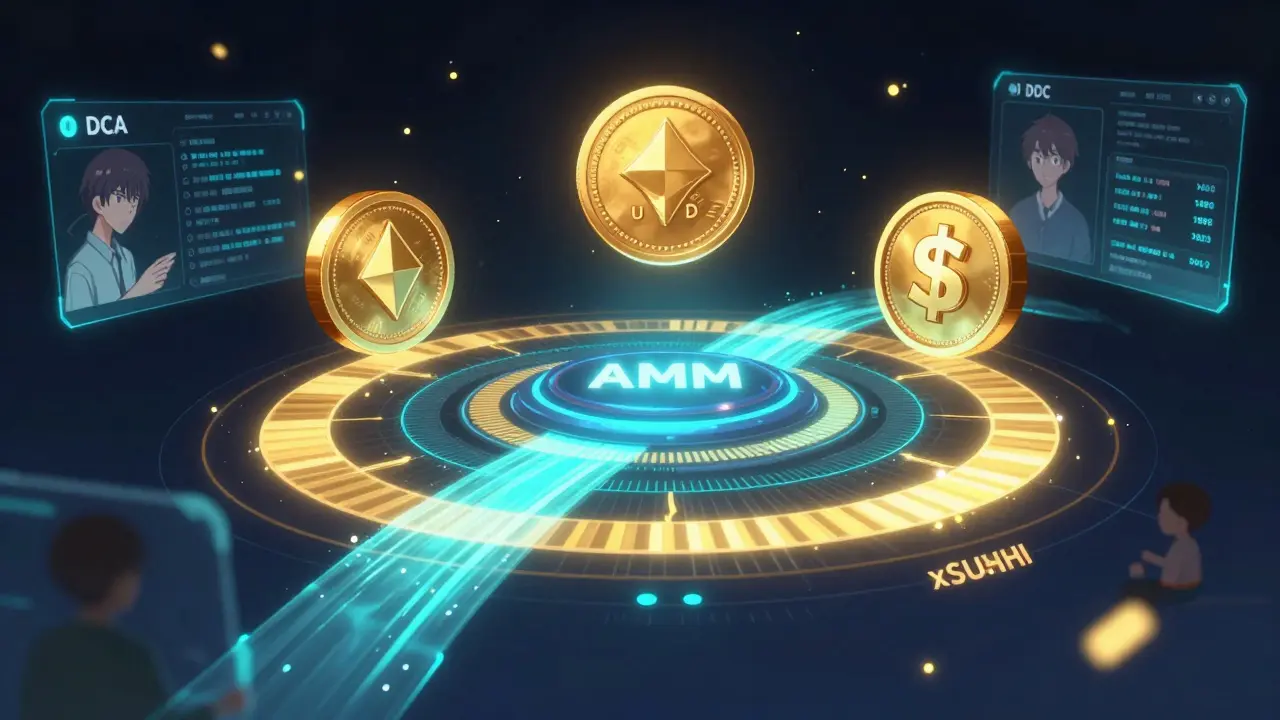
SushiSwap V3 on Arbitrum is a decentralized exchange (DEX) built on the Arbitrum blockchain-a layer-2 solution that runs on top of Ethereum. Unlike centralized exchanges like Binance or Coinbase, SushiSwap doesn’t hold your money. You trade directly from your wallet using smart contracts. The "V3" part means it uses concentrated liquidity, a big upgrade from older versions. Instead of spreading your funds across every price range, you pick where you want your liquidity to work-like setting a price range for a limit order.
Arbitrum makes this fast and cheap. Transactions cost between $0.01 and $0.05. On Ethereum mainnet, the same swap could cost $1 to $50. Confirmation times? Usually under two seconds. That’s not just an improvement-it’s a game-changer for active traders.
How It Works: Concentrated Liquidity Explained
Here’s where SushiSwap V3 gets interesting. In older DEXs like Uniswap V2, if you put $10,000 into ETH/USDC liquidity, your money was spread evenly from $1,500 to $3,000. If ETH only traded between $2,000 and $2,200, 80% of your capital was sitting idle. SushiSwap V3 lets you lock your funds only in the $2,000-$2,200 range. That means your capital works harder. Some liquidity providers report up to 4,000x more efficiency.
But here’s the catch: you have to monitor it. If ETH drops below $2,000, your liquidity stops earning fees until it comes back. You’re basically playing a game of price prediction. If you get it wrong, you lose out on fees-or worse, suffer impermanent loss. This isn’t beginner-friendly. It’s more like options trading than just depositing and earning.
Trading Fees and Rewards
SushiSwap V3 splits trading fees two ways: 0.25% goes to liquidity providers, and 0.05% goes to xSUSHI stakers. That’s different from Uniswap V3, where all fees go to LPs. If you hold xSUSHI (the staked version of SUSHI), you earn a slice of every trade. It’s a quiet way to make passive income without providing liquidity yourself.
Then there’s the Onsen Program. This is SushiSwap’s secret weapon. When a new token gets listed, SushiSwap boosts SUSHI rewards for liquidity providers who add funds to that pair. Some new tokens have offered 10x-20x more SUSHI than usual. That’s why you see people rushing to add liquidity to obscure tokens-they’re not gambling on price, they’re chasing rewards.
Compared to Uniswap V3 on Arbitrum
Uniswap V3 on Arbitrum is the king. It has 60% of the DEX volume on Arbitrum. SushiSwap V3 is second, maybe third. Why? Because Uniswap’s liquidity is deeper. If you’re trading large amounts, Uniswap gives you better prices with less slippage. SushiSwap’s pools are thinner, so big trades can move the price more.
But SushiSwap wins on rewards. If you’re a yield farmer, not just a trader, SushiSwap gives you more ways to earn. Uniswap doesn’t have an Onsen Program. It doesn’t pay you extra for supporting new tokens. SushiSwap does. And if you’re staking xSUSHI, you’re getting a cut of fees that Uniswap doesn’t share.
For most users, it’s not about which is better-it’s about what you’re trying to do. If you want to swap ETH for USDC quickly and cheaply? Either works. If you want to earn the most SUSHI possible? SushiSwap’s your play.

What You Can’t Do
SushiSwap V3 on Arbitrum doesn’t offer margin, leverage, or futures trading. If you’re looking to go long on SOL with 5x leverage, you’ll need a centralized exchange. That’s not a flaw-it’s a design choice. SushiSwap is built for peer-to-peer trading, not speculation with borrowed money. This makes it safer but less flexible.
Also, no fiat on-ramps. You can’t buy crypto with a credit card here. You need ETH or USDC already in your wallet. That means you have to use another exchange first, then bridge your funds to Arbitrum. It’s a two-step process, but it’s standard for DeFi.
Wallets, Security, and User Experience
You’ll need an Ethereum-compatible wallet: MetaMask, WalletConnect, or Rabby. Setup takes 10 minutes. Connecting to SushiSwap is simple. But understanding concentrated liquidity? That’s a 2-4 hour learning curve. The interface doesn’t explain it well. You’ll have to read guides, watch videos, or join Discord communities to figure out how to set your price ranges correctly.
Security-wise, SushiSwap has been around since 2020. Its contracts have been audited multiple times. There’s no evidence of hacks on the Arbitrum version. But remember: no DEX is immune to smart contract risk. If a bug appears, your funds could be at risk. That’s why you never put more in than you can afford to lose.
Community sentiment is mixed. Reddit users love the Onsen rewards. They call it "free SUSHI farming." But others complain the interface feels cluttered. The liquidity management tools are powerful but confusing. It’s like giving someone a Formula 1 car but no driver’s license.
TVL and Liquidity: The Real Weak Spot
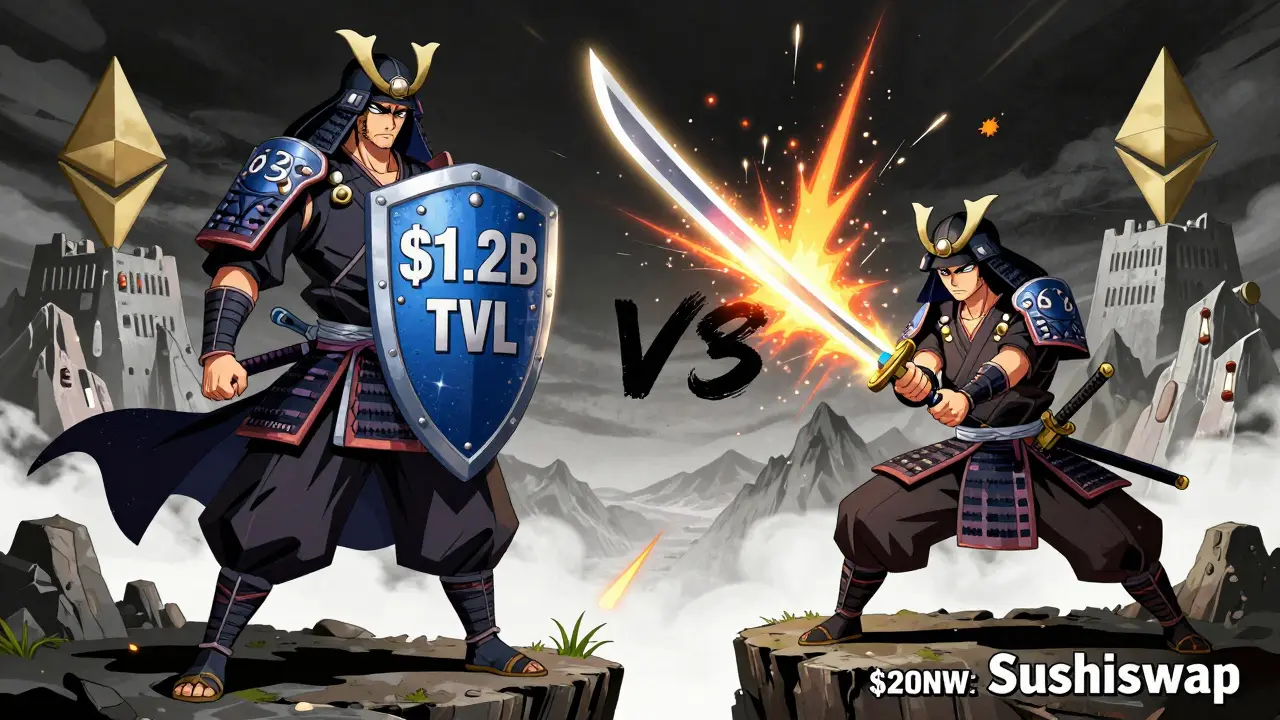
Total Value Locked (TVL) on SushiSwap V3 on Arbitrum hovers around $200 million. Uniswap V3 on Arbitrum? Over $1.2 billion. That’s a huge gap. Lower TVL means less depth. It means bigger slippage on large trades. It means fewer traders. And it means less fee income for everyone.
This is SushiSwap’s biggest challenge. Without deep liquidity, it can’t compete on execution quality. It’s betting that reward incentives will draw in enough users to make up the difference. So far, it’s working-but only for short-term yield hunters. Can it build lasting liquidity? That’s the question.
Who Is This For?
SushiSwap V3 on Arbitrum isn’t for everyone. If you’re new to crypto and just want to swap ETH for DAI? Use Uniswap. It’s simpler. If you’re a passive investor who doesn’t want to manage positions? Stick with a centralized exchange.
This is for three types of people:
- Yield farmers who want to earn SUSHI tokens through liquidity mining and the Onsen Program.
- Active traders who want low fees and fast trades on Arbitrum and don’t mind monitoring their liquidity ranges.
- DeFi enthusiasts who believe in SushiSwap’s long-term vision and want to support its ecosystem.
If you’re not one of those, you’re better off elsewhere.
The Future: Can SushiSwap Survive?
SushiSwap’s future depends on three things: TVL growth, fee capture, and developer adoption. Right now, it’s losing ground to Uniswap on volume. But it’s winning on reward innovation. The BentoBox and Trident upgrades could change that. BentoBox lets users deposit assets once and use them across multiple protocols. Trident is a new multi-chain AMM design. If these work, SushiSwap could become a hub-not just a DEX.
But if TVL keeps falling, and fee income stays low, the SUSHI token will keep struggling. Price predictions for 2025 range from $1.64 to $1.99, but those are guesses. The real value isn’t in the token price-it’s in the ecosystem. If SushiSwap can turn its reward system into sustainable revenue, it could outlast its competitors. If not? It’ll fade into another footnote in DeFi history.
Final Thoughts
SushiSwap V3 on Arbitrum isn’t the best DEX. It’s not even the most popular. But it’s one of the most interesting. It’s not trying to be Uniswap. It’s trying to be the DEX that pays you to use it. And for many, that’s enough.
If you’re willing to learn how to manage concentrated liquidity, if you’re okay with lower TVL, and if you want to earn SUSHI while you trade-then give it a try. Just don’t expect it to be easy. And never put in more than you’re ready to lose.





Jon Martín
January 11, 2026 AT 00:35Bro SushiSwap V3 on Arbitrum is the real deal if you’re tired of paying $30 in gas to swap ETH for USDC
One swap cost me 3 cents and confirmed in under a second
I used to hate DeFi until this
Now I just keep my liquidity in the $1800-$2100 range for ETH/USDC and let it ride
Mujibur Rahman
January 12, 2026 AT 10:30Concentrated liquidity is not for retail
You think you're optimizing yield but you're just gambling on price bands
Impermanent loss isn't a theoretical concept here - it's a daily reality
And don't get me started on the slippage on thin pools
Uniswap V3 has 6x the TVL for a reason
Yield farming SUSHI is a tax on the naive
Danyelle Ostrye
January 12, 2026 AT 12:38I tried it once and got so confused I just withdrew everything
The interface feels like a Bloomberg terminal for people who already know how to code
I just want to swap tokens not manage options positions
Maybe I’m too lazy for DeFi
Katrina Recto
January 13, 2026 AT 04:09Onsen rewards are pure addiction
I’ve lost more money on failed tokens than I’ve made in SUSHI
But the dopamine hit when you claim 500 SUSHI from some new meme coin
It’s like winning the lottery with a 98% chance of losing
Still worth it
Tre Smith
January 13, 2026 AT 17:41Let’s be clear - this article is dangerously misleading. SushiSwap V3 is not a 'game-changer' - it’s a high-risk liquidity trap wrapped in marketing jargon. The 4000x efficiency claims are cherry-picked from edge cases. The average LP earns less than 2% APY after impermanent loss. The Onsen Program is a pump-and-dump engine disguised as innovation. If you’re not running a bot to monitor your ranges, you’re already losing. And no, you don’t 'earn' xSUSHI - you’re just getting paid in a token with no utility beyond speculation.
greg greg
January 15, 2026 AT 03:03It’s interesting how people treat SushiSwap like it’s some revolutionary breakthrough when really it’s just Uniswap V3 with a loyalty program attached - like a gas station that gives you free coffee if you buy 10 gallons of gas. The concentrated liquidity model is brilliant in theory but requires constant attention - you’re not a liquidity provider, you’re a part-time market maker. And the TVL gap isn’t just a number - it’s a death sentence for anyone trying to trade anything over $5k without 10% slippage. Plus, the fact that SushiSwap doesn’t even have a native fiat on-ramp means you need to already be deep in the rabbit hole before you can even start playing - which means it’s only for the already converted, not the curious. And if you think the audits guarantee safety, you haven’t seen what happened to the Polygon bridge or the Wormhole exploit. Smart contracts aren’t magic - they’re code written by humans who sometimes sleep too little and drink too much coffee.
LeeAnn Herker
January 15, 2026 AT 14:24Of course SushiSwap is 'interesting' - it’s the DeFi version of a pyramid scheme with a cute logo
They pay you in SUSHI to give them liquidity so they can sell more SUSHI to you
And you think you're winning because you got 1000 tokens from a new coin that’s already 80% down
Meanwhile the devs are sitting on 20% of the supply
And you’re just the sucker who’s doing the heavy lifting
And yes I know I sound paranoid
But I’ve seen this movie before - remember the Terra collapse?
Same script. Different names.
Caitlin Colwell
January 16, 2026 AT 09:27Just swapped my first 500 USDC to DAI
Gas was 2 cents
Took 1.3 seconds
Didn’t understand half the interface
But it worked
That’s all I need
Calen Adams
January 17, 2026 AT 19:00Yield farmers are the lifeblood of this ecosystem
Without them, TVL dies
And yeah maybe they’re chasing free tokens
But they’re also bringing liquidity that enables everyone else to trade
It’s not perfect
But it’s how DeFi grows
And if you’re not farming, you’re just spectating
And spectating doesn’t build the future
Sarbjit Nahl
January 18, 2026 AT 11:02The fundamental flaw in all these DEX narratives is the assumption that decentralization equals efficiency
But in reality it only equals complexity
Why should I manage price ranges when I can use Binance and forget about it?
DeFi is not about freedom
It is about burden
And the burden is growing
Paul Johnson
January 20, 2026 AT 01:50People dont get it SushiSwap is just a scam
They pay you in SUSHI to lock your money
Then they dump the token and vanish
Remember the sushi chef meme?
That was a warning
And now its real
Theyre just selling you dreams while they cash out
Trust no one in DeFi
Especially not the ones who say 'its free money'
Meenakshi Singh
January 21, 2026 AT 05:53Just got 1200 SUSHI from Onsen on a token that’s now worth $0.03
Worth it 😎
Also my wallet is now 87% SUSHI
But I don’t care
At least I’m not on Coinbase
DeFi or bust 🚀
Kelley Ramsey
January 22, 2026 AT 13:59So I just tried setting up concentrated liquidity for the first time… and I think I accidentally put my funds in the wrong range? I’m not even sure if I’m earning fees or losing money? I watched three YouTube videos, read a Medium article, and still feel like I’m playing chess with a blindfold. But I’m so excited! This feels like I’m part of something real, you know? Like I’m not just buying and selling - I’m helping the network. I just hope I didn’t mess it up. Can someone check my position? I’m using MetaMask on Arbitrum, range is $1950-$2050 for ETH/USDC… please tell me I didn’t break everything 😅
Michael Richardson
January 24, 2026 AT 00:14US traders act like this is some genius innovation
Meanwhile Europe and Asia have had cheap, fast DEXes for years
Arbitrum is just Ethereum’s Band-Aid
And SushiSwap? A desperate Hail Mary
Stop acting like you’re pioneers
You’re just late to the party
sathish kumar
January 24, 2026 AT 09:06It is imperative to recognize that the architectural superiority of Uniswap V3 lies in its liquidity depth and institutional adoption. SushiSwap V3, while commendable in its reward mechanism, remains a niche platform with suboptimal capital efficiency. The Onsen Program, though incentivizing, introduces systemic risk through token dilution. One must evaluate DeFi protocols not by marketing narratives but by on-chain metrics: volume, slippage, and impermanent loss variance. Until SushiSwap achieves TVL parity, it remains a speculative alternative, not a viable infrastructure.
jim carry
January 26, 2026 AT 01:17Did you know that SushiSwap’s team owns 17% of the SUSHI supply? And they’re the ones who decide which tokens get Onsen? That’s not decentralization - that’s centralized control with a fancy UI
And you people are cheering?
You’re not users - you’re fuel
They’re the ones cashing out while you’re stuck with tokens worth nothing
Wake up
Don Grissett
January 27, 2026 AT 10:50Yall act like this is new but its just the same old crypto hustle
Give people free tokens they go crazy
Then when the token crashes they blame the protocol
Not themselves
And then they come back for more
Its like a casino but with more graphs
And you think you're smart because you 'understand liquidity ranges'
Bro you're just gambling with your life savings
Tiffani Frey
January 28, 2026 AT 15:29I’ve been using SushiSwap V3 for 8 months now. I don’t chase Onsen rewards anymore. I just provide liquidity to stablecoin pairs - USDC/DAI, ETH/USDC - and set tight ranges. I’ve earned about $1,200 in fees and SUSHI over that time, and I’ve only had one impermanent loss event - and it was minor. The interface is clunky, yes. But once you get used to it, it’s like a quiet, reliable machine. I don’t trade aggressively. I just let it run. And honestly? That’s the best way to do it. Don’t overthink. Just set it and forget it - with discipline.
Ritu Singh
January 29, 2026 AT 09:19What if this is all a test? What if the entire DeFi ecosystem is a simulation designed to extract human capital and attention? SushiSwap V3 isn’t a DEX - it’s a behavioral experiment. You think you’re earning SUSHI? You’re training your brain to crave rewards. You think you’re optimizing liquidity? You’re optimizing your submission to a system that doesn’t care if you lose everything. The TVL gap? It’s not a weakness - it’s a trap. The bigger the gap, the more you think you need to chase it. And the more you chase, the more you give away. Wake up. You’re not building the future. You’re feeding it.
kris serafin
January 29, 2026 AT 16:13Just did my first SushiSwap V3 trade 🚀
Gas: $0.02
Time: 1.1s
Got 47 SUSHI as bonus
Life is good 😌
DeFi is winning
Rahul Sharma
January 30, 2026 AT 15:01Dear friends, the concept of concentrated liquidity is mathematically elegant and economically sound. However, the adoption of such technology requires a high degree of financial literacy and technical awareness. The average retail investor is not equipped to manage such positions. Therefore, while SushiSwap V3 represents a significant advancement in decentralized finance, it is not suitable for the majority of users. We must not confuse innovation with accessibility. The true measure of success is not the number of yield farmers, but the number of users who remain solvent after participation.
Gideon Kavali
January 31, 2026 AT 17:31Arbitrum is American innovation. SushiSwap is just copying Uniswap and slapping a loyalty card on it.
China and Russia are building real chains.
Meanwhile we’re here chasing free SUSHI like it’s Halloween candy.
USA still leads in tech? Please.
This is a clown show with gas fees.
Jon Martín
January 31, 2026 AT 20:24Man I just saw someone say SushiSwap is a scam
Bro I’ve made $1800 in fees this year just holding ETH/USDC
And I didn’t even touch Onsen
It’s not magic
But it’s real
And you’re not losing unless you’re trying to time the market
Just set your range and chill