

Back in 2021, if you were active in crypto communities, you probably saw alerts about the CPR CIPHER airdrop on CoinMarketCap. It wasn’t just another free token push-it was part of a bigger, more unusual story. Cipher (CPR) wasn’t trying to raise money through an ICO. Instead, it wanted to build a real business ecosystem using token ownership as a tool. But today, you’ll find it labeled as "Cipher [Old]" on CoinMarketCap. What happened? And why does it still matter?
What Was Cipher (CPR)?
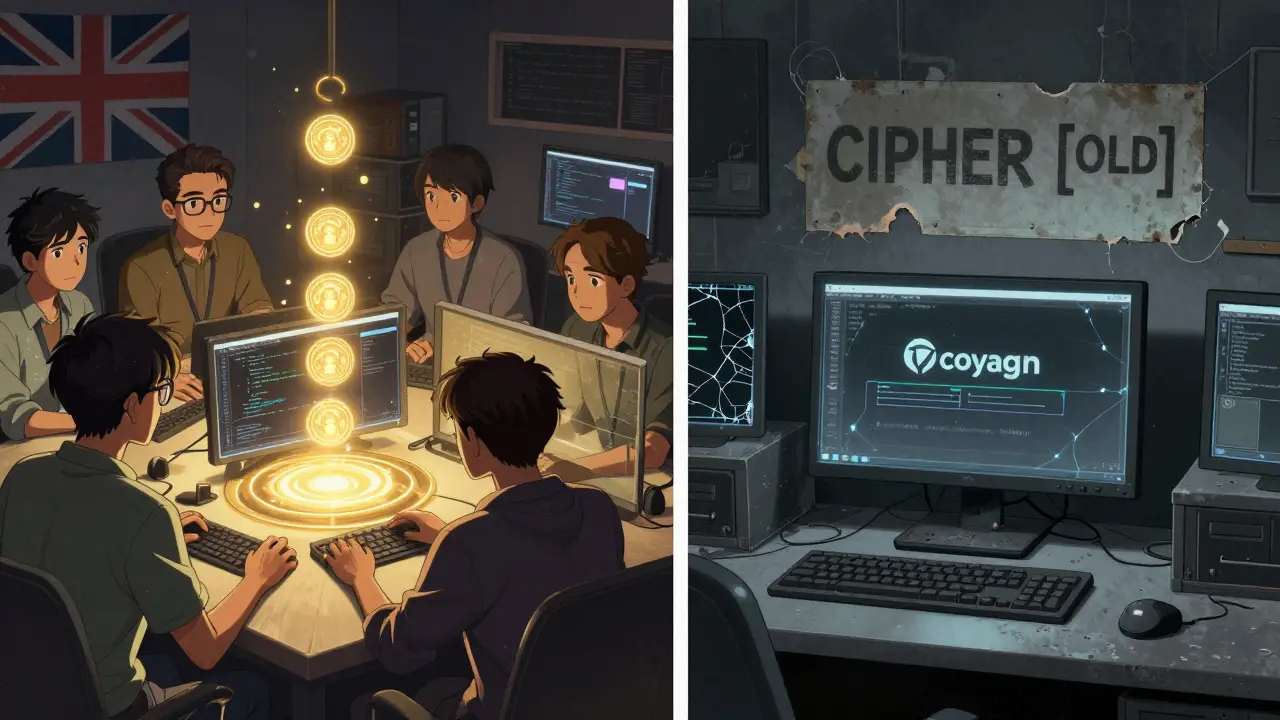
Cipher wasn’t a typical crypto project. Launched in April 2018, it was built as a utility token meant to represent partial ownership in the company, kind of like a share in a startup-but on the blockchain. The team, spread across India, the UK, and New Zealand, claimed they wanted to fix how businesses used crypto. No hype. No promises of moonshots. Just tools for secure, scalable digital apps that could handle real-world tasks like content delivery, real-time data, and user interactions. The token, CPR, was designed to be used inside their own ecosystem. If you used their apps, you earned CPR. If you helped improve their platform, you got more. That’s the opposite of most projects back then, which just sold tokens and disappeared. Cipher tried to tie value directly to usage, not speculation.The 2021 Airdrop: Why CoinMarketCap?
By 2021, the crypto market was booming. New projects were popping up every day. Cipher needed visibility. So they partnered with CoinMarketCap (CMC), one of the most trusted platforms for tracking crypto prices and data. The CMC airdrop wasn’t random. It was targeted. You had to be an active CMC user-someone who tracked coins, checked charts, or used their tools regularly. The goal? Get CPR into real hands, not just wallets waiting for a pump. The airdrop was meant to reward users who were already engaged with crypto data, not just speculators. It was a smart move, honestly. CMC had millions of users. If even 1% of them claimed CPR, that’s tens of thousands of people exposed to the project. But here’s the problem: no one ever published the exact numbers. How many tokens were distributed? Who got them? How much was each wallet worth? There’s no public record. No blog post. No tweet from the team with a breakdown. That silence is telling.The Big Switch: From Ethereum to Polygon
Around the same time as the airdrop, Cipher made a major technical move. They migrated from the Ethereum network to Polygon PoS. Why? Gas fees on Ethereum were insane. Transactions were slow. For a project trying to build real apps, that was a dealbreaker. The new contract address became0xaa404804ba583c025fa64c9a276a6127ceb355c6. If you held CPR before the migration, you had to swap your old tokens for the new Polygon version. Many didn’t. Some didn’t know how. Others thought the project was dead. That’s why today, you’ll see "Cipher [Old]" on CoinMarketCap. It’s not a typo. It’s a warning.
The old Ethereum tokens are essentially useless now. The new ones live on Polygon. But even the new version has struggled to gain traction.
What Happened to the Value?
CPR’s price history tells a story of hope and decline. - All-time high: $0.004065 in February 2024- All-time low: nearly $0 in June 2022
- Current range (as of late 2025): $0.00004791 to $0.00006803 That’s a drop of over 98% from its peak. Even if you got 10,000 CPR in the 2021 airdrop, you’d be sitting on less than $0.70 today. Not nothing, but hardly life-changing. Total supply? 1.08 billion CPR. Circulating supply? Around 186 million. That’s not a huge number for a token that was supposed to power a business ecosystem. The math doesn’t add up to real adoption.
Why Did It Fail?
Cipher had good intentions. But good intentions don’t keep a crypto project alive. - No clear product: People didn’t know what to do with CPR. No apps, no wallets, no dashboards you could actually use.- No marketing after the airdrop: The 2021 campaign was the last big push. After that, silence.
- No team updates: No blog posts. No Twitter threads. No GitHub commits. No community calls.
- No exchange listings: The project claimed to be on Cifinex, but that exchange faded into obscurity.
- No utility: Unlike tokens tied to DeFi, NFTs, or gaming, CPR had no clear use case outside of the project’s own vague promises. Most importantly, the team disappeared. No official statement. No announcement of shutdown. Just… nothing. That’s the quiet death of a crypto project.
What You Can Learn From Cipher [Old]
The CPR airdrop isn’t a success story. But it’s a lesson. - Airdrops don’t create value-they just distribute tokens.- If a project doesn’t have real software, real users, and real updates, it won’t survive.
- Don’t trust a project just because it’s on CoinMarketCap. That’s a directory, not a stamp of approval.
- Always check the contract address. Migrations happen. Old tokens become worthless.
- If a team stops talking, they’ve probably stopped building. Cipher [Old] is a ghost. But its story isn’t unique. Hundreds of projects from 2018-2021 did the same thing: airdrop tokens, get listed, raise a little hype, then vanish. The market has moved on. The ones that survived-like Uniswap, Chainlink, or Polygon-did so because they kept shipping products, not just airdrops.
Is There Any Point in Claiming CPR Now?
No. The 2021 airdrop is long over. Even if you somehow still have old CPR tokens, they’re not transferable on the current network. The Polygon contract doesn’t recognize the old Ethereum ones. There’s no official claim portal. No support team. No way to swap. If you see someone selling "CPR airdrop claims" or offering to help you "recover your tokens," it’s a scam. Don’t click. Don’t send ETH or MATIC. Don’t connect your wallet. The only thing left of Cipher [Old] is a listing on CoinMarketCap and a few forum posts from 2021. That’s it.What Comes After Cipher [Old]?
The crypto space moves fast. Projects that fail are replaced by ones that solve real problems. Today, you’ll find better alternatives if you want a utility token tied to business apps: - Chainlink (LINK): Powers real-world data for smart contracts.- Filecoin (FIL): Decentralized storage.
- Render Network (RNDR): Decentralized GPU power for rendering.
- Arweave (AR): Permanent data storage.
- Fetch.ai (FET): AI-driven automation on blockchain. These projects have active teams, clear use cases, and regular updates. They don’t rely on airdrops to survive. They build tools people actually use. The lesson? Don’t chase old airdrops. Chase real utility.
Was the CPR CIPHER 2021 airdrop real?
Yes, the CPR CIPHER 2021 airdrop was real and conducted through CoinMarketCap. It was part of Cipher’s strategy to distribute tokens to active crypto users instead of selling them via ICO. However, the project never published exact details like distribution amounts or participant numbers, which is unusual for a legitimate campaign.
Can I still claim CPR tokens from the 2021 airdrop?
No, you cannot claim CPR tokens from the 2021 airdrop anymore. The campaign ended years ago, and there is no official portal, smart contract, or team to process claims. Any website or person offering to help you claim old CPR tokens is attempting a scam.
What happened to the Cipher [Old] project?
The Cipher [Old] project effectively shut down after 2021. The team stopped posting updates, no new apps were released, and the project lost all community momentum. The migration to Polygon was the last major technical change, and after that, silence followed. The "[Old]" label on CoinMarketCap confirms the project is no longer active.
Are my old CPR tokens still worth anything?
If you have CPR tokens on the old Ethereum contract, they are worthless. The project migrated to Polygon in 2021, and the new contract does not support old tokens. Even if you hold the new Polygon version, CPR is trading at less than $0.00007 as of 2025, with no active development or demand. It’s not a viable asset.
Why did Cipher migrate from Ethereum to Polygon?
Cipher migrated to Polygon to reduce transaction fees and speed up processing times. Ethereum’s high gas costs made it impractical for the real-time, scalable applications Cipher wanted to build. Polygon offered EVM compatibility with lower costs, making it a better technical fit. However, the migration also confused users, and many lost their tokens because they didn’t swap in time.
Is Cipher [Old] the same as any new Cipher project?
No. Cipher [Old] is the original 2018 project that ended in 2022. There is no active successor project using the same name or token. Any new project claiming to be "Cipher" is unrelated and likely a copycat or scam. Always verify contract addresses before interacting with any token.









Alison Hall
December 29, 2025 AT 00:16Just saw this and had to comment - airdrops are never free money, they’re free attention. And attention is the only thing crypto projects ever really sell.
Alexandra Wright
December 30, 2025 AT 11:31Oh wow, Cipher [Old] - the ghost in the machine. Remember when everyone thought ‘utility token’ meant something more than a fancy way to say ‘we’re gonna vanish after the airdrop’? 😏
They didn’t fail because of tech. They failed because they thought people would care about a blockchain app that didn’t do anything useful. No one wants a ‘secure, scalable digital app’ if it doesn’t let you meme or make money.
The migration to Polygon? Cute. Like renaming your dead pet and pretending it’s still alive.
And don’t get me started on CoinMarketCap - it’s not a stamp of approval, it’s a digital parking lot. Anyone can list. Anyone can vanish. And the bots keep crawling the graveyard anyway.
People still chase these ghosts because they’re addicted to the idea of ‘getting in early.’ But early to what? A funeral?
The real lesson? If the team stops posting, they’re already gone. No ‘pause.’ No ‘hiatus.’ Just gone. Like your ex who stopped replying but still shows up on your ‘people you may know’ list.
And if you see someone selling ‘CPR recovery services’? Block them. Report them. Then go hug a dog. At least dogs don’t promise utility and then ghost you.
Rick Hengehold
January 1, 2026 AT 08:19Don’t waste your time on dead tokens. Move on. There’s real value out there.
Ian Koerich Maciel
January 2, 2026 AT 23:10It is, indeed, a sobering reminder that the absence of communication from a project’s core team is not merely an indicator of stagnation - it is, in fact, the definitive marker of termination. One cannot overstate the importance of transparency, consistent development, and community engagement as non-negotiable pillars of sustainable blockchain innovation. The Cipher [Old] case exemplifies, with tragic clarity, the consequences of neglecting these fundamentals.
Monty Burn
January 4, 2026 AT 12:35Utility is a word people throw around like confetti at a funeral. What does it even mean? If a tree falls in the blockchain and no one uses it… does it still have value?
Or is value just what we pretend to believe before the lights go out?
dayna prest
January 5, 2026 AT 22:45Cipher [Old] wasn’t a project - it was a performance art piece titled ‘How to Vanish Gracefully While Still Being Listed on CMC.’ Bravo. The final bow? A $0.00006 token and a silence so thick you could spread it on toast.
Meanwhile, the team is probably sipping matcha lattes in Bali, laughing at how many suckers still check CoinMarketCap hoping for a miracle.
Next time, just name it ‘The Great Crypto Ghost’ and save us all the drama.
Mike Reynolds
January 7, 2026 AT 04:57I had CPR from the airdrop. Forgot about it. Checked it last month - $0.00005. Laughed. Then deleted the wallet.
Lesson learned: if it doesn’t have a Discord with 50k members screaming about the next moon, it’s already dead.
Bianca Martins
January 7, 2026 AT 08:37Honestly? I’m glad someone wrote this. So many people still think ‘CoinMarketCap listed’ = legit.
I got CPR too. Thought I was smart. Turns out I was just early to the funeral.
Now I check GitHub commits before I even look at price charts. If there’s no code, there’s no future. 🤷♀️
Antonio Snoddy
January 7, 2026 AT 18:14It’s funny, isn’t it? We chase tokens like they’re the meaning of life - a digital sacrament, a blockchain baptism - when in truth, they’re just bits of code abandoned by people who got bored, ran out of funding, or realized the world didn’t need another ‘utility’ token that did nothing but sit there like a lonely sock in the dryer.
Cipher didn’t die because of gas fees or bad marketing. It died because no one cared enough to keep it alive. And isn’t that the real tragedy? Not the price drop - but the silence. The absence of a single human voice saying, ‘We’re still here.’
We’ve turned crypto into a graveyard of promises. And we keep bringing flowers to graves that stopped accepting them years ago.
Maybe the real airdrop wasn’t CPR… it was the lesson we refused to claim.
Rest in peace, Cipher. You were never the problem. We were.
Phil McGinnis
January 8, 2026 AT 01:49Another American startup that thought blockchain was a magic wand. No wonder the world laughs at crypto. You build nothing, you promise everything, and then you vanish like a politician after an election. Pathetic. And yet, people still fall for it. Sad.
Raja Oleholeh
January 8, 2026 AT 11:36India also had many such projects. Everyone wanted free tokens. No one wanted to build. Now they cry when the token dies. 🤦♂️
Haritha Kusal
January 10, 2026 AT 03:46so sad… i thought cipher was gonna be different… but yeah… silence = death. i still have my old tokens… maybe one day they’ll wake up? 😅
Johnny Delirious
January 11, 2026 AT 08:18The migration from Ethereum to Polygon was the smartest thing Cipher ever did. Too bad nobody cared enough to follow.
It’s not the tech that failed. It’s the people who stopped showing up.
Amy Garrett
January 12, 2026 AT 02:01airdrop? more like air-dropped-into-the-trash-can 😂 i had 50k cpr… now its worth less than my coffee
Jack and Christine Smith
January 13, 2026 AT 20:33my bff and i both got cpr… we thought we were so cool… now we just laugh and call it our ‘crypto regret token’ 🤭
ps: i miss when crypto felt like a community, not a casino
Brandon Woodard
January 14, 2026 AT 19:23Let’s be real - the only reason this got attention was because CoinMarketCap listed it. If it had been on some obscure DEX, no one would’ve cared. The airdrop wasn’t about adoption. It was about visibility. And visibility without substance? That’s just noise.
But hey - at least now we have a textbook case. Use it. Learn from it. Don’t repeat it.