
Ethereum Rollup Cost Calculator
See how much you can save by using rollups instead of Ethereum mainnet. Enter your transaction details below to compare costs.
Cost Comparison
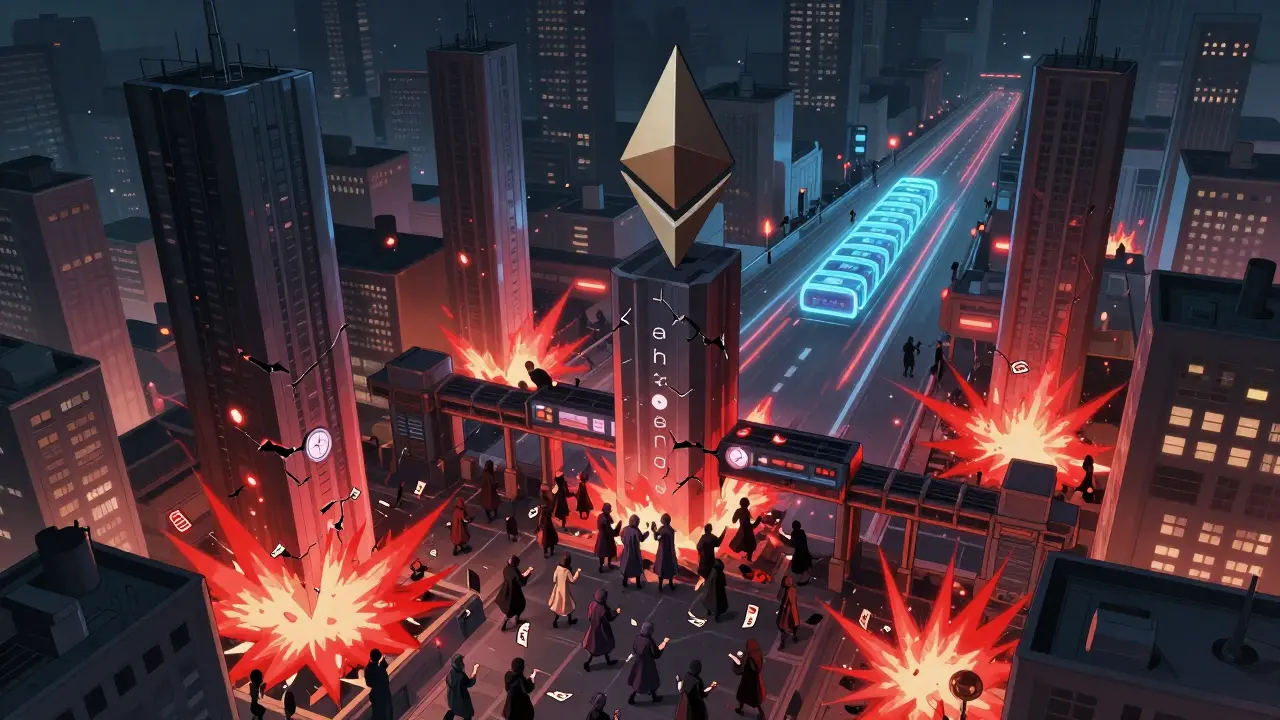
Imagine sending a transaction on Ethereum and paying $80 in fees just to swap two tokens. That wasn’t science fiction - it was real in 2021. Back then, the network could only handle about 15 transactions per second. For a system meant to power global finance, that’s like trying to move a freight train through a toll booth. Enter rollups: the quiet revolution that’s making Ethereum fast, cheap, and actually usable.
Why Ethereum Needed Help
Ethereum wasn’t built for mass adoption. It was built to be secure and decentralized - and it succeeded. But that came at a cost: speed. Every transaction had to be verified by every node on the network. That’s great for security, terrible for scalability. When demand spiked - like during an NFT drop or a DeFi flash crash - gas fees would spike too. People couldn’t afford to use the apps they built. Developers couldn’t build apps that users could afford. The old workarounds didn’t cut it. Sidechains like Polygon offered speed but traded away Ethereum’s security. State channels worked for payments between two people, but not for complex apps like decentralized exchanges. Rollups solved this by keeping the security of Ethereum while moving the heavy lifting off-chain.What Exactly Are Rollups?
Rollups are like express lanes for Ethereum. Instead of processing each transaction one by one on the main chain, rollups collect dozens or hundreds of transactions, bundle them into one big batch, and process them outside Ethereum. Then, they send just a tiny summary - a cryptographic proof or a compressed data snapshot - back to Ethereum. The main chain doesn’t care what happened inside the batch. It only checks: is this proof valid? Think of it like mailing a package. Instead of sending 100 individual letters, you put them all in one box, seal it, and send one envelope. The post office (Ethereum) doesn’t open the box - it just checks the seal and the tracking number. If the seal is intact, it accepts the whole batch. This cuts costs because Ethereum only pays for storing a small amount of data, not running thousands of complex calculations. The heavy work happens on the rollup, which runs like a mini-blockchain.Two Types of Rollups: Optimistic vs ZK
There are two main flavors of rollups - and they work very differently. Optimistic rollups assume everything is fine unless someone proves otherwise. They post transaction data to Ethereum and wait 7 days. During that time, anyone can challenge a transaction they think is fake. If a challenge happens, Ethereum runs a mini-trial to check who’s lying. This system is simpler to build and works with existing Ethereum code - so most DeFi apps moved here first. Projects like Arbitrum and Optimism use this model. ZK rollups use math to prove everything is correct before even posting. They generate a zero-knowledge proof - a tiny cryptographic signature that says, “These 500 transactions are valid, and I can prove it without showing you the details.” This proof gets verified on Ethereum in seconds. No waiting. No challenges. Instant finality. But building these proofs is computationally expensive. It needs powerful hardware and deep cryptography. Projects like Starknet and zkSync are leading here. Here’s the trade-off:| Feature | Optimistic Rollups | ZK Rollups |
|---|---|---|
| Finality Time | 7 days for withdrawals | Seconds |
| Proof Type | Dispute-based (fraud proofs) | Mathematical (zero-knowledge proofs) |
| Computational Load | Low - easy to run nodes | High - needs powerful machines |
| EVM Compatibility | High - most Ethereum apps work as-is | Lower - requires code changes |
| Transaction Cost | Very low | Even lower |
| Examples | Arbitrum, Optimism | zkSync, Starknet |

How Much Faster and Cheaper?
Before rollups, Ethereum handled 15-20 transactions per second. With rollups, that jumps to 1,000-4,000 TPS. Some ZK rollups have tested over 20,000 TPS in labs. Fees? A simple ETH transfer that cost $50 in 2021 now costs less than $0.10 on Arbitrum or zkSync. For complex DeFi swaps, you’re looking at 90-99% cheaper than the mainnet. The real win isn’t just lower fees - it’s predictable ones. On Ethereum mainnet, fees spike unpredictably. On rollups, they’re steady. That’s what makes apps like decentralized exchanges, gaming platforms, and social networks viable. You can’t build a game where every jump costs $2.Why Rollups Are Better Than Other Layer 2s
Other scaling ideas tried to fix Ethereum’s speed problem - but broke its security. Sidechains like Polygon or Binance Chain run their own blockchains. They have their own validators. If those validators get hacked or go offline, your money is at risk. Rollups don’t do that. They use Ethereum’s security. Even if the rollup operator vanishes, you can still withdraw your funds to Ethereum. State channels only work for two people doing repeated transactions - like a chess game between friends. Rollups work for any app, any number of users, any kind of interaction. That’s why rollups are the only Layer 2 solution that scales Ethereum without breaking its promise.The Merge and Sharding: Rollups’ Secret Weapon
The Merge in 2022 didn’t just make Ethereum greener - it made rollups stronger. Proof of Stake freed up resources and set the stage for sharding: splitting Ethereum’s data storage into 64 parallel chains. Each shard can hold rollup data. Right now, rollups use one shard. But once all 64 are live, Ethereum’s data capacity will explode. That means rollups can post way more transactions per second. The goal? 100,000 TPS. Not theory. Not hype. Engineering. Rollups + sharding = the final scaling puzzle piece. Ethereum won’t be a slow, expensive chain anymore. It’ll be a secure backbone for thousands of fast, cheap apps.
What This Means for Users and Developers
For users: You don’t need to understand rollups to use them. Apps like Uniswap, Aave, and even games like Gods Unchained already run on rollups. You just connect your wallet, and it’s faster and cheaper. Your ETH or tokens are still protected by Ethereum’s security. For developers: You can reuse your Ethereum code. Most rollups support the Ethereum Virtual Machine (EVM). That means if you built a smart contract for Ethereum, you can deploy it on Arbitrum or zkSync with almost no changes. You don’t need to learn a new language. You don’t need new tools. Just deploy, and your users get better performance. For builders: Rollups are the foundation of Web3’s future. They’re what make decentralized apps feel as smooth as Instagram or Uber. Without them, blockchain stays niche. With them, it becomes mainstream.What’s Next for Rollups?
The race is on to make rollups even better. Right now, ZK rollups are catching up in EVM compatibility. New tools like ZK-EVM let developers run unmodified Ethereum code on ZK systems. That’s a game-changer. Cross-rollup communication is another big focus. Right now, moving tokens from Arbitrum to zkSync means going back to Ethereum first - slow and expensive. Soon, rollups will talk directly to each other. That’ll unlock true interoperability. And as hardware improves, ZK proof generation will get cheaper and faster. Soon, even small devices could generate proofs. That means more decentralization - not less.Final Thoughts: Rollups Are the Answer
Ethereum didn’t fail. It was just too early. Rollups fixed the bottleneck without compromising what made Ethereum special: security, decentralization, and trustlessness. They’re not a hack. They’re an evolution. If you’re using Ethereum today - whether you’re swapping tokens, playing a game, or staking ETH - you’re already benefiting from rollups. You just don’t see them. That’s how good they are. The future of Ethereum isn’t about bigger blocks or faster nodes. It’s about doing more off-chain, while staying anchored to the most secure blockchain in the world. That’s rollups. And they’re working.Are rollups safe?
Yes. Rollups inherit Ethereum’s security. Even if the rollup operator is malicious, users can still withdraw their funds to Ethereum. Optimistic rollups rely on a 7-day challenge window, while ZK rollups use cryptographic proofs - both ensure no funds can be stolen without detection.
Do I need a new wallet for rollups?
No. You use the same wallet - MetaMask, Coinbase Wallet, etc. You just switch networks in your wallet settings. Your private keys stay the same. Your funds are still under your control.
Can I use DeFi apps on rollups?
Absolutely. Uniswap, Aave, Compound, and dozens of other DeFi platforms have moved to rollups like Arbitrum and Optimism. Transaction fees are a fraction of what they are on Ethereum mainnet, and speeds are near-instant.
Are ZK rollups better than optimistic rollups?
It depends. ZK rollups are faster and cheaper per transaction, but harder to build for. Optimistic rollups are easier to adopt and work with most existing Ethereum apps. Right now, optimistic rollups have more users, but ZK rollups are catching up fast - especially in gaming and high-frequency trading.
Will rollups make Ethereum mainnet obsolete?
No. Ethereum mainnet becomes the security layer. Rollups post their data and proofs to Ethereum, so it stays the foundation. Most users will never interact with mainnet directly - but they’ll still benefit from its security. Think of Ethereum as the vault, and rollups as the fast-moving cash registers.
What’s the biggest challenge with rollups today?
The biggest challenge is user experience. Switching between networks, bridging assets, and understanding which chain you’re on can be confusing. But tools are improving fast. Wallets are adding one-click network switching, and bridges are becoming more reliable. It’s still early, but the friction is dropping every month.







Tara Marshall
December 10, 2025 AT 05:41Simple. Effective. Done.
jonathan dunlow
December 11, 2025 AT 18:54Mariam Almatrook
December 12, 2025 AT 05:17Regina Jestrow
December 14, 2025 AT 00:23Martin Hansen
December 15, 2025 AT 07:21Lore Vanvliet
December 16, 2025 AT 11:23China has been building L2s since 2019. India’s doing better UX. Nigeria’s got cheaper gas. You guys just read Medium blogs and call it innovation. Rollups? Cute. We’re already on to the next thing.
Frank Cronin
December 17, 2025 AT 10:40miriam gionfriddo
December 19, 2025 AT 08:31Nicole Parker
December 20, 2025 AT 11:57michael cuevas
December 21, 2025 AT 14:24Adam Bosworth
December 23, 2025 AT 02:25Uzoma Jenfrancis
December 23, 2025 AT 10:02Renelle Wilson
December 24, 2025 AT 15:37Jonathan Sundqvist
December 25, 2025 AT 22:38Annette LeRoux
December 26, 2025 AT 20:22Like I’m not just sending tokens - I’m helping build the future. Even if I don’t understand the math, I get the vibe. And that’s enough for me.
Jerry Perisho
December 27, 2025 AT 07:03Manish Yadav
December 27, 2025 AT 19:46Vincent Cameron
December 28, 2025 AT 03:51Doreen Ochodo
December 28, 2025 AT 08:38Yzak victor
December 29, 2025 AT 10:02Holly Cute
December 29, 2025 AT 20:10Roseline Stephen
December 29, 2025 AT 20:21Glenn Jones
December 29, 2025 AT 21:02Nelson Issangya
December 29, 2025 AT 21:49