Confusion surrounds the term Virtual Assets Ordinance 2025, which is actually a comprehensive regulatory framework in Hong Kong comprising multiple legislative acts including the Stablecoins Ordinance and new licensing regimes for virtual asset dealing and custody services. This framework took effect in phases starting August 1, 2025, establishing clear rules for cryptocurrency operations. Rather than a single law, this represents Hong Kong's strategic push to become a global digital asset hub while maintaining strict investor protections.
If you're running a crypto business or investing in Hong Kong, understanding these rules isn't optional-it's survival. The framework introduces specific capital requirements, licensing mandates, and operational restrictions that directly impact how you handle digital assets. Let's break down what actually changed and what it means for your wallet.
What Actually Changed in 2025?
The core of Hong Kong's new approach centers on three main pillars: stablecoin regulation, virtual asset (VA) dealing licenses, and custody service requirements. These didn't arrive all at once but rolled out between mid-2025 and early 2026 based on the LEAP strategy, which stands for Legal and regulatory streamlining, Expanding tokenised products, Advancing use cases and cross-sectoral collaboration, and People and partnership development.
- Stablecoins Ordinance: Effective August 1, 2025, requiring licenses for fiat-referenced stablecoin issuers
- VA Dealing Licenses: Consultation closed August 29, 2025, with implementation expected in 2026
- Custody Service Rules: Parallel rollout alongside dealing licenses targeting institutional providers
The Financial Services and Treasury Bureau (FSTB) issued Policy Statement 2.0 on June 26, 2025, reaffirming Hong Kong's commitment to becoming a "global hub for innovation in the digital asset field." This wasn't just talk-the subsequent consultation papers from FSTB and Securities and Futures Commission (SFC) laid out concrete requirements that businesses had to follow.
Who Needs a License Now?
You need a license if you fall into any of these categories operating in or targeting Hong Kong investors:
- Stablecoin Issuers: Anyone creating fiat-referenced stablecoins must obtain a license under the Stablecoins Ordinance by Q4 2025
- Virtual Asset Dealers: Platforms facilitating buying, selling, or trading of cryptocurrencies require VA dealing licenses by Q2 2026
- Custody Service Providers: Entities holding digital assets on behalf of others must secure custody licenses simultaneously with dealers
- Banks and SVFs: Traditional financial institutions offering virtual asset services must register with both Hong Kong Monetary Authority (HKMA) and SFC
The definition matters here. A "stablecoin" under the ordinance means a cryptographically secured digital representation of value that operates on a distributed ledger and purports to maintain stable value against referenced assets. This excludes central bank digital currencies, securities tokens, and banking deposits to avoid regulatory overlap.
Capital Requirements and Operational Costs
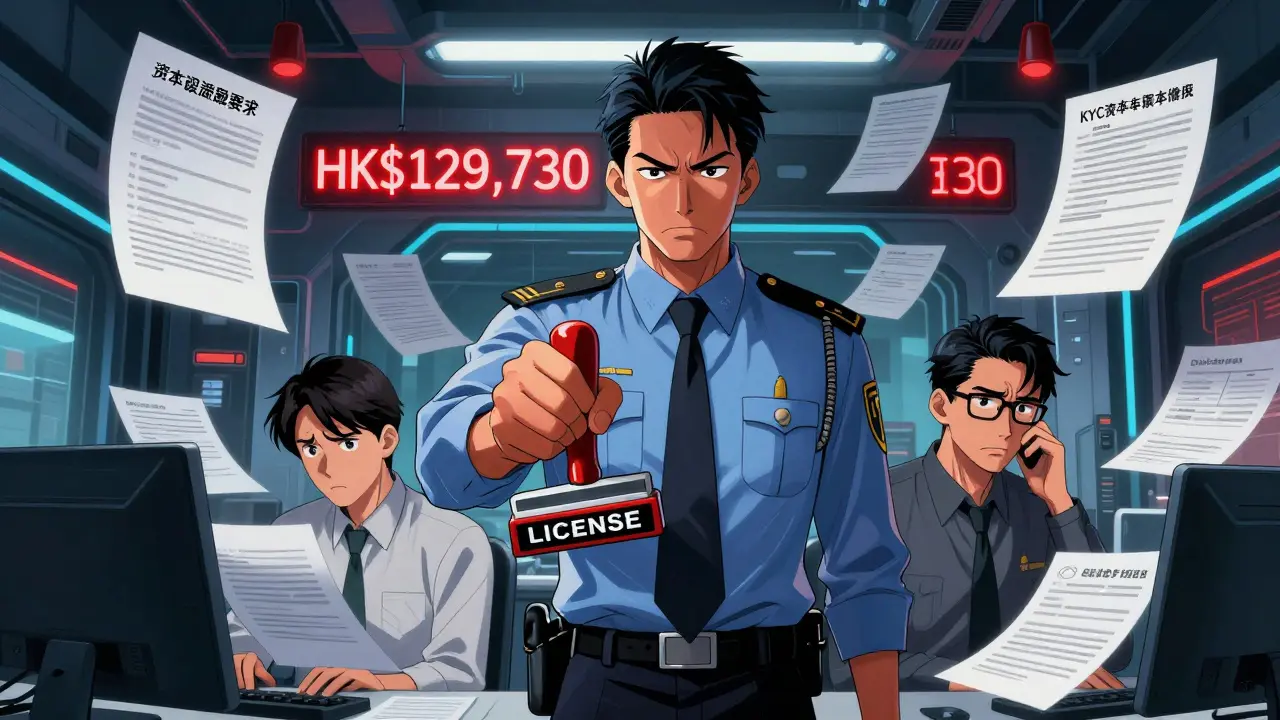
Here's where it gets expensive. The minimum capital requirement for VA dealing licenses sits at HK$129,730, benchmarked against Type 3 Securities and Futures Ordinance (SFO) licenses. But that's just the entry fee.
| Jurisdiction | Minimum Capital | Licensing Timeline | Extraterritorial Application | Retail Access |
|---|---|---|---|---|
| Hong Kong | HK$129,730 | Phased (2025-2026) | Yes (targets HK investors) | Limited (knowledge assessment required) |
| Singapore | Variable | Immediate | No (local entities only) | Moderate |
| EU (MiCA) | €730,000+ | Simultaneous | Yes (EEA-wide) | High |
| Switzerland | CHF 100,000+ | Flexible | Limited | High |
Industry surveys conducted by Sumsub in July 2025 revealed that smaller firms report operational costs increasing by 15-20% due to stringent requirements. The mandatory dual approval system for wallet whitelisting alone increased transaction processing times by 30-40% according to 43% of surveyed firms. At least 12 cryptocurrency companies delayed their Hong Kong market entry because of these cybersecurity and compliance burdens.
Dual Regulator Model: How It Works
Hong Kong uses a unique dual-regulator approach that trips up many newcomers. Here's how it breaks down:
- SFC Role: Acts as standard-setter, establishing regulatory requirements for VA trading platforms and asset managers
- HKMA Role: Serves as frontline regulator for banks and stored value facility (SVF) licensees providing virtual asset services
This division creates clear boundaries compared to the U.S. fragmented approach where SEC, CFTC, and state regulators overlap. However, Sidley Austin analysts question whether this model creates operational friction for cross-border institutions. Forty-one percent of surveyed firms expressed concern about regulatory overlap causing compliance inefficiencies.
The extraterritorial application gives Hong Kong an edge over Singapore. Activities targeting Hong Kong investors trigger licensing requirements regardless of where the company incorporates. This closes a loophole that previously allowed foreign platforms to serve Hong Kong users without local oversight.
Key Restrictions You Must Follow
The framework imposes several hard restrictions that directly affect daily operations:
- Exchange Whitelist: Funds must trade only through regulated exchanges in Hong Kong, U.S., U.K., Dubai, and Japan. No exceptions.
- Portfolio Supervision: At least one responsible officer needs three years of virtual asset portfolio management experience with mandatory 24-hour active supervision
- KYC Requirements: Intermediaries must assess clients' virtual asset knowledge before onboarding retail customers
- AML Compliance: Full adherence to Anti-Money Laundering and Counter-Terrorist Financing Ordinance (AMLO) standards
- Cybersecurity Standards: Implementation of blockchain analytics tools and multi-signature wallet systems becomes practically mandatory
Violations carry severe penalties: up to HK$5 million fines plus seven years imprisonment. That's not a warning shot-that's real jail time for non-compliance.

Market Impact and Industry Response
The numbers tell an interesting story. Hong Kong currently holds 18.7% of Asia's institutional crypto custody market, trailing Singapore's 28.3% but growing at 32% year-over-year versus Singapore's 19%. As of mid-2025, 42 asset managers held SFC licenses to manage virtual asset funds, up from 27 in December 2024.
Institutional activity dominates, representing 83% of virtual asset transactions in Hong Kong compared to just 17% retail. This reflects the SFC's deliberate focus on professional investors rather than everyday traders. Product innovation accelerated too-11 tokenized real-world asset (RWA) funds launched in Q3 2025, managing $2.3 billion in assets.
User sentiment shows mixed results. Reddit discussions from August 2025 showed 62% of 147 comments expressing optimism about regulatory clarity. One user noted: "The Stablecoins Ordinance gives us certainty that wasn't there before, though the HK$129,730 minimum capital is tough for small startups." Meanwhile, complaints focused heavily on the 24-hour supervision requirement being operationally challenging across multiple time zones.
Implementation Timeline and Next Steps
Here's your roadmap for compliance:
- Q4 2025: Stablecoin issuers must obtain licenses under the Stablecoins Ordinance
- Q2 2026: VA dealers and custodians must secure licenses under new regimes
- December 15, 2025: SFC publishes detailed guidance on stablecoin reserve requirements
- Q1 2026: FSTB launches legal review on tokenization focusing initially on bonds
- Q2 2026: HKMA launches regulatory sandbox for cross-border stablecoin transactions
Firms report needing 3-6 months to achieve full compliance based on Skadden's analysis of early adopters. The learning curve involves mastering blockchain analytics tools like Chainalysis (used by 68% of compliant firms) and establishing multi-signature wallet systems (adopted by 82% of compliant custodians).
The Hong Kong Fintech Association established a dedicated support channel with 47 verified experts who resolved over 1,200 queries since June 2025, averaging 1.7 business days response time. They're your first stop when things get confusing.
Future Developments to Watch
Hong Kong isn't stopping here. The framework will likely expand to cover non-fungible tokens (NFTs) by 2027, with FSTB indicating they'll review regulatory approaches following current implementation success. Morgan Stanley predicts Hong Kong could capture 25-30% of Asia's institutional virtual asset custody market by 2027 if implementation stays on schedule.
Long-term viability looks strong with 87% of surveyed financial institutions showing high confidence in Hong Kong's approach, compared to 72% for Singapore and 65% for Japan. The key challenge remains balancing investor protection with market innovation while maintaining the promised 120-day processing time for license applications by Q3 2026.
Is there actually a "Virtual Assets Ordinance 2025" in Hong Kong?
No single ordinance exists by that exact name. Instead, Hong Kong implemented a comprehensive framework consisting of the Stablecoins Ordinance (effective August 1, 2025), proposed VA dealing licensing regimes, and custody service requirements. These work together under the LEAP strategic vision to regulate different aspects of virtual asset activities.
When do I need to get licensed for crypto activities in Hong Kong?
Stablecoin issuers needed licenses by Q4 2025. Virtual asset dealers and custody service providers must secure licenses by Q2 2026. Banks and stored value facilities offering virtual asset services must register with both HKMA and SFC during the same timeframe. Foreign companies targeting Hong Kong investors also face these requirements due to extraterritorial application.
What happens if I violate the new regulations?
Penalties include fines up to HK$5 million plus imprisonment for up to seven years. Additional consequences include license revocation, operational shutdowns, and potential criminal prosecution for serious violations involving money laundering or fraud. The severity reflects Hong Kong's zero-tolerance approach to regulatory breaches.
How does Hong Kong's approach compare to Singapore's?
Hong Kong uses a phased implementation with dedicated stablecoin legislation, while Singapore regulates under broader payment services frameworks. Hong Kong applies extraterritorially to activities targeting local investors, whereas Singapore focuses on locally incorporated entities. Hong Kong's capital requirements are lower but operational burdens higher due to stricter supervision rules.
Can retail investors still buy cryptocurrency in Hong Kong?
Yes, but with restrictions. Intermediaries must assess clients' virtual asset knowledge before onboarding them. The framework emphasizes institutional participation (83% of activity) over retail access (17%). Retail investors can trade through licensed platforms but face additional verification steps and limited product availability compared to professional investors.
What technology tools do I need for compliance?
Essential tools include blockchain analytics platforms like Chainalysis (used by 68% of compliant firms), multi-signature wallet systems (adopted by 82% of custodians), automated KYC/AML screening software, and 24-hour portfolio monitoring systems. These aren't optional-they're practically mandatory given the stringent cybersecurity requirements imposed by regulators.
Will NFTs be regulated under this framework?
Not immediately, but likely by 2027. The Financial Services and Treasury Bureau indicated they would review regulatory approaches to NFTs following successful implementation of current measures. Current exclusions focus on securities tokens and utility tokens with clear commercial purposes, leaving most NFTs unregulated for now.