Imagine waking up to a knock on your door because you bought Bitcoin last week. In some parts of the world, this isn't a paranoid fantasy-it's a legal reality. While most people think of crypto as a digital asset, governments in countries like China, Algeria, and Egypt view it as a threat to national security, financial stability, or moral order. But here is the twist: just because a country bans crypto doesn't mean they will throw you in jail for holding it. The gap between what the law says and what actually happens on the street is massive.
If you are living in or traveling to a country with strict cryptocurrency restrictions, you need to know more than just "is it banned?" You need to understand the specific criminal penalties, how enforcement works, and whether your activity puts you at risk. This guide breaks down the real-world consequences of violating crypto bans worldwide, moving beyond generic warnings to show you exactly where the legal lines are drawn.
The Global Landscape: Who Actually Bans Crypto?
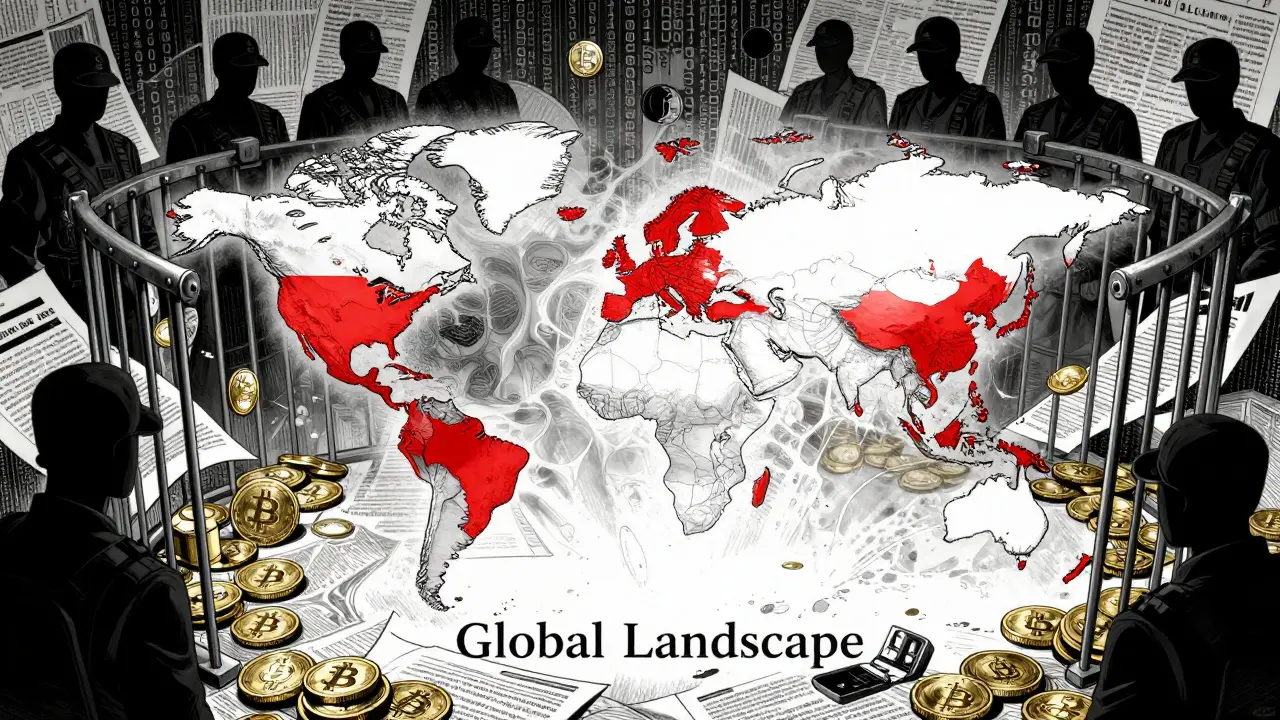
To understand the penalties, we first have to identify who is enforcing them. According to the Atlantic Council's Cryptocurrency Regulation Tracker from 2025, the world is split into three clear camps. Out of 75 countries studied, 45 allow crypto fully, 20 have partial bans, and 10 maintain general prohibitions. The countries with general bans include Algeria, Bangladesh, Bolivia, Egypt, Morocco, Nepal, Qatar, Turkmenistan, and Uzbekistan. China also enforces a comprehensive ban on exchanges and mining, though its approach differs slightly from outright criminalization of holders.
Why do these nations ban it? The reasons usually boil down to three fears: capital flight (money leaving the country), money laundering, and terrorist financing. For example, the TRM Labs 2025 Crypto Crime Report highlights how sanctions target entities supporting illicit economies, such as those linked to Hamas or Hezbollah. Governments fear that anonymous digital assets bypass their ability to control the flow of money. However, data suggests these bans often fail. Even in countries with strict prohibitions, adoption rates remain high. People still want to send money home, hedge against inflation, or invest. When the law forbids something popular, the enforcement becomes selective and unpredictable.
Criminal vs. Civil Penalties: Knowing the Difference
Not all violations lead to prison. It is crucial to distinguish between civil fines and criminal charges. In many jurisdictions, using crypto might result in frozen bank accounts or heavy fines (civil penalties), while operating an exchange or facilitating large-scale illegal transfers can lead to imprisonment (criminal penalties).
In Algeria, Article 117 of the official journal dated December 28, 2017, prohibits the purchase, sale, use, and holding of virtual currency. The law states that any breach is punishable according to existing regulations, but it does not specify exact prison terms. This vagueness creates a dangerous gray area where local authorities have wide discretion. Similarly, in Morocco, the Office des Changes declared in 2017 that transactions via virtual currencies infringe on exchange regulations. Governor Abdellatif Jouahri clarified that Bitcoin is not currency but a risky "financial asset." Violations here typically trigger administrative fines rather than immediate criminal prosecution for individual users, unless the amounts involve significant capital flight.
However, the line blurs when money laundering enters the picture. If you use crypto to evade sanctions or move stolen funds, you are no longer just breaking a "crypto ban"-you are committing serious financial crimes. This distinction is vital for understanding why some users face severe consequences while others get away with minor infractions.
Case Study: China’s Strict Enforcement Model
China offers the most detailed look at how a major economy enforces a crypto ban. Since 2021, China has banned crypto exchanges, trading, and mining. Unlike smaller nations that struggle with enforcement, China uses sophisticated surveillance and banking controls. They do not typically arrest individuals for simply holding Bitcoin in a cold wallet. Instead, they target the infrastructure.
If your bank account shows regular deposits from crypto exchanges, your account may be frozen, and you could face interrogation. In extreme cases, individuals involved in running underground mining operations or facilitating P2P (peer-to-peer) trading platforms have faced criminal charges for illegal business operations. Chainalysis estimated that $28.7 billion in peer-to-peer cryptocurrency transactions originated from China in 2024 despite the ban. This shows that while the government cracks down hard on businesses, individual usage persists through informal networks. The penalty here is less about jailing every user and more about making crypto unusable within the formal financial system.
How Users Circumvent Bans (And Get Caught)
People in banned countries don't stop using crypto; they just go underground. Common methods include:
- Peer-to-Peer (P2P) Platforms: Using services like LocalBitcoins or Binance P2P to trade directly with other individuals.
- Decentralized Exchanges (DEXs): Using non-custodial platforms that don't require KYC (Know Your Customer) verification.
- Cross-Border Wallets: Holding assets in wallets registered in friendly jurisdictions.
But these methods carry risks. A March 2025 Reddit thread titled "Using crypto in banned countries" revealed mixed experiences. User u/MaghrebTrader reported successful use of LocalBitcoins in Morocco for 18 months without incident. Meanwhile, u/CairoCrypto noted frequent payment processor blocks in Egypt but no personal legal consequences. However, the danger lies in KYC failures. Trustpilot reviews of platforms like KuCoin (prohibited in Canada and restricted elsewhere) show that 68% of negative reviews cite "account freezes when KYC verification fails." If you provide false information to bypass a ban, you are now committing fraud, which carries much heavier criminal penalties than simple crypto usage.
The Shift Toward Targeted Sanctions
Global enforcement is changing. Instead of blanket bans that are hard to enforce, regulators are using targeted sanctions. The U.S. Department of the Treasury’s Office of Foreign Assets Control (OFAC) leads this trend. In 2024, OFAC issued 13 sanctions designations including 86 cryptocurrency addresses targeting Russia-related entities. These aren't just warnings; they freeze assets and make it a crime for anyone globally to interact with those addresses.
This approach was highlighted in the TRM Labs report regarding "Operation Destabilise" by the UK National Crime Agency. Individuals like Elena Chirkinyan were designated for money laundering through crypto channels. The key takeaway? Governments are less interested in prosecuting the average person buying $100 of Bitcoin and more focused on shutting down the pipes used for terrorism financing and sanctions evasion. The April 2025 U.S. Department of Justice memorandum "Ending Regulation by Prosecution" explicitly re-scoped enforcement to prioritize misappropriation of client assets, sanctions evasion, and fraud, deprioritizing minor regulatory disputes.

Risks for Travelers and Expats
If you are an expat or traveler, you might assume foreign laws don't apply to you. Think again. In countries like Egypt, individuals and banks are prohibited from dealing in cryptocurrencies. While enforcement against tourists is rare, carrying large amounts of crypto on devices or attempting to exchange it locally can draw attention. Customs officials in some nations may confiscate hardware wallets if they suspect illegal activity. Always research the specific entry requirements of your destination. Some countries require declaration of digital assets upon arrival.
| Country | Ban Type | Primary Penalty | Enforcement Focus |
|---|---|---|---|
| China | Comprehensive | Fines, Account Freezes | Exchanges, Mining Ops |
| Algeria | General Prohibition | Vague Criminal Fines | All Usage |
| Morocco | Exchange Regulation | Administrative Fines | Capital Flight |
| Egypt | Outright Ban | Unspecified Legal Action | Banks & Institutions |
| USA (Sanctions) | Targeted | Asset Freeze, Jail | Terrorism/Sanctions Evasion |
Practical Advice for High-Risk Jurisdictions
If you live in a country with a crypto ban, here is how to minimize your risk:
- Avoid Centralized Exchanges: Do not link your local bank account to a known exchange. Use decentralized options where possible.
- Keep Records Private: Do not discuss your holdings on social media or in public forums. Digital footprints can be subpoenaed.
- Understand Local Banking Rules: Many banks in banned countries monitor for crypto-related transactions. Receiving funds from a labeled crypto source can trigger account closure.
- Consult a Local Lawyer: Laws change rapidly. The Atlantic Council notes that regulatory frameworks are evolving quickly. Professional legal advice is worth the cost.
Remember, the goal of these bans is often economic control, not necessarily mass incarceration. However, crossing the line into money laundering or sanctions evasion turns a regulatory violation into a serious international crime.
Can I go to jail for holding Bitcoin in a banned country?
In most cases, simply holding Bitcoin does not lead to jail time. Countries like Algeria and Morocco focus on fines and administrative penalties for usage. However, if your holdings are linked to money laundering, tax evasion, or sanctions violations, criminal charges including imprisonment become possible. China targets infrastructure providers more than individual holders, but large-scale illegal business operations can lead to prison sentences.
What are the penalties for using crypto in China?
China bans crypto trading and mining. Individual holders rarely face direct criminal prosecution for possession. However, if you operate a mining farm or run a P2P trading platform, you can be charged with illegal business operations. Banks may freeze your accounts if they detect crypto-related flows, effectively cutting off your access to the traditional financial system.
Is it safe to use P2P exchanges in banned countries?
P2P exchanges are commonly used to circumvent bans, but they carry significant risk. While many users report no issues, providing false identity information (KYC) to bypass restrictions constitutes fraud. Additionally, if you accidentally transact with a sanctioned entity, you could face international legal consequences. Always verify the legal status of P2P activities in your specific jurisdiction.
How do governments enforce crypto bans?
Governments primarily enforce bans through banking channels. They block transactions to and from known crypto exchanges, freeze suspicious accounts, and monitor for capital flight. Increasingly, they use targeted sanctions against specific addresses and entities involved in illicit activities, rather than trying to prosecute every individual user. Intelligence sharing between agencies like OFAC and local police helps track high-value illicit flows.
Will crypto bans disappear in the future?
Blanket bans are becoming less common as regulators realize they are ineffective. The trend is shifting toward targeted regulation and taxation. Countries like South Korea have moved from bans to protective legislation (Virtual Asset Users Protection Act). However, nations with strict capital controls may maintain prohibitions to prevent currency devaluation. Expect more nuanced enforcement rather than total legalization in restrictive regimes.