You want to participate in the blockchain network and earn rewards. But standing at the crossroads of Proof of Work (mining) and Proof of Stake (staking), you face a stark reality: one path demands industrial-scale hardware and cheap electricity, while the other asks for capital and patience. The question isn't just which is more profitable; it's which barrier can you actually clear?
The landscape has shifted dramatically since Bitcoin launched in 2009. Today, with Ethereum’s transition to staking complete and regulatory frameworks tightening globally, the choice between these two consensus mechanisms defines your entry into the crypto economy. This guide breaks down the real-world costs, technical hurdles, and risks so you can decide where your resources belong.
Key Takeaways
- Mining requires heavy upfront capital: Competitive ASIC miners cost $12,500+ plus significant ongoing electricity bills ($200-$600/month).
- Staking lowers technical barriers: You can start staking with as little as $1 via exchanges, or run a node on a $55 Raspberry Pi.
- Energy consumption differs by magnitude: Staking uses up to 99.8% less energy than mining, making it environmentally sustainable.
- Risk profiles are distinct: Mining faces hardware obsolescence and rising energy taxes; staking faces slashing penalties and smart contract risks.
- Accessibility is global for staking: While mining concentrates in regions with cheap power, staking is available in 189 countries.
The Hardware Hurdle: Physical vs. Digital Assets
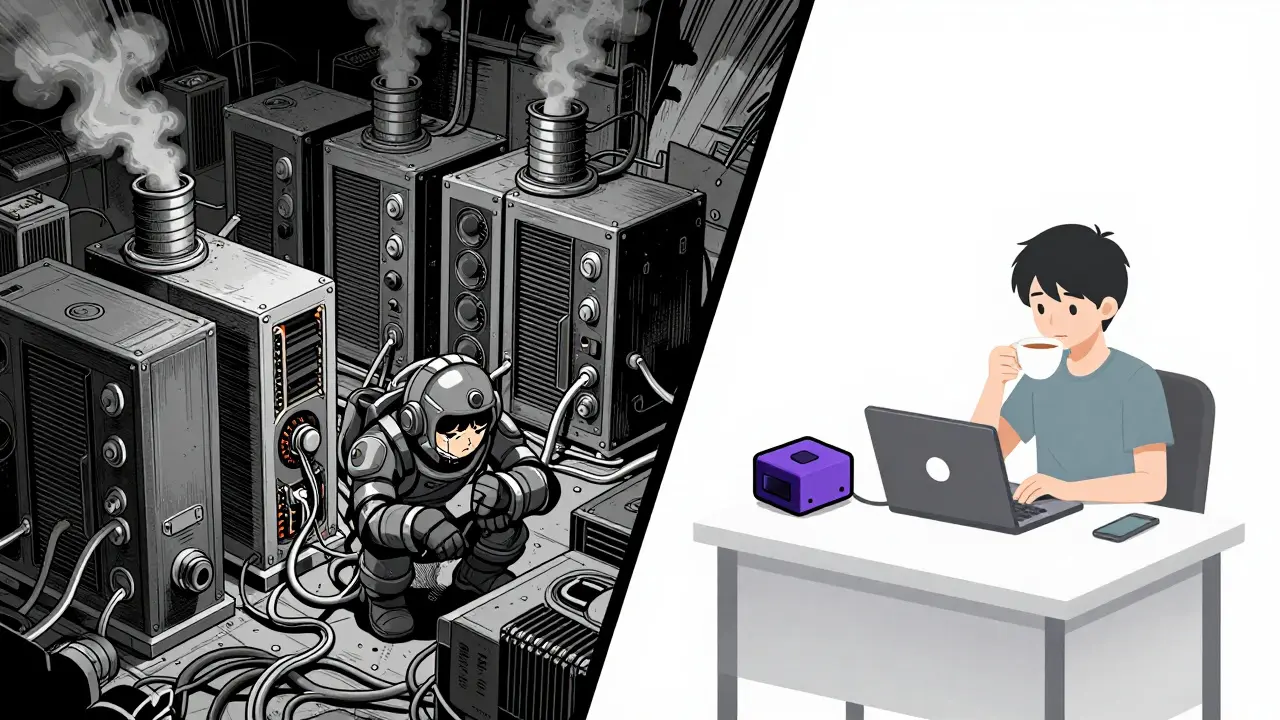
Let's talk about what you need to buy before you even begin. If you choose mining, you are entering an arms race against specialized hardware manufacturers. In late 2024, Bitmain released the Antminer S21 Hyd, which boasts a 335 TH/s hashrate but comes with a price tag of $12,500. Even if you opt for GPU mining using NVIDIA RTX 4090s, you need 6-8 units just to remain competitive, costing around $1,600 each. That’s nearly $13,000 in silicon before you mine a single block.
Contrast this with staking. Your primary requirement is the cryptocurrency itself. For Ethereum solo validation, you need 32 ETH (approximately $104,000 as of December 2025). That sounds high, but consider the hardware: a standard laptop or a $55 Raspberry Pi 4 suffices. There is no need for water-cooling systems or industrial-grade power supplies. The barrier here is financial liquidity, not physical infrastructure.
| Feature | Mining (PoW) | Staking (PoS) |
|---|---|---|
| Hardware Cost | $3,000 - $15,000+ | $0 - $55 (optional node) |
| Minimum Capital | Low (hardware only) | High (32 ETH for solo) or Low (via pools) |
| Space Required | Dedicated room/garage | Desk space |
| Noise Level | Very High (industrial fans) | Silent |
Operational Costs: Electricity vs. Opportunity Cost
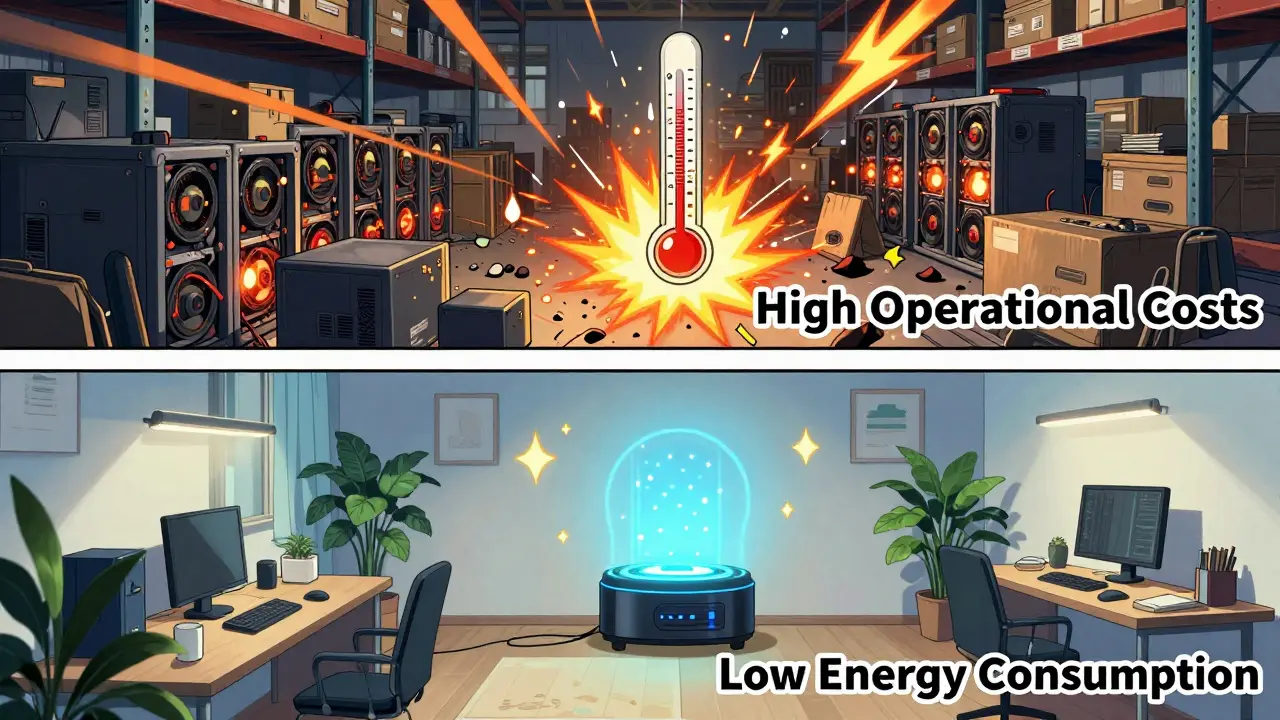
Buying the gear is only step one. Running it is where many miners get trapped. According to Bitdeer’s 2025 report, a typical mining rig consumes 3,200-5,500 kWh monthly. At an average US rate of $0.10/kWh, that’s $320 to $550 every month. In regions like Nevada, new electricity taxes have added a 0.025¢/kWh surcharge, reducing profitability by 17%. You also need cooling infrastructure to keep temperatures below 25°C, adding further strain on your wallet.
Staking nodes, however, sip energy. A Raspberry Pi consumes 15-30 watts continuously. Over a month, that’s roughly 10-13 kWh-less than 1% of a miner’s usage. The Ethereum Foundation notes that post-Merge, Ethereum’s annual energy consumption dropped from 78.55 TWh to 0.01 TWh. Your operational cost for staking is negligible. Instead, your "cost" is opportunity cost: the capital locked up in the protocol could be earning yield elsewhere.

Technical Complexity: IT Skills vs. Wallet Management
Do you know how to wire a 240V outlet? Do you understand BIOS settings and pool configuration files? Mining requires professional IT assistance for 78% of participants, according to Coin Bureau’s 2025 survey. The setup involves a 27-step process including electrical upgrades, hardware procurement, and software tuning. It’s a job, not a hobby.
Staking is designed for accessibility. Coinbase’s staking onboarding takes under two minutes and four clicks. For those who want to run their own validator, Ethereum’s launchpad achieves a 92% user success rate. You don’t need to learn electrical engineering. You just need to manage private keys securely. The learning curve is steep in terms of security awareness, but shallow in terms of technical implementation.
Financial Barriers: Upfront Investment vs. Liquidity Lock
Here is the trade-off. Mining has high fixed costs but low variable capital requirements. You can buy a used GPU for $500 and start mining altcoins immediately. However, your hardware depreciates rapidly. ASICs become unprofitable within 12-18 months as newer, more efficient models hit the market. You are constantly reinvesting to stay relevant.
Staking has low fixed costs but high capital thresholds for solo participation. The 32 ETH requirement creates a $100,000+ barrier. However, liquid staking derivatives like Lido’s stETH allow entry with fractions of a cent. The downside? Slashing. If your validator goes offline or acts maliciously, you lose part of your stake. One Reddit user reported losing 0.5 ETH ($1,625) due to just four hours of downtime. Mining doesn’t slash you; it just stops paying you when you’re offline.
Regulatory and Geographic Constraints
Where you live matters more for mining than staking. Mining is concentrated in China (21.8%), USA (17.3%), and Kazakhstan (13.4%) because of cheap electricity. Thirty-two countries have restricted or banned mining, including China’s 2021 ban. The EU’s MiCA regulations require mining operations to offset 100% of carbon emissions at $50/ton, adding another layer of compliance cost.
Staking is available in 189 countries. Regulatory scrutiny exists, but it’s lighter. SEC Commissioner Hester Peirce’s proposed "Staking Safe Harbor" aims to classify staking rewards as non-securities, potentially unlocking massive institutional adoption in the US. Currently, only 12 countries have specific staking limitations. This geographic freedom makes staking a truly global opportunity.
Market Trends: Where Is the Industry Going?
The data points clearly toward staking. As of 2025, 29% of top cryptocurrencies use Proof of Stake, up from 19% in 2020. PoW dominance has fallen from 55% to 38%. Gartner predicts 80% of new blockchains will use PoS variants by 2027. Why? Sustainability and efficiency. Institutions prefer staking because it aligns with ESG goals. JPMorgan, Microsoft, and IBM participate in staking, while mining remains dominated by energy firms.
However, PoW isn’t dead. Bitcoin remains the store-of-value king, and its security model is proven over 15 years. But for new entrants, the barriers to meaningful participation in Bitcoin mining are prohibitive without industrial backing. Staking offers a democratized path to network security and reward generation.
Decision Matrix: Which Path Fits You?
If you have access to free or extremely cheap electricity (<$0.05/kWh) and enjoy tinkering with hardware, mining might still offer niche opportunities in smaller PoW chains. But for most people, the math doesn’t add up against the convenience of staking.
If you hold crypto assets long-term, staking turns idle balances into productive capital. Use pooled staking services like Coinbase or Lido if you lack the 32 ETH threshold. Run your own node if you value decentralization and privacy. Just ensure your internet connection is stable to avoid slashing.
Is mining still profitable in 2026?
For retail investors, generally no. With ASIC prices above $12,000 and electricity costs rising, payback periods exceed 22 months. Profitability is largely confined to industrial operations with access to subsidized energy.
What is the minimum amount needed to start staking?
Through exchange-based or liquid staking platforms, you can start with as little as $1. For solo validation on Ethereum, you currently need 32 ETH, though upcoming upgrades may reduce this to 16 ETH.
Can I lose money while staking?
Yes. Risks include slashing penalties for validator downtime, smart contract bugs in liquid staking protocols, and general market volatility affecting the underlying asset's value.
How much electricity does a staking node use?
A typical staking node on a Raspberry Pi or old laptop uses 15-30 watts, costing less than $2 per month in electricity. This is 99.8% less than a mining rig.
Which countries ban crypto mining?
As of 2025, 32 countries have restrictions or bans on mining, including China, India, and several African nations. Staking faces far fewer geographic restrictions.