Imagine a world where you could move money between different blockchains as easily as sending an email. That was the promise of Fusion (FSN), a cryptocurrency project launched in 2017 with the ambitious goal of becoming the infrastructure for the 'Internet of Values.' But if you are looking at charts today, you might be scratching your head. The price has dropped significantly from its highs, and development activity seems quiet. So, what exactly is Fusion, how does it work, and is it still worth your attention in 2026?
The Core Concept: Solving Blockchain Isolation
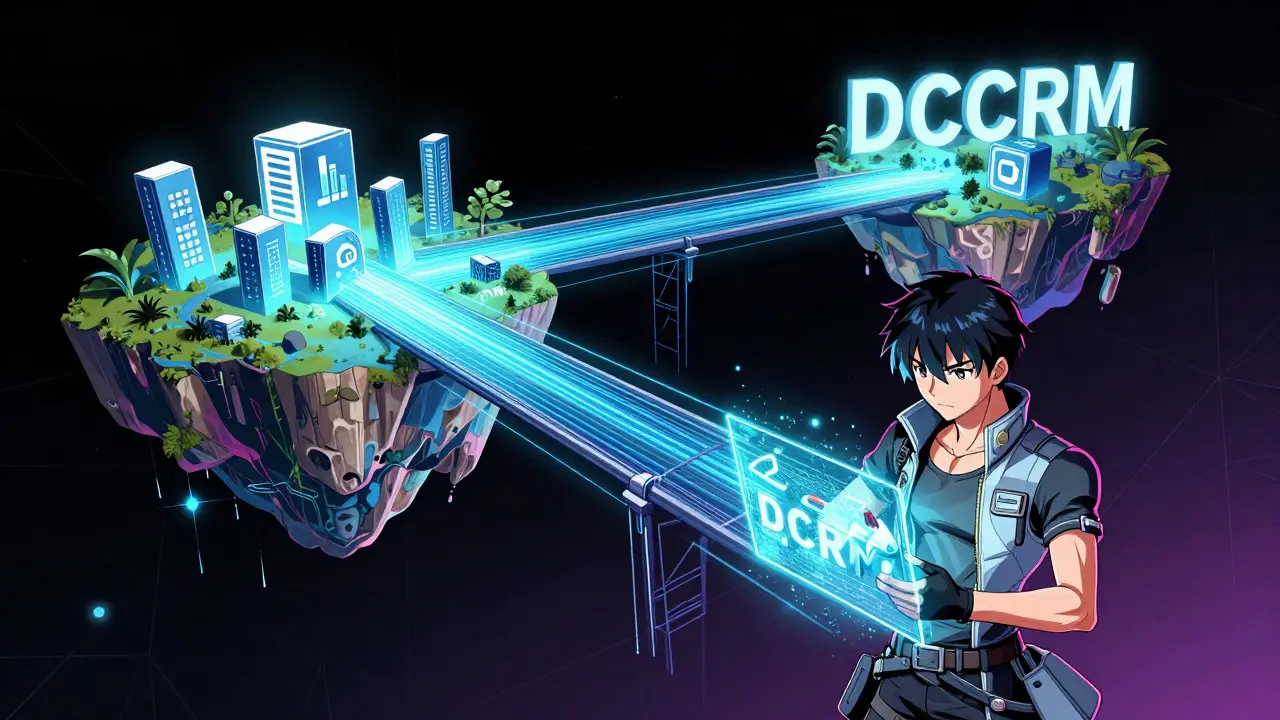
To understand Fusion, you first need to understand the problem it tried to solve. Blockchains like Bitcoin and Ethereum are isolated islands. They cannot talk to each other natively. If you want to use Bitcoin to pay for something on Ethereum, you usually need a bridge or a wrapped version of the asset. This process is often slow, expensive, and risky.
Fusion aimed to fix this by creating a platform specifically for decentralized finance (DeFi) that allows cross-chain, cross-organization, and cross-data source value transfers. Founded by Dejun Qian, who also co-founded BitSE Inc. (the incubator behind QTUM and VeChain), Fusion launched its mainnet on June 30, 2018. Its unique selling point was Distributed Control Rights Management (DCRM). Unlike other projects that rely on complex bridges or wrapped tokens, Fusion’s DCRM splits private keys across multiple nodes, allowing direct interaction between different blockchains without intermediaries.
How Fusion Technology Works
Fusion is not just another copy of Ethereum. While it is compatible with the Ethereum Virtual Machine (EVM), which means developers familiar with Solidity can build on it, it uses a distinct consensus mechanism called Hierarchical Hybrid Consensus Mechanism (HHCM).
This system combines Proof-of-Work (SHA-256) and Proof-of-Stake elements. It uses Ticketed Proof-of-Stake (TPoS) for operational consensus. Here is how it works in practice:
- Asset Fragmentation: Users can delegate their staking rights without giving up ownership of their tokens. This is a patented technology designed to make staking more flexible.
- Quantum Swaps: This feature allows for instant cross-asset trades within a single transaction. For example, you could swap Token A on Chain X for Token B on Chain Y in one step.
- Time Locks: These allow for conditional, time-based asset transfers. Think of it as a smart contract escrow that releases funds only when specific conditions are met.
Technically, Fusion supports the FRC20 token standard, similar to ERC20 on Ethereum, but optimized for these cross-chain interactions. In its early days, applications like Dopamine used this standard for NFT transactions. The network claimed to handle up to 3,000 transactions per second with a 15-second block time, which was competitive at the time of launch.
Fusion vs. Competitors: Why It Lost Ground
In the race for blockchain interoperability, Fusion had strong technical foundations but faced stiff competition. Let’s compare it to the current leaders: Cosmos and Polkadot.
| Feature | Fusion (FSN) | Cosmos (ATOM) | Polkadot (DOT) |
|---|---|---|---|
| Interoperability Method | DCRM (Distributed Control Rights) | IBC Protocol (Inter-Blockchain Communication) | Relay Chain Model |
| Ecosystem Size (Active Apps) | ~17 (as of late 2023) | 250+ | 600+ |
| Market Position | Niche/Legacy | Dominant Leader | Dominant Leader |
| Key Advantage | Complex multi-asset collateralization | Sovereign chains, high flexibility | Shared security, unified network |
While Fusion’s DCRM offered sophisticated security for cross-chain transactions, competitors like Cosmos and Polkadot built larger ecosystems. Developers flocked to platforms with more users, more tools, and active communities. By 2023, Fusion had fallen to rank #1,387 by market capitalization, trailing far behind its rivals. The lack of a massive developer community meant fewer new applications were built on Fusion, creating a vicious cycle of declining relevance.
Tokenomics and Market Reality
If you are considering buying FSN, you need to look at the numbers. As of recent data, Fusion operates with a circulating supply of approximately 78.2 million FSN tokens. This represents about 95% of its maximum supply cap of 81.92 million FSN. With a price hovering around $0.006, the total market capitalization is very low, often under $1 million.
Compare this to its all-time high in January 2018, when FSN traded at $12.60. That is a decline of over 99%. The trading volume is thin, concentrated on minor exchanges like Gate.io and Bitrue. This illiquidity means that large buys or sells can drastically affect the price, making it volatile and risky for investors.
The token’s utility was originally tied to gas fees, staking rewards, and governance. However, with minimal new development, the incentive to hold or stake FSN has diminished for many users. Reports from 2023 indicated issues with staking portals and inconsistent RPC gateway availability, further eroding confidence.

Current Status and Development Activity
Here is the hard truth: Fusion appears to be in a state of technical maintenance rather than active growth. The last significant commit to its core GitHub repository was in November 2022. The official website was last updated in April 2023 with vague statements about "strategic restructuring." No major roadmap items have been delivered since mid-2022.
Community support has also dried up. The official Telegram group, which once had thousands of members, now has very few active participants. Developer documentation contains broken code samples, and API endpoints are often deprecated. For a developer trying to build on Fusion today, the learning curve is steep, and the resources are scarce compared to Ethereum or Binance Smart Chain.
Industry analysts have been blunt. Reports from 2023 categorized Fusion as "effectively abandoned" by some metrics, noting that projects with similar patterns of development cessation have a high failure rate. While the underlying technology-specifically DCRM-was praised for its sophistication, the execution failed to keep pace with the rapidly evolving crypto landscape.
Is Fusion Still Relevant?
For most retail investors, Fusion is likely too risky to consider as a primary investment. The lack of development, shrinking ecosystem, and poor liquidity suggest limited upside potential. However, for blockchain historians or developers interested in niche interoperability solutions, Fusion remains a case study in how technical innovation alone is not enough to succeed in crypto. You need a community, continuous updates, and real-world adoption.
If you are looking for exposure to cross-chain technology, established players like Cosmos, Polkadot, or newer protocols like LayerZero offer more robust ecosystems and active development teams. Fusion serves as a reminder that in the fast-moving world of cryptocurrency, staying relevant requires constant evolution.
What is the main purpose of Fusion (FSN)?
Fusion (FSN) was designed to enable cross-chain interoperability for decentralized finance (DeFi). It allows users to transfer value and assets between different blockchains securely using its Distributed Control Rights Management (DCRM) technology, without needing intermediaries or wrapped tokens.
Is Fusion (FSN) still being developed?
As of 2026, development activity on Fusion is minimal. The last major updates to the core codebase occurred in late 2022. The project is currently considered to be in a state of technical maintenance, with no significant new features or roadmap items announced recently.
How does Fusion differ from Polkadot or Cosmos?
Fusion uses Distributed Control Rights Management (DCRM) to split private keys across nodes for secure cross-chain transactions. Polkadot uses a Relay Chain model for shared security, while Cosmos uses the IBC protocol for sovereign chains. Fusion focused heavily on complex financial instruments like fractional ownership, whereas Polkadot and Cosmos built broader general-purpose ecosystems.
What is the maximum supply of FSN tokens?
The maximum supply of Fusion (FSN) tokens is capped at 81,920,000. Currently, approximately 95% of this supply is in circulation, meaning very few new tokens will be issued in the future.
Can I still stake FSN tokens?
Staking functionality may exist technically, but user reports from recent years indicate issues with staking portals and inconsistent performance. Due to the lack of active development and support, staking FSN carries higher risk compared to more actively maintained networks.