

South Korea isn’t just another country with crypto traders. It’s one of the few places in the world where the government actually built a full legal system around cryptocurrency exchanges - and it’s getting even stricter in 2025. If you’re trading on Bithumb, Upbit, Coinone, or Korbit, you’re not just using an app. You’re operating inside a tightly controlled financial sandbox designed by the Financial Services Commission (FSC). This isn’t about banning crypto. It’s about bringing it into the mainstream - safely.
How South Korea’s Crypto Rules Got So Strict
Back in 2017, South Korea cracked down hard. All crypto exchanges were basically shut out of the banking system. No real-name bank accounts? No trading. The goal was simple: stop money laundering and protect everyday investors from scams. At the time, it looked like a total ban. But it wasn’t. It was a setup. By March 2020, the FSC flipped the script. Instead of blocking exchanges, they forced them to comply. Every exchange had to link up with Korea’s real-name banking system. That meant you couldn’t just deposit Bitcoin from a random wallet. You had to use a bank account under your real name, verified by the government. And your exchange? It had to have its own authorized bank account at the same institution. No more anonymous deposits. No more ghost accounts. Then came the security rules. Every exchange had to get certified by the Korea Internet Security Agency (KISA) for an Information Security Management System (ISMS). Think of it like a digital fortress audit. If you didn’t pass, you couldn’t operate. And if you did? You were now officially recognized by the state.The Travel Rule: Korea’s Crypto Money Trail
South Korea was one of the first countries in Asia to fully adopt the FATF Travel Rule - and they made it real. If you send or receive more than KRW 1 million (about $800 USD) in crypto, the exchange must share your name, address, and account details with the recipient’s exchange. Same if you trade Bitcoin for Ethereum. Same if you move coins between wallets you own. This isn’t just paperwork. It’s tracking. Every transaction over that threshold leaves a digital fingerprint. The Korean Financial Intelligence Unit (KoFIU) watches for anything suspicious. If a pattern shows up - say, someone moving $10 million in crypto through 50 different accounts - the FSC gets notified within hours. Most countries talk about the Travel Rule. South Korea enforces it. And because of this, foreign exchanges that want to serve Korean users have to comply too. That’s why you can’t just sign up for Binance Korea without jumping through the same hoops as a local exchange.Only Four Exchanges? Not Anymore
In 2020, only Bithumb, Upbit, Coinone, and Korbit had the infrastructure to meet all the rules. They were the only ones allowed to operate. But that changed. By 2025, every single virtual asset service provider (VASP) in South Korea - no matter how small - had to meet the same standards. New exchanges popped up. Some failed. Others got acquired. The FSC doesn’t just say “follow the rules.” They check. They audit. They penalize. In 2024, one exchange lost its license after failing to update its KYC system for six months. Another was fined for letting users trade without linking to a real-name bank account. The message is clear: no exceptions.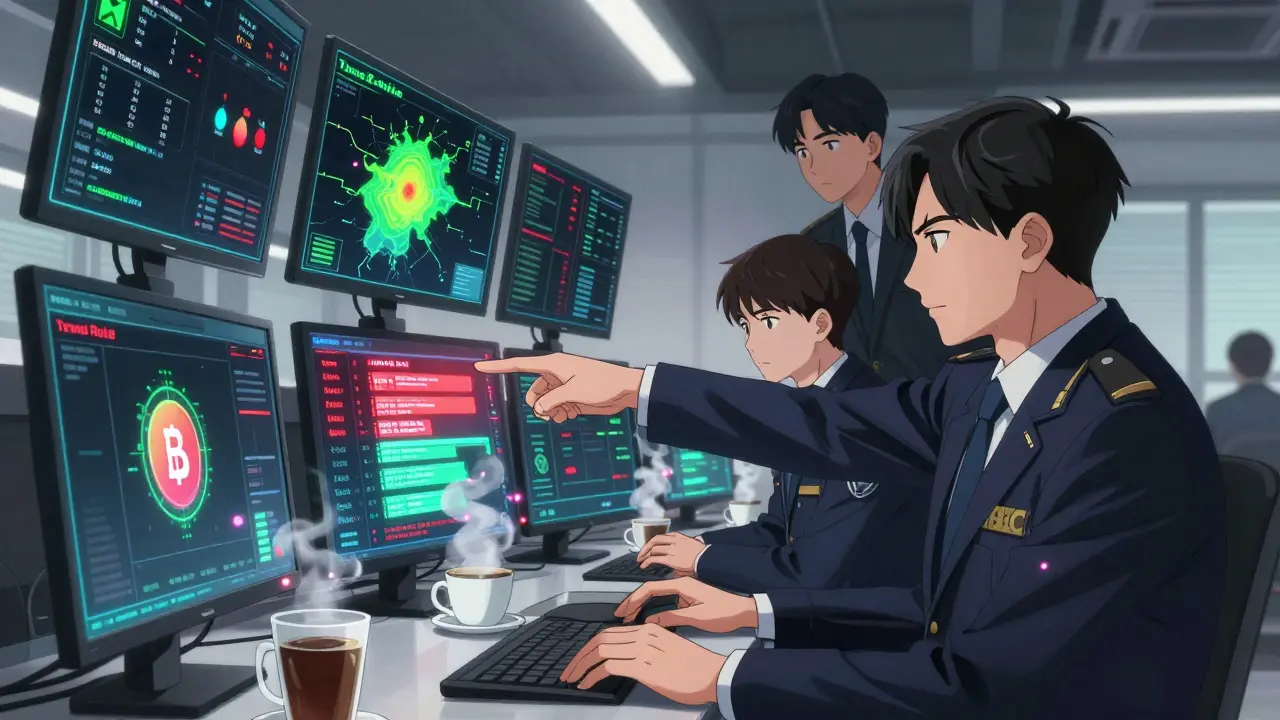
Corporate Crypto Is Finally Coming
For years, Korean companies couldn’t hold Bitcoin. Not even a single coin. The FSC banned corporate crypto holdings in 2017 over fears of financial instability. But in early 2025, that changed. The FSC’s Virtual Asset Task Force proposed a phased approach. Large corporations - think Samsung, Hyundai, LG - can now open KYC-verified accounts at licensed exchanges. They can buy crypto, but only up to a certain percentage of their treasury. They must report every transaction. And they can’t use it for speculation. It’s for treasury management, not gambling. This isn’t just about big tech. It’s about finance. Korean pension funds, insurance companies, and mutual funds are now being allowed to explore crypto as an asset class - but only through regulated channels. The goal? To stop companies from buying Bitcoin on shady overseas platforms and bring it all under the FSC’s watch.Spot Crypto ETFs Are Coming - Late 2025
One of the biggest shifts in 2025? The FSC approved spot cryptocurrency ETFs. Not futures. Not derivatives. Actual Bitcoin and Ethereum held in secure custody, tracked by indices like the Korea Digital Asset Index. These ETFs will trade on the Korea Exchange (KRX), just like stocks. Retail investors can buy them through their brokerage apps. Pension funds can allocate a small slice of their portfolio. And because the ETFs are regulated, the underlying assets must be stored in FSC-approved cold wallets. The fund managers must report net asset value in real time. And every audit is public. This is huge. It’s the same move the U.S. made with Bitcoin ETFs - but Korea’s version is even tighter. There’s no room for manipulation. No hidden fees. No unverified custodians. If you buy a Korean crypto ETF, you know exactly what you’re holding.NFTs and DeFi? Still in a Gray Zone
Not everything is clear. NFTs are treated case by case. If an NFT is just a digital art piece? No regulation. But if it’s sold as an investment - say, a tokenized real estate NFT that pays dividends - then it’s treated like a security. Same with DeFi protocols. If a platform lets you lend, borrow, or earn yield on crypto, and it’s targeting Korean users, the FSC says: “You’re a VASP. Register.” There’s no blanket ban on DeFi. But if you’re running a lending app from Seoul and Koreans are using it? You’re now under FSC supervision. No more anonymous smart contracts hiding behind offshore servers.
Taxes? Not Yet - But Coming
Right now, you don’t pay capital gains tax on crypto profits in South Korea. The government planned to start taxing gains in 2025, but they postponed it. Why? Because they’re still figuring out how to track it without crushing the market. The plan, when it comes, will allow losses to offset gains in the same year. So if you made $50,000 in Bitcoin and lost $30,000 in altcoins, you’d only pay tax on $20,000. But you’ll have to report everything. No more hiding trades on unregulated exchanges.Busan’s Secret Weapon: A Crypto Hub
While Seoul tightens rules, Busan is building something new. The Busan Digital Asset Nexus is a government-backed zone where companies can test Security Token Offerings (STOs) - real assets like stocks or bonds tokenized on blockchain. Foreign investors can participate, but only if they go through Korean KYC. This isn’t a loophole. It’s a controlled experiment. If it works, Jeju and Incheon will copy it. The goal? Make South Korea the Singapore of Asia for regulated digital assets - not by being lax, but by being smarter.Why This Matters Outside Korea
Most countries either ban crypto or ignore it. South Korea does neither. They built a system that’s strict, transparent, and scalable. They didn’t just regulate exchanges. They regulated the entire flow of money - from bank accounts to wallets to ETFs. That’s why global exchanges like Coinbase and Kraken had to redesign their Korean operations from the ground up. That’s why institutional investors are watching Korea closely. If the FSC’s 2025 laws pass, other countries will use them as a blueprint - not because they’re harsh, but because they work. This isn’t about control. It’s about credibility. South Korea proved you can have a thriving crypto market without letting it run wild. And now, they’re opening the door for pensions, corporations, and everyday people to join - safely.Are crypto exchanges legal in South Korea?
Yes, but only if they’re licensed by the Financial Services Commission (FSC). All exchanges must comply with real-name banking, KISA security certification, AML/KYC rules, and the FATF Travel Rule. Unlicensed exchanges are illegal and blocked from operating in Korea.
Can I trade crypto without using a Korean exchange?
You can, but it’s risky. If you use an overseas exchange like Binance or Coinbase to trade while living in Korea, you’re not breaking the law - but you’re not protected by Korean regulations either. You won’t have access to legal recourse if funds are stolen, and you’ll still be taxed if future rules apply. The FSC strongly encourages using only licensed Korean exchanges.
Do I need to pay taxes on crypto profits in South Korea in 2025?
Not yet. The planned 20% capital gains tax on crypto profits was postponed until further notice. However, the FSC is finalizing a tax framework that will likely require reporting all trades and allow losses to offset gains. Expect taxation to begin in 2026 or 2027, with retroactive reporting rules.
Can Korean companies own Bitcoin now?
Yes, but under strict limits. Since early 2025, large corporations can hold crypto in FSC-licensed exchange accounts, up to a percentage of their treasury reserves. They must report all transactions, and crypto cannot be used for speculative trading. This is designed for treasury diversification, not gambling.
What’s the difference between a spot ETF and a futures ETF in Korea?
A spot ETF holds actual Bitcoin or Ethereum in secure custody, and its value tracks the real market price. A futures ETF tracks price predictions based on contracts - not the actual asset. South Korea only approved spot ETFs in 2025 because they’re less risky and more transparent. Futures ETFs are still under review.
Are NFTs regulated in South Korea?
It depends. NFTs that function as investments - like fractionalized real estate or tokens that pay dividends - are treated as securities and fall under FSC rules. Purely collectible NFTs, like digital art or game items, are not regulated. The FSC evaluates each NFT based on its use case, not its format.
What happens if an exchange gets hacked in South Korea?
Exchanges are required to hold at least 90% of user funds in offline cold storage and maintain insurance coverage. If a hack occurs, the exchange must compensate users from its insurance fund. The FSC investigates the cause and may suspend or revoke the license if security failures are found. Users are protected - but only if they used a licensed exchange.
Can foreigners trade on Korean crypto exchanges?
Yes, but only if they complete full KYC verification through a Korean-licensed exchange. Foreigners must provide a valid passport, proof of address, and sometimes a Korean tax identification number. They’re subject to the same rules as Korean citizens, including the Travel Rule and real-name banking requirements.




Craig Nikonov
December 15, 2025 AT 16:12Kelsey Stephens
December 16, 2025 AT 07:17Florence Maail
December 17, 2025 AT 03:46Greg Knapp
December 17, 2025 AT 18:11Shruti Sinha
December 18, 2025 AT 02:13Cheyenne Cotter
December 18, 2025 AT 18:28Donna Goines
December 19, 2025 AT 11:24Madhavi Shyam
December 19, 2025 AT 18:14Timothy Slazyk
December 20, 2025 AT 11:52Emma Sherwood
December 20, 2025 AT 16:19SeTSUnA Kevin
December 22, 2025 AT 03:14Bradley Cassidy
December 22, 2025 AT 08:12Jesse Messiah
December 22, 2025 AT 12:19Heather Turnbow
December 24, 2025 AT 09:15Mark Cook
December 25, 2025 AT 23:31Patricia Amarante
December 26, 2025 AT 18:08Abby Daguindal
December 28, 2025 AT 06:05Jack Daniels
December 28, 2025 AT 21:32Tom Joyner
December 30, 2025 AT 12:28Jesse Messiah
December 30, 2025 AT 17:18