You see a token named MM Finance (Polygon) on your screen. It promises the stability of a decentralized exchange and the speed of the Polygon network. It sounds legitimate. It sounds safe. But before you connect your wallet, stop. In the world of crypto, names can be borrowed, but value cannot be faked. This review isn't about how to trade this asset; it’s about why you probably shouldn’t.
There is a critical confusion here that costs people money every day. There is a legitimate platform called MM Finance, which is a functional decentralized exchange (DEX) on Polygon. However, there is also a token tickered as MMF associated with this name that appears in market data trackers. The reality? They are not the same thing. The MM Finance platform operates without a native governance token. The MMF token listed on aggregators like CoinMarketCap is likely a copycat, a dead project, or an outright scam.
The Identity Crisis: Platform vs. Token
To understand the risk, we have to separate the tool from the ticket. MM Finance (the platform) is a real DeFi protocol. It allows users to swap tokens and provide liquidity on the Polygon blockchain. It has a website, a contract address, and daily volume. According to DappRadar data from late 2023, the legitimate platform processed roughly $15 million in daily volume. It updated its software regularly, releasing version 2.3.1 with concentrated liquidity features.
Now look at the token: MMF. Market data shows a circulating supply of zero. Yes, zero. A cryptocurrency with no coins in circulation cannot have a market cap. It cannot have a fair price. Yet, trackers list it with a price near $0.000006. How does a token with no supply trade? It doesn’t. Or rather, it trades in such negligible amounts that the data is effectively noise. This discrepancy is the first massive red flag. You are looking at a ghost.
Red Flags That Don’t Lie
If you are evaluating any crypto asset, you need a checklist. For MMF, almost every item fails. Let’s look at the hard data points that signal danger.
- Zero Circulating Supply: Crypto.com and Binance listings show a supply of 0. This contradicts the basic definition of a tradable asset. If there are no tokens, who are you buying from?
- Negligible Volume: Trading volume fluctuates between $0 and $29.80 in a 24-hour period. Compare this to legitimate Polygon projects. QuickSwap and SushiSwap handle millions in volume daily. MMF handles less than the cost of a cup of coffee.
- No Liquidity Pools: On-chain analysis via PolygonScan reveals no active liquidity pools for the contract address 0x22a31bD4cB694433B6de19e0aCC2899E553e9481. Without liquidity, you cannot sell what you buy. You are locked in.
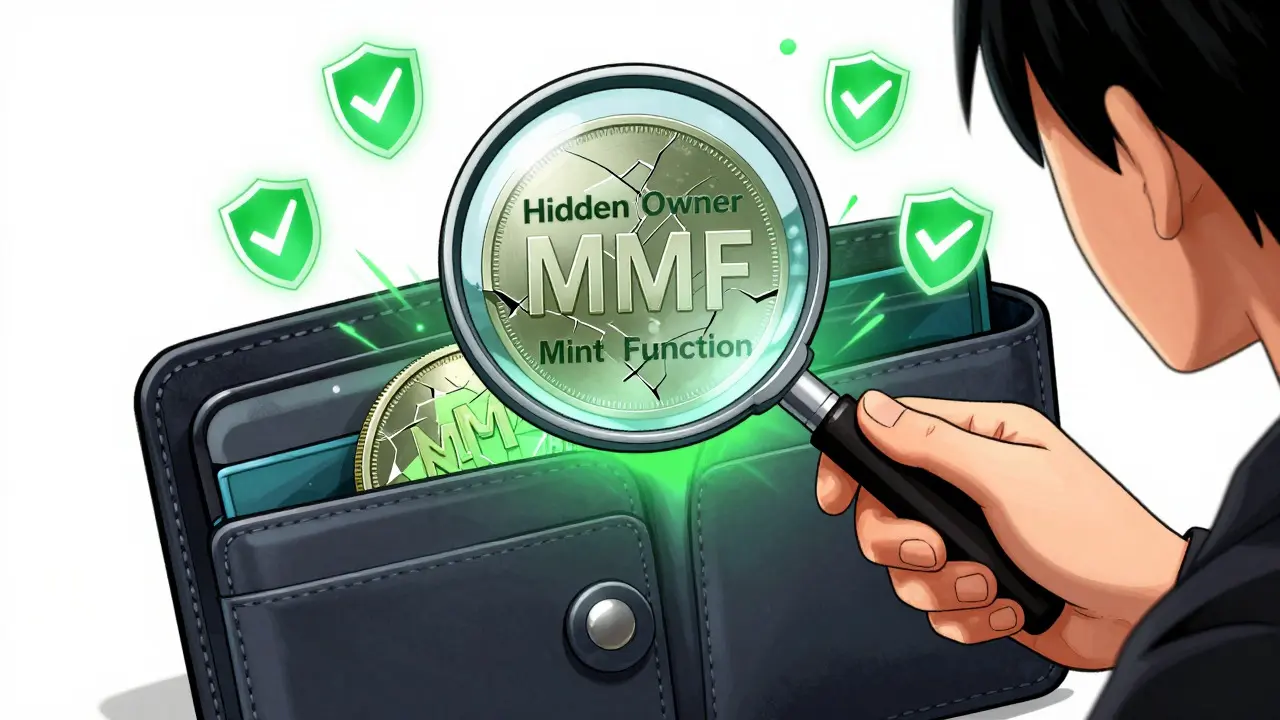
- Hidden Ownership: Security scanners like TokenSniffer gave MMF a safety score of 0 out of 10. The contract contains hidden ownership privileges and mint functions. This means the creator can print infinite tokens and drain the pool at any time.
These aren't minor issues. They are structural failures. A token with hidden ownership is a loaded gun pointed at your portfolio.
| Feature | Legitimate DEX (e.g., QuickSwap) | MM Finance (MMF Token) |
|---|---|---|
| Circulating Supply | Verifiable Millions/Billions | 0 (Data Error/Scam) |
| Market Cap | $100M+ Range | $0 |
| 24h Volume | $1M - $10M+ | $0 - $30 |
| Contract Security | Audited, Renounced Ownership | Unaudited, Hidden Owner |
| Developer Activity | Active GitHub Repositories | Zero Repositories |

The Silence of Experts
In the crypto industry, attention is currency. If a project is good, analysts talk about it. If it’s bad, they ignore it-or warn against it. Look at the coverage for major Polygon assets. Changelly, Token Metrics, and CoinGecko publish detailed reports on MATIC, Aave, and Uniswap. They discuss zkEVM advancements, partnerships with Meta, and institutional adoption.
Where is MMF? Nowhere. Professional crypto analysts do not mention it. It is absent from reputable industry reports. This silence is deafening. When a token drops 97% in a year and has zero developer activity on GitHub, experts move on. The absence of MMF from professional portfolios confirms its status as non-viable. You don’t invest in what nobody watches.
User Sentiment and Community Warnings
Data tells one story; community feedback tells another. On Reddit, specifically in r/CryptoCurrency, users have flagged tokens mimicking legitimate names. One user noted, "Tokens with circulating supply of 0 are either scams or dead projects." This is a common pattern. Scammers register a domain similar to a popular DEX, create a token with the same name, and hope beginners will confuse the two.
Trustpilot has no verified reviews for MM Finance as a token issuer. Scam warning platforms rate it poorly due to liquidity risks. Meanwhile, the legitimate MM Finance DEX continues to operate quietly, updating its platform without issuing a token. This separation is key. The platform works; the token is a parasite.
How to Protect Your Wallet
If you encounter MMF or similar low-cap, zero-supply tokens, follow these steps to stay safe:
- Check the Contract Address: Never trust the name alone. Copy the contract address from a trusted source (like the official project site) and paste it into Etherscan or PolygonScan. Verify the holder count. If it’s near zero, walk away.
- Verify Liquidity: Go to a DEX like Uniswap or SushiSwap. Search for the pair. If the pool size is tiny (under $10k), slippage will eat your investment, or you won’t be able to sell at all.
- Use Security Tools: Run the contract through TokenSniffer or GoPlus Security. Look for terms like "mint function," "blacklist," or "hidden owner." If any are present, assume it’s a rug pull waiting to happen.
- Distinguish Platform from Token: Ask yourself: Does this DEX actually use a token for fees or governance? If the answer is no, but a token exists with the same name, it’s likely a copycat.
The Verdict: Avoid MMF
Is MM Finance (Polygon) a good investment? No. Is it even a functional asset? Barely. The evidence points to a token that is either abandoned or malicious. With a 0/10 safety score, zero circulating supply, and no developer activity, MMF offers nothing but risk. The legitimate MM Finance DEX is a fine tool for swapping on Polygon, but it does not issue MMF. Do not let the name fool you.
Stick to established protocols with transparent teams, audited contracts, and real liquidity. In crypto, if something looks too obscure to be true, it usually is. Keep your funds in wallets you control, and never buy a token because the name sounds familiar. Familiarity is not a feature; it’s often a trap.
Is MM Finance (Polygon) a scam?
The MMF token associated with MM Finance on Polygon exhibits strong signs of being a scam or a dead project. It has a reported circulating supply of zero, negligible trading volume, and a 0/10 safety rating on security scanners due to hidden ownership functions. While the MM Finance DEX platform itself is legitimate, the MMF token is not part of its official ecosystem.
Does MM Finance have a native token?
No, the legitimate MM Finance decentralized exchange operates without a native governance or utility token. Any token tickered as MMF found on market aggregators is likely an unrelated, unofficial, or fraudulent asset mimicking the brand name.
What is the contract address for MMF on Polygon?
The contract address often cited for MMF is 0x22a31bD4cB694433B6de19e0aCC2899E553e9481. However, on-chain analysis shows no significant activity or liquidity pools for this address, confirming its lack of viability as a tradable asset.
Why is the market cap of MMF listed as $0?
Market cap is calculated by multiplying the current price by the circulating supply. Since multiple data sources report the circulating supply of MMF as 0, the mathematical result for market capitalization is $0. This indicates the token is not actively traded or distributed.
Can I trade MMF on major exchanges?
MMF is not listed on major centralized exchanges like Coinbase or Kraken. It may appear on obscure decentralized exchanges or data aggregators, but with virtually no liquidity, executing a trade is nearly impossible without severe slippage or total loss.