
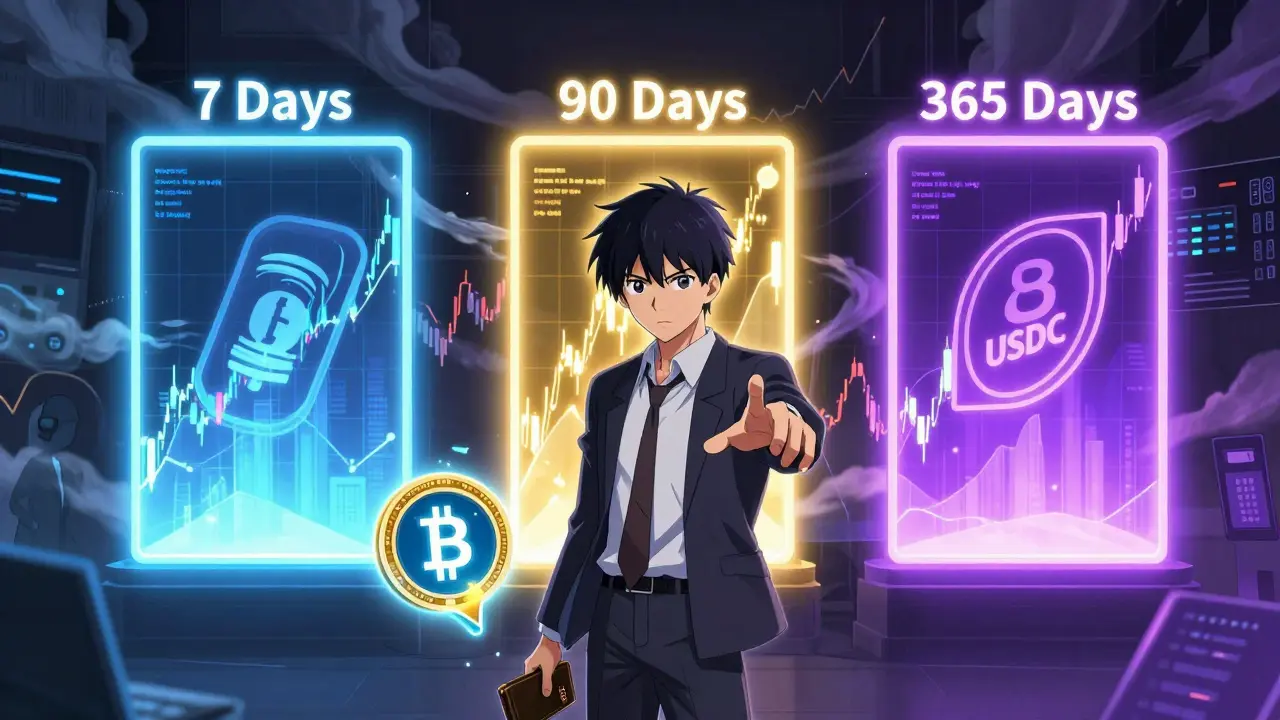
When you stake your crypto in a liquidity pool, you’re not just earning rewards-you’re making a time commitment. Liquidity mining isn’t a quick cash grab. The length of your lock-up, whether it’s 7 days or 365, directly affects how much you earn, how safe your assets are, and even how much say you have in the protocol’s future. Most beginners jump in for the high APYs without realizing what they’re signing up for. That’s where things go wrong.
What Liquidity Mining Actually Is
Liquidity mining means you deposit two tokens-like ETH and USDC-into a decentralized exchange (DEX) pool. That pool lets traders swap between those tokens. In return, you earn a share of trading fees and extra tokens from the protocol. It sounds simple, but the real game is in the timing.Early DeFi platforms like Uniswap let you pull your money out anytime. That freedom came at a cost: liquidity kept draining out when prices moved. Traders would pull their funds during dips, then rush back in when things rose. The pools became unstable. Protocols realized they needed people to stay longer.
Why Lock-Ups Exist
Lock-ups aren’t about locking you in-they’re about locking in stability. When a protocol knows your funds will stay for 30, 90, or 365 days, it can plan better. Trading volume stays steady. Prices don’t swing wildly from panic withdrawals. And the protocol can afford to pay you more.Think of it like a bank CD. You lock your money for a year and get a higher interest rate. Same idea. The longer you commit, the more the protocol rewards you. Why? Because long-term liquidity is valuable. It reduces risk for everyone using the platform.
Types of Duration Models
There are three main ways protocols handle time:- Flexible pools: No lock-up. You can withdraw anytime. Rewards are lower-usually under 10% APY. These are good for testing or if you need cash flow.
- Time-weighted rewards: Your reward rate increases the longer you stay. For example, 1x after 7 days, 2x after 30 days, 3x after 90 days. This is common on SushiSwap and Curve.
- Fixed-term pools: You pick a duration upfront-14 days, 6 months, 1 year. You can’t touch your funds until it’s over. These often offer 30% to 100%+ APY, but only if you stay the full term.
Some platforms, like Curve Finance, combine lock-ups with governance. The longer you lock your CRV tokens, the more voting power you get. This turns liquidity providers into stakeholders, not just passive earners.

How Lock-Ups Affect Your Earnings
Let’s say you put $10,000 into a pool with a 50% APY. If you leave it for 30 days, you earn $410. If you lock it for 90 days and get a 3x boost, you earn $3,750. That’s almost 10x more. But here’s the catch: you’re exposed to price changes for 90 days.Impermanent loss is the silent killer. If one token in your pair drops 30% while the other stays flat, you lose value compared to just holding. Lock-ups don’t prevent this-they just force you to ride it out. Some newer protocols now offer partial impermanent loss protection after 60 days, but that’s still rare.
Gas fees matter too. On Ethereum, withdrawing and re-depositing every week can cost $50-$100 in fees. That eats into small rewards. On networks like Binance Smart Chain or Polygon, fees are under $1, so short-term strategies are more viable.
Risks You Can’t Ignore
Lock-ups aren’t risk-free. The biggest danger? Smart contract bugs. If the code has a flaw and your funds get drained, you can’t pull out early to escape. In 2022, a popular DeFi protocol lost $40 million due to a reentrancy bug. Users locked in for 180 days lost everything.Protocol changes are another silent threat. A governance vote could cut rewards in half, change the token distribution, or even pause withdrawals. If you’re locked in, you have zero control. That’s why some users only lock into protocols with proven track records-like Curve, Aave, or Uniswap v3.
Regulation is also looming. If a government decides your locked-up tokens are securities, you could face tax penalties or legal exposure. Lock-ups make it harder to move assets quickly if things turn sour.

veTokenomics: The New Standard
The biggest shift in liquidity mining happened with veTokenomics-short for “vote-escrowed tokens.” Curve started it. You lock CRV for up to four years. The longer you lock, the more voting power you get. You also earn a share of protocol fees and boosted rewards.Now, almost every major DeFi project has copied it: Convex, Frax Finance, Lido, and even newer chains like Arbitrum and Optimism. It’s not just about earning-it’s about owning a piece of the system. Locking your tokens becomes an investment in the protocol’s future.
Some platforms now offer “boosts” of up to 5x. If you lock for 365 days, your rewards multiply. But that means you’re betting the protocol will still be around-and thriving-in a year.
What Should You Do?
There’s no one-size-fits-all answer. But here’s how to decide:- If you’re new: Start with 7- to 14-day pools. Test the waters. Learn how rewards change with price swings.
- If you’re comfortable: Try 30- to 90-day time-weighted pools. You’ll earn 2-3x more than flexible options.
- If you’re serious: Lock for 180+ days on established protocols. You’ll get the highest yields and governance power. But only if you trust the team and the code.
Avoid anything promising 200%+ APY with no lock-up. That’s usually a sign of a dying token or a rug pull. Real long-term value doesn’t come from hype-it comes from sustainable incentives.
Future Trends
The next wave of liquidity mining will focus on flexibility within commitment. Imagine locking your ETH for 6 months, but being able to trade your locked position on a secondary market. Or using your locked tokens as collateral for loans without unlocking them.Some projects are already testing “partial unlock” features. You can withdraw 20% of your stake early, but lose 50% of your rewards. It’s a compromise between freedom and reward.
As DeFi matures, liquidity mining will look less like gambling and more like structured investing. The days of chasing 500% APYs are fading. The winners will be those who understand time as a currency-and use it wisely.
What happens if I withdraw early from a locked liquidity pool?
If you withdraw before the lock-up ends, you’ll typically lose all or most of your earned rewards. Some protocols let you withdraw your original deposit, but you forfeit the bonus multipliers. Others may charge a penalty fee. Always check the contract terms before locking.
Are longer lock-ups always better?
Not always. Longer lock-ups offer higher rewards, but they also increase your exposure to impermanent loss, smart contract risk, and protocol changes. If you need access to your funds or are unsure about the project’s longevity, shorter terms are safer. The best strategy balances reward potential with risk tolerance.
Can I lose money even if the token price goes up?
Yes. If you’re in a token pair and one token drops significantly while the other rises, you can experience impermanent loss. Even if the overall value of your assets increases, you might still earn less than if you had just held the tokens outside the pool. Lock-ups don’t eliminate this-they just make you hold through the volatility.
Do all DeFi protocols use lock-ups?
No. Early platforms like Uniswap V2 had no lock-ups. But most newer protocols now use some form of time-based incentive. Lock-ups are becoming standard because they improve liquidity stability and align user incentives with long-term protocol health.
How do I know if a lock-up is safe?
Check three things: 1) Has the protocol been audited by a reputable firm like CertiK or OpenZeppelin? 2) Is the team transparent and do they have a track record? 3) Is the tokenomics sustainable? Avoid projects where over 80% of the supply is allocated to liquidity mining-it’s often a sign of a short-term pump.






Jason Zhang
January 16, 2026 AT 10:02Look, I get the whole 'time is money' thing, but locking up my ETH for a year just to get 5x rewards? Nah. I’d rather take the 15% APY and flip that cash into a new memecoin before breakfast. Lazy? Maybe. Smart? Definitely.
Also, who the hell still uses Ethereum for this? Gas fees alone could buy me a decent burrito.
Not even mad, just bored.
Katherine Melgarejo
January 17, 2026 AT 11:15So you’re telling me I have to *wait* for my crypto to make me money? Like, actually sit on it? For months? Bro. I thought this was the whole point of crypto - no rules, no waiting, just go brrrr and cash out before your ex texts you.
Also, ‘impermanent loss’ sounds like a bad breakup. And I’m not emotionally ready for that again.
Patricia Chakeres
January 18, 2026 AT 21:45veTokenomics? Please. This is just Wall Street’s way of turning DeFi into a Ponzi with a fancy name. They want you to lock your tokens so they can manipulate the voting power, then quietly dump their bags while you’re ‘committed.’
Remember when they said ‘decentralized’? Yeah, that was a lie. It’s just corporate governance with a blockchain tattoo.
And don’t get me started on how the same 12 wallets control 80% of the votes. This isn’t finance - it’s feudalism with gas fees.
Jill McCollum
January 19, 2026 AT 20:16ok so i just tried a 7-day pool and got 8% apy?? like wow?? 🤯
then i checked the gas fee to withdraw and it was $47 😭
so i just left it there and now i’m like… is this even worth it??
also why do all the guides say ‘do your own research’ but none of them tell you how to actually do it??
help?? 🙏
Hailey Bug
January 21, 2026 AT 05:42Lock-ups aren’t about trapping you - they’re about aligning incentives. If you’re in a pool with a 30-day lock and you’re worried about impermanent loss, you’re not ready for DeFi. Start with stablecoin pairs. USDC/DAI. Low volatility. Low risk. High sanity.
Also, always check the audit reports. Not just ‘CertiK audited’ - read the actual findings. Most people skip this and wonder why their funds vanished.
And no, ‘high APY’ is not a strategy. It’s a red flag.
Josh V
January 22, 2026 AT 06:11Just lock it for 90 days and chill
you want to make money not play chess with your portfolio
the math is simple longer time higher reward
gas on polygon is 10 cents
stop overthinking
just do it
Stephen Gaskell
January 23, 2026 AT 19:07Lock-ups are a scam designed by crypto bros to make Americans think they’re investing. Real investors buy land. Real investors buy gold. You’re gambling with code written by teenagers in a basement.
And don’t tell me about ‘decentralization.’ The SEC is already drafting rules. When they shut this down, you’ll be the one begging for your money back.
Wake up.
CHISOM UCHE
January 25, 2026 AT 16:41From a Nigerian DeFi participant perspective - lock-ups are a double-edged sword. On one hand, they provide yield stability in a hyperinflationary economy. On the other, if the protocol collapses, you’re locked out of your savings while your naira devalues by 20% in a week.
That said, veCRV on Curve has been the most reliable thing I’ve touched in crypto. Even my cousin in Lagos is staking now.
But always - always - check the treasury. If the treasury is under 5% of circulating supply, run.
Sarah Baker
January 26, 2026 AT 09:03You’ve got this. Seriously. Even if you only lock for 14 days, you’re already ahead of 90% of people who just HODL and never interact with DeFi.
Every time you stake, you’re learning. Every time you check your rewards, you’re building financial muscle.
It’s okay to start small. It’s okay to be scared. But don’t let fear stop you from showing up.
You’re not behind - you’re just getting started. And that’s beautiful.
Keep going. 💪
Liza Tait-Bailey
January 26, 2026 AT 15:14so i locked my usdc for 30 days and got like 12% apy
then i saw a tweet saying the devs were gonna change the reward schedule
so i panicked and checked the contract
turns out it was just a scam account
but now i’m paranoid every time i see a new update
anyone else feel like this??
also why does crypto make me feel like i’m in a thriller movie?? 🤭
Chris O'Carroll
January 27, 2026 AT 21:43They said ‘liquidity mining’ but what they really meant was ‘emotional rollercoaster with extra steps.’
One day you’re a crypto wizard, next day you’re crying over impermanent loss like it’s your ex’s last text.
And don’t even get me started on the ‘community governance’ - turns out the only votes that matter are the ones from whales who locked 10 million tokens.
It’s not DeFi. It’s a reality show where the prize is more volatility.
Andre Suico
January 28, 2026 AT 10:59The post provides a thorough and accurate overview of liquidity mining mechanics. The distinction between flexible, time-weighted, and fixed-term pools is correctly delineated. However, the discussion of regulatory risk is underdeveloped. In jurisdictions like the U.S., locked tokens may be classified as unregistered securities under the Howey Test, particularly if the protocol offers profit-sharing mechanisms tied to governance rights. Legal exposure is non-trivial. Users should consult tax and securities counsel before engaging in long-term lock-ups, especially with veToken models. Caution is advised.
Chidimma Okafor
January 30, 2026 AT 09:28Dear fellow crypto enthusiasts, I must express my heartfelt appreciation for this meticulously crafted exposition on liquidity mining and lock-up structures. The alignment of economic incentives through time-based commitment is not merely a technical innovation - it is a philosophical triumph of collective responsibility over speculative frenzy.
As a Nigerian participant in the global DeFi ecosystem, I can attest that these mechanisms provide a rare beacon of stability in an otherwise turbulent financial landscape.
May we all proceed with wisdom, humility, and unwavering integrity.
Bill Sloan
January 31, 2026 AT 16:23Guys I just locked 5k in a 180-day pool and got 78% APY 😍
AND I’M NOT EVEN SCARED
because i checked the audit
and the team has been around since 2021
and the treasury is healthy
and the community is active
and the code is clean
and i even DM’d the dev and he replied in 10 mins
you think i’m dumb? i’m not dumb
you think this is gambling? no it’s STRATEGY
you think i’m gonna pull out early? no way
im in for the long haul
who’s with me?? 🚀
ASHISH SINGH
February 2, 2026 AT 16:15Lock-ups are just the latest illusion to make you feel like you’re building something while you’re actually feeding the machine.
They tell you ‘time is currency’ - but who prints the money? The devs.
Who controls the votes? The insiders.
Who gets the real profits? The ones who bought in at $0.01.
You’re not a stakeholder - you’re a renter in someone else’s casino.
And the house always wins.
Even when you win, you’re still losing.
Vinod Dalavai
February 3, 2026 AT 15:12Start small. 7 days. USDC/ETH. See how you feel.
Then go 30. Then 90.
Don’t rush to 365 like it’s a race.
DeFi is a marathon, not a sprint.
And if you’re not sleeping well because you’re checking your wallet every hour - you’re doing it wrong.
It’s okay to take breaks.
It’s okay to walk away.
It’s okay to just hold BTC and chill.
You’re not failing. You’re learning.
Callan Burdett
February 4, 2026 AT 20:39Imagine locking your money for a year… just to earn 60% APY.
Meanwhile, my cousin in Melbourne just bought a Tesla with his ‘quick flip’ profits.
Who’s the real genius here?
Not me. Not him.
But definitely not the protocol that made us both think we were investing.
It’s not finance - it’s performance art.
Nishakar Rath
February 6, 2026 AT 05:07Lock-ups are a trap for the gullible and a gift for the insiders
They want you to think you’re part of the system
But the system was built to extract your liquidity and sell it back to you at a premium
And when you finally realize it
your tokens are locked
your rewards are gone
and the dev team has vanished with a new name and a new website
don’t be the last one holding the bag
kristina tina
February 6, 2026 AT 10:30I locked my first $2k in a 30-day pool and cried when I saw the reward - like, actual tears.
It wasn’t just the money.
It was the feeling that for once, I didn’t FOMO into something dumb.
I did my research.
I waited.
I committed.
And it paid off.
Not because I’m smart - because I didn’t panic.
If you’re reading this and you’re scared - I was too.
But you can do this.
I believe in you.
And I’m rooting for you.
Always.
Lauren Bontje
February 6, 2026 AT 18:05Lock-ups are just the latest scam to make retail investors think they’re ‘part of the movement.’
Meanwhile, the same people who created these protocols are dumping their tokens on the first day of launch.
They call it ‘liquidity mining’ - it’s just a pump-and-dump with a whitepaper.
And you’re the sucker who’s waiting for your ‘boosted rewards’ while they’re already on their third yacht.
Wake up. This isn’t innovation. It’s theft with a blockchain.
Stephanie BASILIEN
February 8, 2026 AT 09:11While the post provides a commendable structural overview of liquidity mining mechanisms, one must consider the epistemological implications of time-based token commitment. The veToken model, in particular, introduces a paradox: the more one commits to the protocol’s temporal architecture, the more one surrenders autonomy to its governance, which is, in practice, oligarchic. One must therefore question whether the ‘stakeholder’ identity is a liberation or a reconfiguration of subjugation under algorithmic feudalism. The illusion of decentralization persists - not through code, but through narrative.
Deb Svanefelt
February 9, 2026 AT 23:34I’ve been in DeFi since 2020. I’ve lost money. I’ve made money. I’ve cried. I’ve celebrated.
But the one thing I’ve learned is this: the best investments aren’t the ones with the highest APY - they’re the ones where you can sleep at night.
Lock-ups aren’t about maximizing returns. They’re about aligning your values with your actions.
If you believe in the project, lock it.
If you don’t, walk away.
Don’t chase yields. Chase conviction.
And always, always - ask yourself: would I still do this if the price dropped 80% tomorrow?
If the answer isn’t yes - you’re not ready.