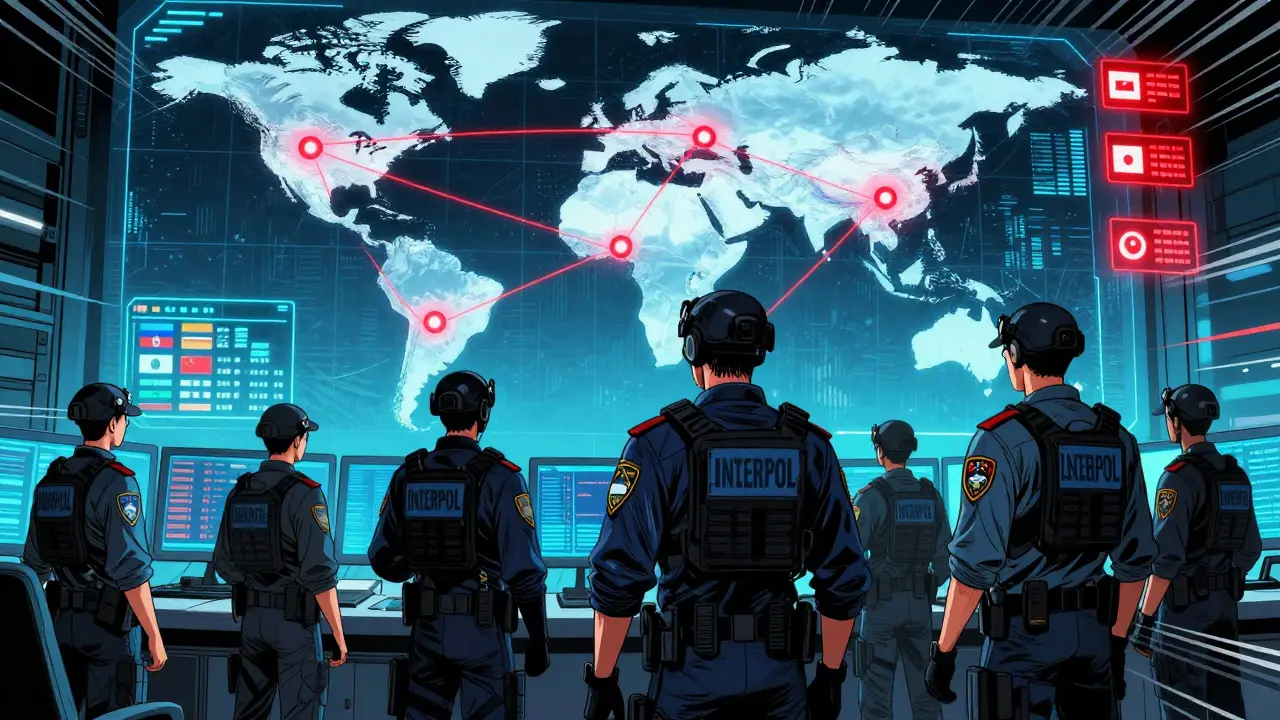
Money stolen by hackers doesn't care about borders. If you lose funds to a scammer in one country, the money might be sitting in a wallet registered in another, laundered through a third. For years, this reality made crypto crime feel like a game where the criminals always had the home-field advantage. But that dynamic is shifting fast.
In 2025 and early 2026, we’ve seen a dramatic pivot from isolated national efforts to massive, synchronized global strikes. Agencies like INTERPOL, working alongside private sector giants such as Chainalysis and TRM Labs, are dismantling networks that once seemed untouchable. The question isn’t whether international cooperation works anymore-it’s how quickly it can keep up with evolving criminal tactics.
The Shift from Local Limits to Global Strikes
For a long time, law enforcement was stuck in a frustrating loop. A victim in Germany would report a fraud, but the suspect operated out of Côte d'Ivoire. Without a unified framework, the German police had limited power, and the Ivorian authorities lacked the resources or incentive to chase a case that didn't directly impact their local economy. This jurisdictional gap was the lifeblood of cybercriminals.
That changed with the formalization of frameworks like the Global Financial Crime Programme, established by INTERPOL in 2014. By 2025, this program evolved into something much more aggressive. Sean Doyle, Lead of the Cybercrime Atlas Initiative at the World Economic Forum, notes that each coordinated operation builds on the last, deepening information sharing across member countries. It’s no longer about asking for help; it’s about executing simultaneous raids.
Take Operation Serengeti 2025. Launched in August 2025, this wasn't just a single country's effort. Authorities in Angola dismantled 25 cryptocurrency mining centers while simultaneously taking down a massive investment scam based in Zambia. That Zambian scheme had defrauded at least 65,000 victims of an estimated $300 million. The arrests happened across Africa, Europe, and Asia all at once. Criminals couldn't warn each other because the net closed everywhere simultaneously.
How Real-Time Coordination Works
Speed is the most critical factor in crypto crime recovery. Once funds hit the blockchain, they move fast. To counter this, agencies now use tools like I-GRIP (Global Rapid Intervention of Payments). Launched in 2022, I-GRIP acts as a stop-payment mechanism that allows financial intelligence units to communicate in real-time across borders.
Imagine a scenario: A steel company in South Korea detects forged shipping documents and realizes they’ve been scammed. They send KRW 6.6 billion (about USD 3.91 million) to an illegitimate bank account in Dubai. In the past, recovering this would take months of diplomatic requests. Today, the Korean National Police Agency uses I-GRIP to alert Emirati authorities instantly. The result? The funds were recovered. This kind of speed turns the tide against scams that rely on quick disappearances.
This technical architecture relies heavily on blockchain analytics. Tools provided by firms like Elliptic and Chainalysis allow investigators to trace transactions across multiple networks. According to Chainalysis data from 2025, illicit entities hold nearly $15 billion, with stolen funds making up the largest category. Downstream wallets holding these illicit funds contain over $60 billion. Tracing that money requires identifying patterns, not just looking at individual addresses.
Record-Breaking Recoveries: Operation HAECHI VI
If there’s one metric that proves international cooperation works, it’s the recovery rate. Operation HAECHI VI, which ran from April to August 2025, set a new benchmark. Targeting seven types of cyber-enabled financial crimes-including voice phishing and romance scams-the operation involved 40 countries.
The results were staggering. Authorities recovered USD 439 million. Theos Badege, Director pro tempore of INTERPOL’s Financial Crime and Anti-Corruption Centre, pointed out that these outcomes prove recovery is possible despite the common belief that "funds lost to fraud are often irretrievable." Compared to standalone national operations in 2024, HAECHI VI achieved a 78% higher recovery rate. Lee Jun Hyeong, Head of Korea's INTERPOL National Central Bureau, called it proof of the "power of unified global action."
What made HAECHI VI different? It wasn't just bigger; it was smarter. It combined traditional law enforcement with advanced private-sector insights. INTERPOL partnered with experts who understand the nuances of decentralized finance (DeFi) and cross-chain bridges. This partnership allowed them to track funds that previously vanished into the fog of anonymous swaps.
| Feature | National Operations (Pre-2024) | International Cooperation (2025-2026) |
|---|---|---|
| Coordination Speed | Weeks to months for cross-border requests | Real-time via systems like I-GRIP |
| Recovery Rate | Low (<10% average) | High (78% increase in major ops like HAECHI VI) |
| Jurisdictional Reach | Limited to domestic laws | Simultaneous multi-country execution |
| Technical Resources | Varied, often outdated | Standardized access to top-tier blockchain analytics |
| Criminal Response | Minimal disruption | Network dismantling and asset freezing |
The Growing Threat: Cross-Chain Laundering
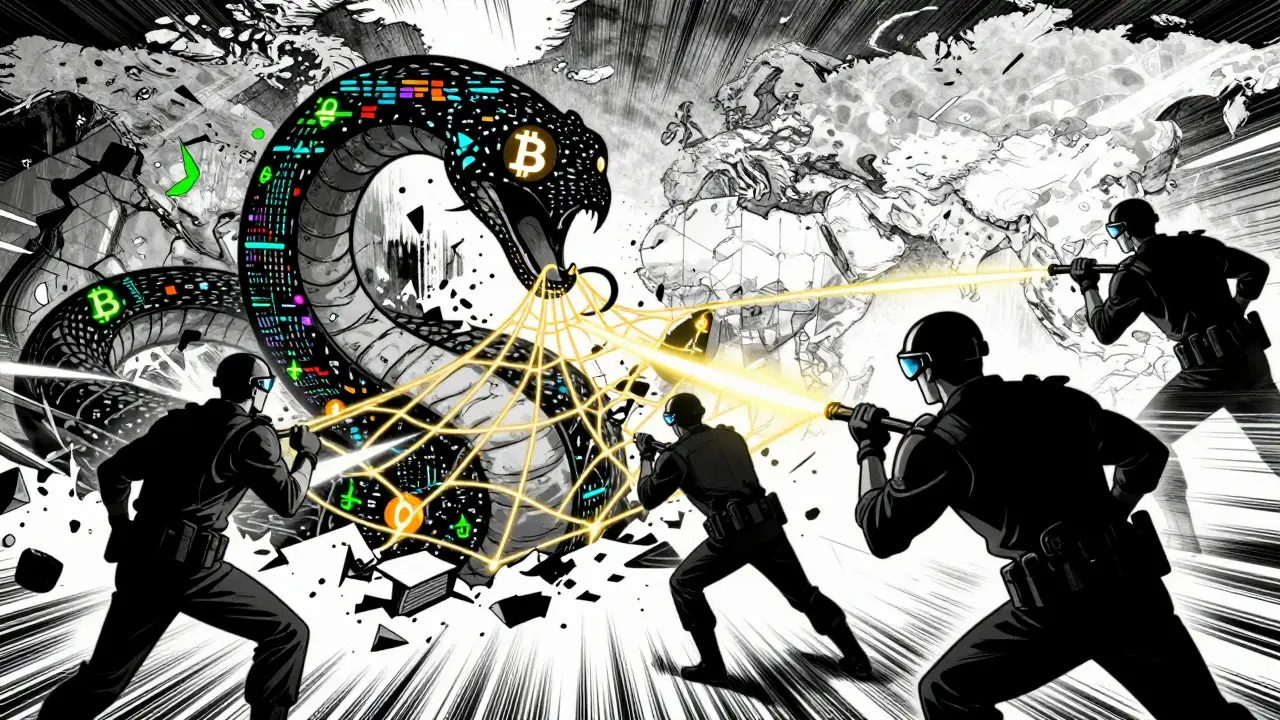
Criminals aren't standing still. As enforcement tightens, so do their methods. The biggest challenge facing international agencies today is cross-chain laundering. In the past, tracking Bitcoin was relatively straightforward. Now, illicit actors move funds between Ethereum, Solana, Tron, and dozens of other chains using decentralized exchanges (DEXs), bridges, and no-KYC coin swap services.
Elliptic’s 2025 research identified more than $21.8 billion in illicit and high-risk crypto laundered using cross-chain methods. This is a mainstream method for obscuring origins. When funds jump from one blockchain to another, the trail breaks. Investigators used to spend hours manually tracing these hops. Now, they need automated cross-chain tracing capabilities.
TRM Labs’ 2025 Crypto Crime Report highlights that sanctioned entities, terrorist organizations, and ransomware groups have shifted tactics in response to global crackdowns. They are embracing new technologies to obscure activities. For example, direct transfers from illicit entities to regulated exchanges collapsed from roughly 40% in 2021-2022 to around 15% in Q2 2025. Why? Because criminals know exchanges will freeze those accounts. Instead, they use complex routing through mixers and privacy coins before cashing out.
Regional Approaches: US vs. Europe vs. Global
While INTERPOL provides the backbone for global coordination, regional bodies play distinct roles. The United States Department of Justice (DOJ) focuses heavily on criminal prosecutions. In October 2024, the DOJ charged 17 individuals in Massachusetts for using bots to manipulate altcoin and meme coin volumes. This approach targets the infrastructure of market manipulation.
In contrast, the European approach, led by Europol, emphasizes broader societal impacts. Their August 2025 conference highlighted issues ranging from crypto-enabled money laundering to the online recruitment of minors. The EU tends to integrate crypto enforcement into wider digital safety nets.
The INTERPOL model, however, excels in scale. It connects 195 member countries. During Operation Serengeti, this network allowed for arrests in places like Côte d'Ivoire for crimes originating in Germany. No single region could have managed that complexity alone. The weakness remains in the speed of asset recovery for smaller, decentralized crimes where attribution is difficult, but for large-scale syndicates, the global model is unmatched.

The Human Element: Training and Skills
Technology alone doesn't solve crypto crime. You need people who understand both law and code. There’s a significant learning curve. Effective cross-border investigations now require specialized training. INTERPOL reported that officers participating in Operation Serengeti underwent 120 hours of specialized training in cryptocurrency tracing techniques.
By 2025, 87% of INTERPOL member countries reported having dedicated cryptocurrency investigation units, up from 62% in 2022. These units don't just look at IP addresses; they analyze smart contract interactions, identify threat actors through behavioral patterns, and understand the legal frameworks for asset repatriation.
This shift means that "cybercrime" is no longer just an IT issue. It’s a financial crime issue requiring forensic accounting skills mixed with blockchain expertise. The collaboration between public agencies and private firms like Chainalysis and TRM Labs has accelerated this skill transfer, providing law enforcement with actionable methodologies rather than raw data dumps.
What’s Next for Crypto Enforcement?
The trajectory is clear: integration. Blockchain analytics are becoming standard workflow tools for law enforcement, not special requests. Elliptic was the first to release holistic cross-chain screening capabilities, and competitors are following suit. The goal is to reduce manual investigation time from hours to minutes.
However, challenges remain. Fragmentation in the crypto ecosystem continues to offer hiding spots. Market-based services, like peer-to-peer exchanges, operate longer than illicit entities, making them harder to shut down permanently. Furthermore, state-sponsored actors and terrorist organizations are increasingly using cryptocurrencies, adding a geopolitical layer to what was once purely financial crime.
As we move through 2026, the expectation is that regulatory bodies, law enforcement, and the private sector will continue to adapt. The fight is proactive now. Agencies aren't waiting for victims to report losses; they’re monitoring known illicit clusters and pre-positioning resources. The era of "untraceable" crypto is ending, replaced by a transparent, albeit complex, ledger that global cooperation is learning to read fluently.
Can my stolen crypto actually be recovered?
Yes, recovery is increasingly possible. Operations like HAECHI VI demonstrated that international cooperation can recover hundreds of millions of dollars. However, success depends on speed. Reporting immediately allows agencies to use stop-payment mechanisms like I-GRIP before funds are laundered across multiple chains.
What is Operation Serengeti?
Operation Serengeti 2025 was a major INTERPOL-coordinated campaign launched in August 2025. It targeted cryptocurrency mining centers and investment scams across Africa, Europe, and Asia, resulting in the dismantling of schemes that defrauded tens of thousands of victims of hundreds of millions of dollars.
Why is cross-chain laundering a problem?
Cross-chain laundering involves moving funds between different blockchains (e.g., from Bitcoin to Ethereum) using bridges and decentralized exchanges. This breaks the direct transaction trail, making it harder for investigators to link illicit funds to specific wallets or identities without advanced automated tracing tools.
Who leads international crypto crime enforcement?
INTERPOL serves as the central coordinating body, connecting 195 member countries. They work closely with private sector partners like Chainalysis, Elliptic, and TRM Labs for technical blockchain analysis, and regional bodies like Europol and national agencies like the US DOJ for specific operational executions.
How does I-GRIP help in crypto crime cases?
I-GRIP (Global Rapid Intervention of Payments) is a system launched by INTERPOL in 2022 that enables real-time communication between financial intelligence units. It allows for immediate alerts and stop-payment actions across borders, crucial for intercepting funds before they are fully laundered or withdrawn.