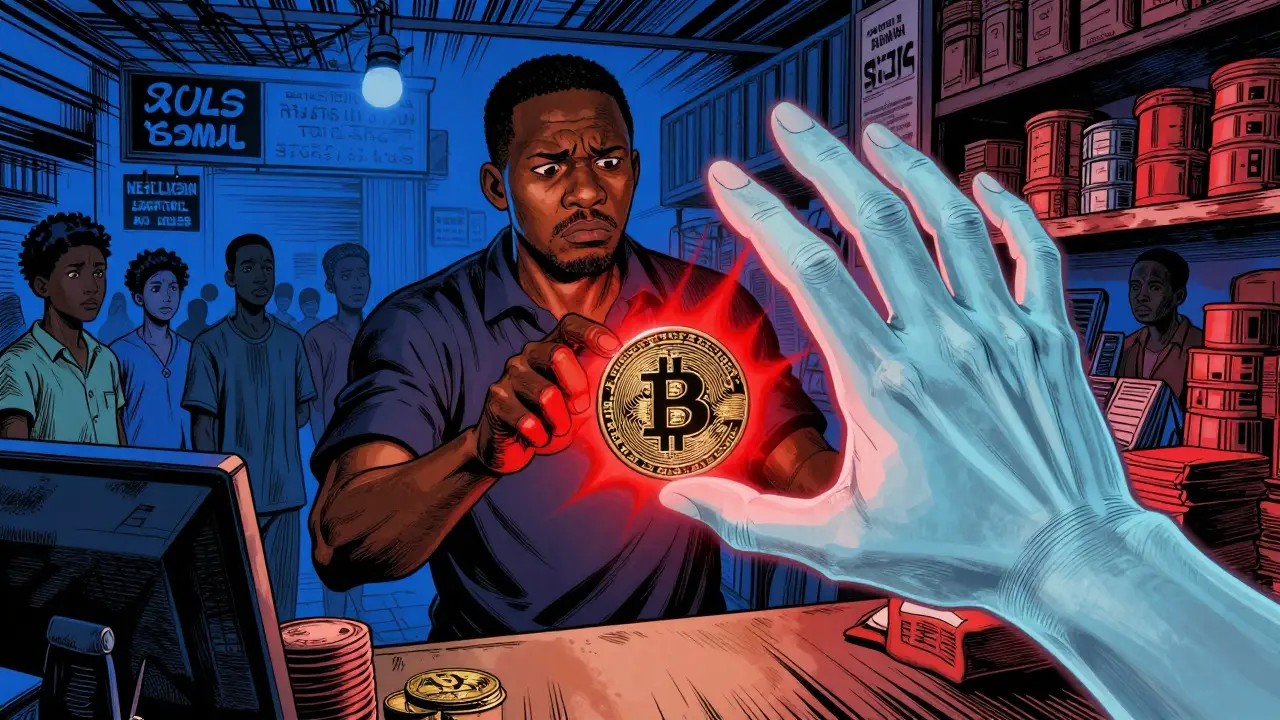
Running a business in Nigeria and wanting to accept Bitcoin or USDT as payment? The short answer is: not directly. If you are a regular shop owner, freelancer, or e-commerce store operator, you cannot legally accept cryptocurrency as direct payment for goods or services under the current laws. However, there is a legal workaround that thousands of businesses are using right now.
The landscape changed dramatically with the Investments and Securities Act (ISA) 2025, which was signed into law by President Bola Ahmed Tinubu on March 29, 2025. This law recognizes digital assets as securities, placing them under the strict supervision of the Securities and Exchange Commission (SEC). While this brings clarity and safety, it also means crypto is treated like stocks, not cash. Since the Naira remains the only legal tender according to the Central Bank of Nigeria Act 2007, accepting crypto directly without a license is illegal.
Key Takeaways
- No Direct Payment: Regular businesses cannot accept crypto directly; it must be converted to Naira via licensed intermediaries.
- Licensed Only: Only entities registered as Virtual Asset Service Providers (VASPs) can handle crypto transactions legally.
- High Barriers: Becoming a licensed VASP requires ₦500 million in capital and strict compliance measures.
- The Workaround: Most merchants use platforms like Quidax or Bybit Nigeria to accept crypto and receive instant Naira settlements.
- Future Outlook: A potential 'Digital Payment Vehicle' category may lower barriers for small businesses by 2027.
Why You Can't Just Accept Bitcoin Like Cash
To understand why your local café can’t just display a QR code for Bitcoin payments, we have to look at how the Nigerian government defines money versus investment. Under the ISA 2025, cryptocurrencies like Bitcoin, Ethereum, and stablecoins are classified as securities. This is a crucial distinction. When you buy a security, you are investing with the expectation of profit. When you pay for coffee, you are conducting a commercial transaction.
The SEC’s official guidance document, released on April 15, 2025, states clearly: "Digital assets are recognized as securities and investment instruments, not as currency substitutes for everyday commercial transactions." This means that if you accept crypto from a customer, you are technically engaging in an unlicensed securities activity unless you are a regulated entity. The Central Bank of Nigeria (CBN) reinforces this by maintaining that only the Naira has legal tender status.
This regulatory stance is different from some neighbors. For example, South Africa allows more flexible acceptance under its Financial Sector Regulation Act, while Kenya maintains a stricter prohibition on crypto as payment. Nigeria sits in the middle: it allows trading and investment but blocks direct merchant adoption to protect financial stability. According to Dr. Olayemi Cardoso, Governor of the CBN, this approach prevents systemic risks to the national payment system. However, critics like former Finance Minister Dr. Ngozi Okonjo-Iweala argue this stifles innovation for the 36% of Nigerians who remain unbanked.

The Legal Pathway: Becoming a Licensed VASP
If your business model involves handling crypto custody, exchange, or transfer services, you might qualify for a license. The ISA 2025 created three main categories for licensed entities: Virtual Asset Service Providers (VASPs), Digital Asset Operators (DOPs), and Digital Asset Exchanges (DAEs). These are the only businesses allowed to touch crypto funds legally.
However, getting this license is not easy. It is designed for large financial institutions, not small startups. Here is what you need to know about the requirements:
- Capital Requirement: You must prove access to at least ₦500 million (approximately $350,000 USD) in liquid capital. This alone excludes most small and medium-sized enterprises.
- Compliance Infrastructure: You need robust Anti-Money Laundering (AML) and Combating the Financing of Terrorism (CFT) systems. This includes real-time transaction monitoring capable of handling over 1,000 transactions per second.
- Cybersecurity Standards: Your systems must meet ISO/IEC 27001 standards. You also need cold storage solutions for 95% of client assets to prevent hacking losses.
- Reporting Obligations: You must integrate with the Nigerian Financial Intelligence Unit (NFIU) for suspicious activity reporting.
The application process takes an average of 145 days, with a 63% initial rejection rate due to inadequate AML procedures or insufficient capital documentation. As of August 31, 2025, only 47 entities had successfully obtained VASP approval. Major players include Quidax, Bybit Nigeria, and Binance Nigeria. For a typical business owner, applying for this license is likely not feasible.
How Regular Businesses Actually Accept Crypto Today
So, if you can’t take the license and you can’t accept crypto directly, how do businesses serve international clients who want to pay in crypto? They partner with licensed VASPs. This is the "legal workaround" that powers the majority of crypto commerce in Nigeria today.
Here is how it works in practice:
- Integration: You sign up with a licensed platform like Quidax, Bybit Nigeria, or BitFinance. These platforms provide payment links or API integrations for your website.
- Customer Payment: Your customer pays in Bitcoin, USDT, or other supported cryptos to the platform’s wallet address.
- Instant Conversion: The platform automatically converts the crypto into Naira at the current market rate.
- Settlement: The Naira is deposited directly into your bank account within minutes.
This method keeps you fully compliant because the licensed VASP handles the crypto custody and conversion. You never actually hold the crypto; you only receive Naira. According to data from Q2-Q3 2025, Quidax reported a 215% growth in merchant users, and Bybit Nigeria saw 187% growth, indicating this model is working well for many businesses.
There is a cost, however. These platforms charge fees ranging from 1.5% to 3.5% per transaction. Additionally, you lose control over the pricing volatility during the split-second conversion window. But compared to the risk of SEC fines or having your bank accounts frozen, this fee is a reasonable price for legal compliance.
| Feature | Direct Crypto Acceptance (Illegal) | VASP Partnership (Legal) |
|---|---|---|
| Legal Status | Prohibited for non-licensed entities | Fully Compliant with ISA 2025 |
| Capital Required | N/A (but high risk) | None (pay per transaction) |
| Bank Account Risk | High (potential freezing) | Low (funds arrive as Naira) |
| Transaction Fees | Network gas fees only | 1.5% - 3.5% platform fee |
| Volatility Risk | You bear the risk | Platform bears the risk |

Real-World Impact on Nigerian Merchants
The shift to the ISA 2025 framework has had mixed results for businesses. On one hand, it has cleaned up the market. The SEC reported a 63% reduction in crypto-related scams in Q2 2025 compared to the previous year. Investors feel safer knowing their exchanges are regulated. On the other hand, merchant adoption dropped sharply. A survey by Breet.io in July 2025 found that while 78% of merchants tried to accept crypto before the new laws, only 11% continued after implementation.
Why the drop? Complexity and cost. Many small business owners cited the difficulty of understanding SEC registration (89%) and high compliance costs (76%) as primary barriers. One e-commerce vendor shared on social media: "Had to turn away international customers who wanted to pay in USDT. SEC rules say I must convert to Naira first through their approved channels, adding unnecessary steps and fees."
However, larger enterprises are adapting. Companies like MTN and Airtel now accept crypto for international settlements through SEC-approved channels. They don’t let customers pay for airtime with Bitcoin directly, but they use crypto rails for cross-border B2B payments, which is highly efficient. This suggests that while consumer-facing retail acceptance is hard, B2B and remittance-focused models are thriving.
What’s Next? Regulatory Evolution in 2026-2027
The current system isn’t perfect, and regulators know it. In September 2025, the SEC announced a six-month review of the merchant acceptance framework. Director General Emomotimi Agama acknowledged the need to balance innovation with stability. There are whispers of a new category called "Digital Payment Vehicle" being considered for 2027.
If implemented, this category could lower the capital requirement from ₦500 million to just ₦50 million. It would also streamline compliance procedures specifically for merchants who convert crypto to Naira instantly, rather than holding it as an investment. This would make it much easier for small businesses to offer crypto payments without needing a full VASP license.
In the meantime, the Central Bank of Nigeria launched the commercial phase of the eNaira on October 1, 2025. With 1.2 million users in the first week, the eNaira offers a state-backed digital alternative. While it doesn’t replace private crypto, it reduces the pressure on the government to liberalize Bitcoin payments for everyday goods.
For now, if you want to accept crypto in Nigeria, stick to the licensed partners. Don’t try to build your own wallet infrastructure unless you have half a billion naira and a team of compliance experts. The law is clear: treat crypto as an investment asset, not cash, and let the licensed pros handle the conversion.
Is it illegal to accept Bitcoin as payment in Nigeria?
Yes, for most businesses. Under the Investments and Securities Act (ISA) 2025, only licensed Virtual Asset Service Providers (VASPs) can handle cryptocurrency transactions. Regular businesses accepting crypto directly are violating securities laws because crypto is classified as a security, not legal tender. You must use a licensed intermediary to convert crypto to Naira.
Which companies are licensed to accept crypto in Nigeria?
As of late 2025, 47 entities are licensed by the SEC. Major platforms include Quidax, Bybit Nigeria, and Binance Nigeria. These companies act as intermediaries, allowing merchants to accept crypto from customers and settle in Naira. Always verify a platform's license status on the SEC website before partnering.
How much does it cost to get a VASP license in Nigeria?
The minimum capital requirement is ₦500 million (approx. $350,000 USD). Beyond capital, setup costs for compliance technology, cybersecurity (ISO/IEC 27001), and legal documentation range from ₦85 million to ₦200 million. This makes licensing prohibitive for small businesses.
Will banks freeze my account if I accept crypto?
If you accept crypto directly without a license, yes. Banks are prohibited from servicing unlicensed crypto activities. However, if you use a licensed VASP partner, the funds hit your account as Naira, so there is no risk of freezing. The CBN lifted the banking ban in December 2023, but only for licensed entities.
When will it be easier for small businesses to accept crypto?
The SEC is reviewing the framework in 2025-2026. Analysts predict a new "Digital Payment Vehicle" category could launch by Q2 2027, potentially lowering capital requirements to ₦50 million and simplifying compliance for merchants who convert crypto to Naira instantly.