
Confusion often surrounds the name "HTX" in the crypto world. Is it an exchange? A new coin? Or just a rebrand of Huobi? If you are looking at your portfolio or reading news headlines, you might be seeing "HTX" and wondering if this is a brand-new asset or simply the old Huobi Token (HT) wearing a new hat. The short answer is that HTX refers to both the global cryptocurrency exchange formerly known as Huobi Global and its native utility token, which was renamed from HT to HTX following the platform's major rebranding in September 2023.
Understanding what the HTX token actually does-and why it exists-is crucial before you consider holding it. Unlike meme coins that rely purely on hype, HTX is a utility token deeply integrated into one of the world’s largest centralized exchanges. It functions as the fuel for fee discounts, governance rights within a decentralized autonomous organization (DAO), and access to exclusive yield opportunities. But with the exchange owned by controversial figure Justin Sun and operating in a heavily regulated industry, there are significant risks and rewards attached to this asset.
The Evolution: From Huobi to HTX
To understand the token, you first have to look at the platform behind it. Founded in 2013 in China, the exchange originally operated under the name Huobi (Chinese: 火币网). For over a decade, it was one of the dominant forces in Asian crypto trading, processing billions in daily volume during the peak years of 2016 and 2017. However, as regulatory pressure mounted in China, the company shifted its headquarters to the Seychelles and expanded globally with offices in Hong Kong, South Korea, Japan, and the United States.
In September 2023, the platform officially rebranded from Huobi Global to HTX. This wasn't just a cosmetic change; it signaled a strategic shift toward decentralization and broader ecosystem integration. The name HTX stands for three components:
- H for Huobi, acknowledging its legacy and user base.
- T for TRON, reflecting the deep ties between the exchange and the TRON blockchain network.
- X for Exchange, defining its core function.
This rebranding coincided with the renaming of the native token from Huobi Token (HT) to HTX. While the ticker symbol changed, the underlying technology and utility remained largely consistent, though enhanced with new features related to the newly formed HTX DAO.
Who Owns HTX? The Justin Sun Connection
You cannot talk about HTX without addressing Justin Sun. The Chinese-Canadian entrepreneur, best known as the founder of TRON, purchased the majority stake in Huobi in 2022. This acquisition merged two massive entities in the crypto space: one of the oldest centralized exchanges and one of the most prominent public blockchains.
Sun’s ownership brings both capital and controversy. On one hand, his resources have allowed HTX to expand rapidly into new markets like Dubai, Lithuania, and Australia, focusing on compliance and local licensing. On the other hand, Sun has faced legal scrutiny in various jurisdictions, including investigations by the U.S. Securities and Exchange Commission (SEC) regarding unregistered securities offerings. For investors, this means that HTX’s success is tightly coupled with Sun’s ability to navigate regulatory challenges and maintain trust in a post-FTX era where exchange solvency is paramount.
Token Utility: What Can You Do With HTX?
The value proposition of any utility token hinges on its use cases. HTX is not designed to be a store of value like Bitcoin or a smart contract platform like Ethereum. Instead, it serves specific functions within the HTX ecosystem. Here is how holders typically utilize the token:
| Utility Function | Description | Benefit to Holder |
|---|---|---|
| Trading Fee Discounts | Users can pay trading fees using HTX tokens. | Reduces costs for active traders, potentially saving significant amounts over time. |
| VIP Level Access | Holding a certain amount of HTX contributes to VIP tier calculations. | Higher VIP tiers unlock lower maker/taker fees and higher withdrawal limits. |
| Yield Earning | Participate in HTX Earn products or liquidity pools. | Generate passive income through staking or lending HTX. |
| DAO Governance | Vote on proposals within the HTX DAO. | Influence the direction of the ecosystem and distribution of funds. |
| Ecosystem Payments | Use HTX for payments in partner services and OTC trades. | Seamless integration with corporate payment solutions and legal support services. |
One of the most compelling aspects of HTX is its deflationary mechanism. The exchange commits to using 20% of its revenue to regularly repurchase and burn HTX tokens. This reduces the circulating supply over time, which can create upward price pressure if demand remains constant or increases. As of March 2026, the total supply is capped at 999.99 trillion HTX, with approximately 916.53 trillion in circulation.

HTX DAO: Bridging CeFi and DeFi
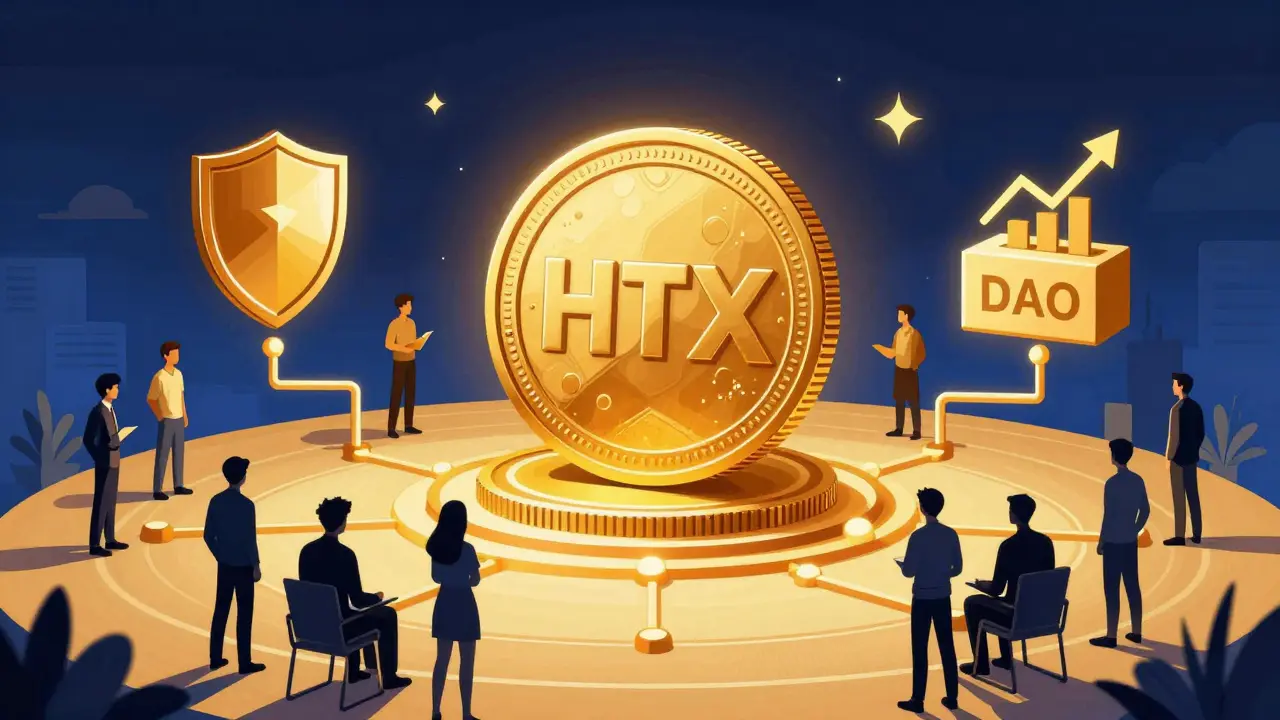
A major differentiator for HTX compared to other centralized exchanges is the launch of HTX DAO. This decentralized autonomous organization operates without formal registration, relying on smart contracts and community voting to manage funds and make decisions. The goal is to bridge the gap between Centralized Finance (CeFi) and Decentralized Finance (DeFi).
Through HTX DAO, token holders can participate in governance by voting on proposals related to ecosystem development, partnerships, and fund allocation. The DAO emphasizes transparency, with all votes recorded on-chain to ensure tamper-proof results. One unique feature is the "Ecosystem Liquidity Pledge," where the exchange and partners voluntarily pledge HTX tokens to provide liquidity for DeFi applications. This initiative aims to boost developer activity and attract new projects to the HTX ecosystem.
For users, this means that holding HTX isn't just about getting discounts on trades; it's about having a voice in how the platform evolves. However, it's important to note that while the DAO adds a layer of decentralization, the HTX exchange itself remains a centralized entity controlled by Justin Sun and his team. The DAO complements the exchange but does not replace its central authority.
Market Performance and Trading Metrics
As of March 21, 2026, HTX trades at approximately $0.05168, representing a modest 1.35% increase over the previous 24 hours. The token has seen significant volatility since its relaunch. Its all-time high was reached on December 3, 2024, at $0.053589, while the all-time low occurred on August 5, 2024, at $0.0068026. This wide range highlights the speculative nature of the asset and its sensitivity to market sentiment and regulatory news.
The current market capitalization stands at roughly $1.55 billion, ranking it #203 on CoinMarketCap. With over 75,000 holders, HTX maintains a broad user base, though it lags behind top-tier tokens like BTC, ETH, and SOL in terms of widespread adoption. The 24-hour trading volume of nearly $20 million indicates moderate liquidity, which is sufficient for most retail traders but may pose slippage risks for large institutional orders.
Fees and Yield Opportunities
If you plan to trade on the HTX platform, understanding the fee structure is essential. HTX charges competitive rates compared to other major exchanges:
- Maker Fee: 0.02%
- Taker Fee: 0.04%
These fees can be further reduced by holding HTX tokens and achieving higher VIP levels. Additionally, HTX offers various yield-generating products through its "Earn" section. These include flexible savings, locked-term deposits, and dual investment strategies. For example, users can earn up to 5% APY on stablecoins like USDC, 3.63% APY on Solana (SOL), and 3.05% APY on Ethereum (ETH). These yields are generated from the platform's operational revenue, including trading fees, market-making spreads, and interest from margin traders.
While these returns are attractive, they come with counterparty risk. Since HTX is a centralized exchange, your funds are held in custody by the platform. In the event of a hack, insolvency, or regulatory seizure, there is no guarantee of recovery. Always diversify your holdings and avoid keeping more than you can afford to lose on any single exchange.
Security and Regulatory Compliance
Security is a top priority for HTX, especially given the increased scrutiny on centralized exchanges in recent years. The platform employs multiple layers of protection, including two-factor authentication (2FA), cold storage for the majority of user funds, and regular third-party audits. HTX also maintains a reserve proof system to demonstrate solvency.
Regulatory compliance is another critical area. HTX has been actively seeking licenses in key jurisdictions, including Hong Kong, Dubai, Lithuania, and Australia. This strategy aims to legitimize its operations and attract institutional clients who require strict adherence to anti-money laundering (AML) and know-your-customer (KYC) regulations. However, the regulatory landscape remains fluid, and changes in policy could impact HTX's ability to operate in certain regions.
Is HTX a Good Investment?
Whether HTX is a good investment depends on your goals and risk tolerance. If you are an active trader on the HTX platform, holding HTX makes economic sense due to the fee discounts and VIP benefits. The deflationary burn mechanism also provides a long-term value accrual model, assuming the exchange continues to generate substantial revenue.
However, if you are looking for a pure speculation play, HTX carries significant risks. Its price is heavily influenced by Justin Sun’s activities and the overall health of the TRON ecosystem. Regulatory crackdowns on either the exchange or TRON could lead to sharp price declines. Additionally, competition from other major exchanges like Binance, Coinbase, and Kraken means HTX must continuously innovate to retain market share.
Before investing, consider your exposure to centralized exchange tokens. Diversifying across different types of assets-such as Layer 1 blockchains, DeFi protocols, and real-world asset (RWA) tokens-can help mitigate the risks associated with relying on a single platform’s success.
What is the difference between HTX and Huobi?
HTX is the new name for Huobi Global. The exchange rebranded from Huobi to HTX in September 2023 to reflect its evolution and integration with the TRON ecosystem. The native token was also renamed from HT to HTX, but it serves the same fundamental purpose within the platform.
Who owns the HTX exchange?
The HTX exchange is majority-owned by Justin Sun, the founder of the TRON blockchain. He acquired the platform in 2022, merging it with his existing interests in the crypto industry. This ownership structure links HTX closely to the performance and reputation of TRON and Justin Sun himself.
How does the HTX token burn mechanism work?
HTX allocates 20% of its quarterly revenue to buy back HTX tokens from the open market and permanently destroy them. This reduces the circulating supply, which can increase the value of remaining tokens if demand stays steady or grows. The process is transparent and regularly reported to the community.
Can I use HTX tokens to pay for trading fees?
Yes, one of the primary utilities of the HTX token is to pay for trading fees on the HTX exchange. Using HTX for fees typically results in a discount compared to paying with other cryptocurrencies or fiat currencies. Additionally, holding HTX can help you achieve higher VIP levels, which offer even lower fee rates.
What is HTX DAO and how do I participate?
HTX DAO is a decentralized autonomous organization that allows HTX token holders to vote on governance proposals. Participation involves holding HTX tokens and casting votes on-chain for issues such as ecosystem funding, partnership approvals, and protocol upgrades. Voting is transparent and tamper-proof, ensuring fair representation for all participants.
Is HTX safe to hold?
Like any cryptocurrency, HTX carries risks. While the exchange employs robust security measures such as cold storage and 2FA, centralized platforms are vulnerable to hacks, regulatory actions, and operational failures. It is advisable to only invest what you can afford to lose and consider using hardware wallets for long-term storage if possible.
What are the trading fees on HTX?
HTX charges a standard maker fee of 0.02% and a taker fee of 0.04%. These rates can be reduced by holding HTX tokens and reaching higher VIP tiers based on your trading volume and token balance. Competitive fees make HTX an attractive option for active traders.
Where is HTX headquartered?
Although founded in China, HTX is currently headquartered in the Seychelles. The company has expanded globally with offices in Hong Kong, South Korea, Japan, and the United States. This international presence helps it serve a diverse user base and comply with varying regional regulations.




Tobias Gjerlufsen
May 25, 2026 AT 03:28you guys are missing the forest for the trees here. HTX is just another centralized honeypot wrapped in decentralization buzzwords. Justin Sun bought Huobi to prop up TRON and now he's trying to pass off a rebrand as innovation. The DAO is a joke because Sun still holds the keys. Stop pretending this is anything other than a pump scheme for his own ecosystem.
Gavin Wonnacott
May 25, 2026 AT 08:46I find it utterly pathetic that people still trust entities owned by individuals with such a questionable legal history. It’s not just about the token utility, it’s about the moral bankruptcy of investing in platforms that operate in regulatory gray areas. You’re essentially funding a potential SEC lawsuit. Wake up.
Samara McCallum
May 25, 2026 AT 14:20i mean its funny how everyone acts like they know better but then keep buying anyway. maybe the problem isnt the exchange but our own greed? just saying. no need to get defensive.
Sheldon Friesen
May 27, 2026 AT 13:58Look, I get the skepticism! But let’s be real; fee discounts are tangible benefits! If you trade actively, holding HTX saves you money! That’s not magic, that’s math! Don’t let the noise distract you from the practical utility!
Jan Gilmore
May 28, 2026 AT 14:41Actually, the burn mechanism is quite sophisticated. 20% of revenue going back to buy and burn is a strong deflationary pressure if volume stays high. Most exchanges don't commit to that level of transparency. It’s worth watching the quarterly reports closely.
Caique Muniz
May 30, 2026 AT 02:51lol another day another crypto scam waiting to happen. sun is a clown and anyone holding this is a mark. dont invest your rent money idiots.
Bradley Geldenhuys
May 30, 2026 AT 18:57look man i think we gotta give credit where its due. the platform works and the fees are low. sure sun is controversial but the tech delivers. why hate on progress just because the founder has baggage?
robert Whitehead
May 31, 2026 AT 23:51The hypocrisy is staggering. People claim to support decentralization yet flock to CeFi tokens backed by oligarchs. It’s a contradiction in terms. True freedom doesn’t come from a token issued by a centralized entity controlled by one man. This is financial illiteracy at its finest.
Mike S
June 2, 2026 AT 09:02Oh wow, look at me, I read a whitepaper! The market cap is $1.5 billion? Pathetic compared to Binance or Coinbase. And don’t get me started on the liquidity issues. Try moving a large order and watch the slippage eat your profits. Amateur hour.
H F
June 2, 2026 AT 19:53I actually think the move to Dubai and Lithuania is smart. Regulatory compliance is the future. If they can legitimize their operations there, institutional money might start flowing in. It’s risky but potentially rewarding.
Michael Berggren
June 4, 2026 AT 04:58Great breakdown! 📊 The yield opportunities are pretty sweet too. 5% APY on stablecoins is hard to beat right now. Just remember to diversify though! Don’t put all your eggs in one basket! 🥚🧺
Kiran CS
June 5, 2026 AT 23:49It is rather amusing to witness the naivety displayed here. One must question the intellectual rigor of those who blindly follow a rebranding exercise without scrutinizing the underlying governance flaws. The pretense of decentralization via a DAO while retaining central control is intellectually dishonest.
Bijan Das
June 7, 2026 AT 03:54why do people care so much about this trash. its just another coin. boring.
Ashley Rodriguez
June 7, 2026 AT 22:18i have been using ht for years before it was htx and honestly the interface is fine for what i need. i like that i can earn interest on my idle coins without having to learn complex defi protocols. it feels safer even if some people say otherwise
Bridget Coogle
June 9, 2026 AT 17:12Let’s stay calm and focused on the facts. The security measures are solid. Cold storage is standard practice now. Trust is earned over time, and HTX is making efforts to prove its solvency.
Zara Zaman
June 10, 2026 AT 14:06American investors should be wary of foreign-owned exchanges with ties to Chinese founders. National security implications aside, the risk of capital controls or sudden delisting is too high. Keep your money on US-regulated platforms.
Larry Port
June 12, 2026 AT 01:14I’m curious about the voting power distribution in the DAO. Is it truly one-token-one-vote or are there whale protections? Understanding the governance structure is key to assessing its legitimacy.
Jocelyn Garcia
June 12, 2026 AT 21:11From a DeFi perspective, the integration with TRON is interesting. Low gas fees make it viable for micro-transactions. However, the reliance on a single blockchain limits scalability options long-term.
Amit Varpe
June 14, 2026 AT 14:39Indian users love HTX because of the low fees and easy onboarding. We don't have many good local options so we use what works. Stop judging us from your ivory towers 😎
Pauline Larocco71
June 14, 2026 AT 23:42i think the article missed the point about community sentiment. people feel heard when they can vote on proposals. even if its symbolic it makes a difference in engagement levels compared to old huobi days
beti macedo
June 15, 2026 AT 14:35It is imperative to note that the regulatory landscape is shifting rapidly. Compliance is not just a box to check but a strategic advantage. Those who adapt will survive the coming winter.