
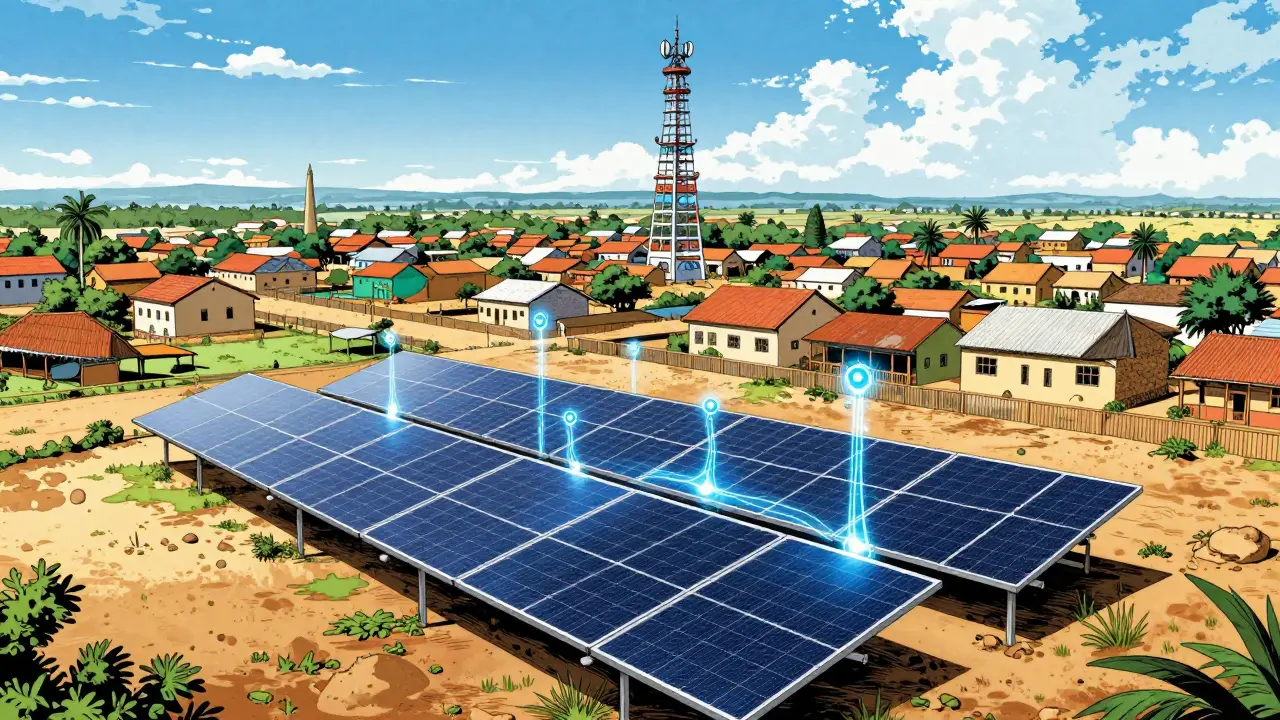
Imagine trying to build a high-speed internet network in the middle of West Africa, where the power grid is unreliable and funding is scarce. That is exactly what Cajutel is a telecommunications infrastructure project that uses blockchain technology to fund solar-powered broadband access in Guinea-Bissau and Guinea. Also known as CAJ, this project launched its token back in December 2017 with a bold vision: to bridge the digital divide using a modern, decentralized fundraising mechanism.
But if you're looking at the charts today, you'll see a wild story. The token once hit an all-time high of $50.02, only to crash nearly 100% from that peak. For most people, this looks like a classic crypto rollercoaster. For others, it's a glimpse into the struggle of tying digital assets to physical, real-world construction in some of the most challenging environments on earth.
How the CAJ Token Actually Works
At its core, CAJ is an ERC-20 token running on the Ethereum blockchain . This means it doesn't have its own separate blockchain; instead, it piggybacks on the security and infrastructure of Ethereum . By using this standard, the project made it easier for users to store tokens in common wallets, though the actual trading of CAJ has become quite difficult over time.
The project is managed by Cajutel SARL, a Guinea-Bissau company under Swiss ownership. What makes this interesting from a technical standpoint is their goal to become one of the first Distributed Autonomous Organization or DAO, in Africa . In a DAO, the rules are written into code (smart contracts), and token holders can theoretically have a say in how the organization is run, rather than relying on a traditional corporate board of directors.
| Attribute | Value |
|---|---|
| Blockchain Platform | Ethereum (ERC-20) |
| Total Supply | 1,780,000 CAJ |
| Circulating Supply | 1,352,389 CAJ |
| All-Time High | $50.02 |
| Primary Use Case | Telecommunications Infrastructure Funding |
Solar Power and Broadband: The Real-World Goal
Most crypto coins are just numbers on a screen or a way to power a decentralized app. CAJ is different because it's tied to physical hardware. The mission is to deploy broadband networks that are entirely solar-powered. Why solar? Because in Guinea-Bissau and neighboring Guinea, the electrical grid often fails or simply doesn't exist in rural areas. By removing the need for a traditional power grid, Cajutel can bring internet to the masses more cheaply and reliably.
The project focuses on creating a cost-effective access network. In the telecommunications world, the biggest hurdle is "the last mile"-the expensive part of getting a cable from a main hub to a person's house. By using a combination of solar energy and blockchain funding, the team aims to bypass the slow pace of government-funded infrastructure projects.
The Hard Truth: Market Performance and Risks
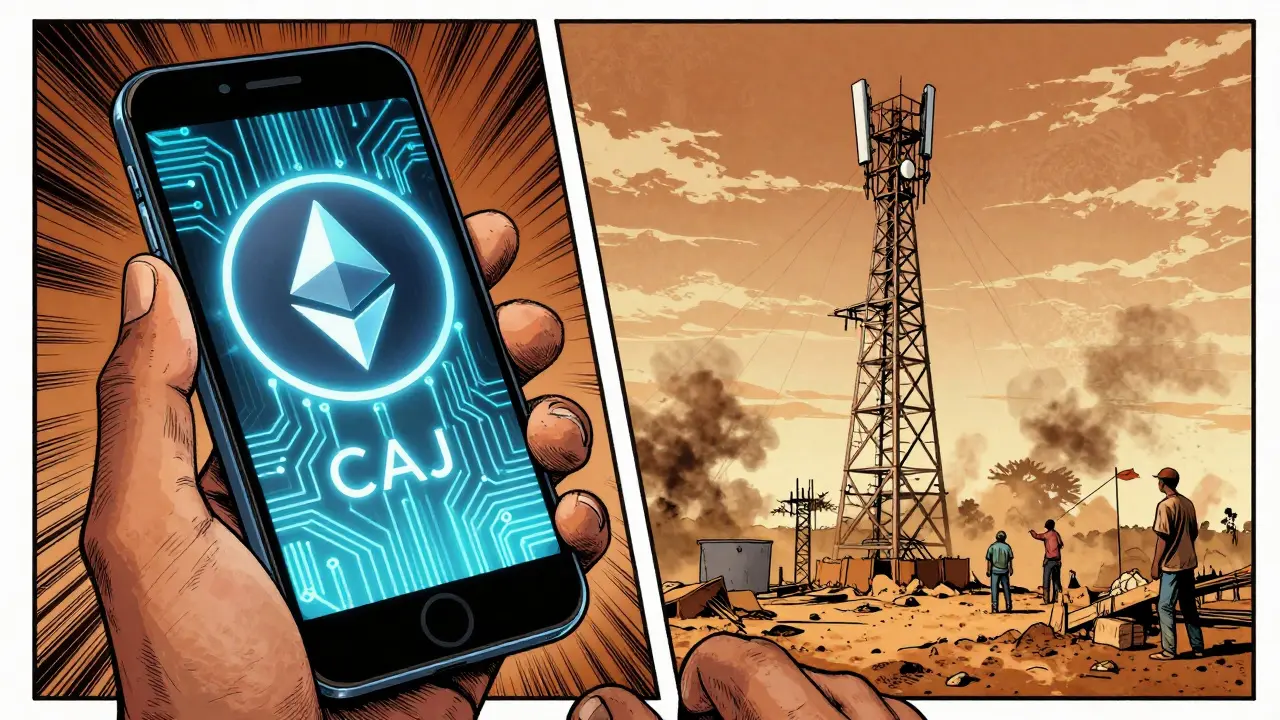
If you are considering putting money into CAJ, you need to look at the red flags. The price history is a cautionary tale. After its initial hype, the token's value plummeted. Currently, you'll find wildly different prices depending on where you look. Some platforms show it around $0.02, while others show it as low as $0.002. This is a massive warning sign called "low liquidity."
Low liquidity means there aren't enough buyers and sellers. If you buy a large amount of CAJ and then try to sell it, you might find that there is no one to buy it from you, or that your own selling pressure crashes the price even further. Furthermore, the token isn't listed on major exchanges like Binance for active trading, which leaves investors stranded on small, obscure exchanges or forced to use decentralized platforms that require a high level of technical skill.
Evaluating the Leadership and Execution
The project is led by a team including CEO Andreas Fink and CTO David Vine. On paper, the goals are noble-who doesn't want more people in Africa to have high-speed internet? However, the gap between the vision and the reality is wide. In the crypto world, we look for "proof of work" or "proof of build." For Cajutel, there is very little public evidence of the actual towers being built or the network being operational.
When a project has a 99% price drop and minimal social media activity on Reddit or X (Twitter), it usually suggests that the community has moved on. The lack of regular updates on technical milestones makes it hard for any serious analyst to provide a price prediction. It currently behaves more like a dormant asset than a growing company.
How to Get (or Avoid) CAJ Tokens
Because CAJ isn't on the big exchanges, getting your hands on it is a chore. You would need an Ethereum-compatible wallet (like MetaMask) and a basic understanding of how to interact with a smart contract. You'd likely have to find a peer-to-peer seller or a very small exchange that still supports the pair.
For the average person, the risks here far outweigh the rewards. You aren't just betting on a coin; you're betting that a small team can successfully navigate the complex regulatory and physical landscape of West African telecommunications. If they pull it off, the utility is huge. If they don't, the token is essentially worthless.
Is Cajutel (CAJ) a safe investment?
Generally, no. With a 99% drop from its all-time high, very low trading volume, and a lack of recent updates, CAJ is considered a high-risk asset. It lacks the liquidity and transparency typically required for a safe investment.
What is the purpose of the CAJ token?
The CAJ token was designed as a fundraising tool to build solar-powered broadband internet infrastructure in Guinea-Bissau and Guinea. It aims to fund the physical rollout of networks to underserved regions in West Africa.
Does Cajutel actually have a working network?
Publicly available information is very limited. While the project describes its goals in detail, there is a lack of verified, current evidence showing the scale of the operational network or recent deployment milestones.
Which blockchain does CAJ use?
Cajutel uses the Ethereum blockchain. It is an ERC-20 token, meaning it follows the standard technical specifications for tokens on the Ethereum network.
Where can I buy CAJ tokens?
CAJ is not listed on major exchanges like Binance. Investors typically have to use smaller, niche exchanges or decentralized platforms, which often involves higher risk and higher transaction fees.
Next Steps and Troubleshooting
If you already hold CAJ tokens and are struggling to sell them, your best bet is to check the current contract address (0x3c6a...aca40e) on a decentralized exchange (DEX) to see if there is any remaining liquidity. Be extremely careful with "support" accounts on social media; because this project is so niche, scammers often target holders by pretending to offer "unlocking" services.
If you are a researcher interested in African infrastructure, don't look at the token price-look at the actual telecommunications reports for Guinea-Bissau. The success of the mission is more important than the price of the coin. If you're looking for more stable ways to support connectivity in Africa, you might explore larger, established infrastructure funds or government-backed initiatives that provide more transparency than a micro-cap cryptocurrency.






James Bone
April 9, 2026 AT 08:45Typical crypto garbage. You take a noble cause like internet in Africa, slap a token on it to fleece some suckers, and then the 'team' disappears into the ether once the liquidity dries up. It's almost poetic how these projects always use the most vulnerable populations as a marketing shield for what is essentially a sophisticated pump-and-dump scheme. We're not investing in infrastructure; we're investing in the ego of some Swiss owners who think they can disrupt a continent from a boardroom in Zurich. The philosophy here is simple: if you can't build a real business, just make a coin and pretend the 'DAO' is the solution to everything. Absolute joke.
Tyler Webb
April 9, 2026 AT 22:15It's really sad to see a project with such a heart-warming goal fail like this. :( Hope the people who actually needed the internet didn't get hurt by the financial side of things.
Heather Warren
April 11, 2026 AT 14:28The concept of using solar power for the last mile is actually very sound. If anyone is looking for similar initiatives, I recommend checking out traditional micro-grid grants which offer much more transparency than an ERC-20 token.
Aaliyah BROTHERS
April 13, 2026 AT 10:49SURELY you can't be blind to the GLOBALIST agenda here!!! Why are Swiss 'owners' suddenly so keen on West Africa??? It's a data grab!!! They want the infrastructure to spy on people under the guise of 'charity'!!! Wake up people!!! This is just another layer of the shadow game!!! Total scam!!!
daniella davis
April 15, 2026 AT 02:27omg please... a DAO in Africa? as if they could even manage a group chat let alone a decentralized organization lol. so pretenshious to think a smart contract fixes political instability.
Adam Auksel
April 15, 2026 AT 23:35Even with the price crash, the idea of solar-powered broadband is a game changer for rural connectivity! ☀️🌐 We should keep pushing for these kinds of tech intersections, even if this specific token wasn't the way to go. 🚀
ssjuul z
April 17, 2026 AT 16:31Exactly! Let's focus on the tech, not the token! ⚡️ The vision is still valid even if the execution was messy. Let's get it!
william manes
April 18, 2026 AT 04:29Waste of money. 🤡 America first. Why fund this stuff anyway? 🇺🇸
7stargee Emmanuel Obani
April 19, 2026 AT 03:35I'm from Nigeria and trust me, this is just another rug pull. :)
Lela Singh
April 21, 2026 AT 01:33Focus on the utility! If the towers exist, the token is just a side effect. Let's dig deeper into the actual hardware deployment!
Prasanna Shembekar
April 22, 2026 AT 17:04my heart actually hurts for the investors lol
Scott Fenton
April 22, 2026 AT 17:17It is imperative to exercise extreme caution when dealing with assets that exhibit such low liquidity. The discrepancy in pricing across platforms is a definitive indicator of a market failure.
Mikayla Murphy
April 23, 2026 AT 06:49Bridging the digital divide is so important for education and healthcare in Guinea-Bissau. It's a shame the financial vehicle used for this was so unstable.
Stanly Hayes
April 23, 2026 AT 15:40Who cares about the token? Just build the damn towers! Stop playing with digital coins and actually put some boots on the ground!
Lane Montgomery
April 24, 2026 AT 06:12Still a scam.
Rob Mitchell
April 26, 2026 AT 04:53ERC-20 was the wrong choice here. They needed a layer 1 for actual utility.
Kelly Cantrell
April 27, 2026 AT 16:11Typical. They use a 'Swiss' company to hide the money trail. I bet the funds never even left Europe. It's all a front for something bigger.
Rebecca Violette
April 29, 2026 AT 08:00i can't even believe people still fall for this stuff... its just so depressing lol
Emily H
April 30, 2026 AT 00:56One must admire the ambition of utilizing decentralized finance to solve infrastructure woes, regardless of the current market valuation. It serves as a valuable case study for future ventures.
Swati Sharma
April 30, 2026 AT 10:19If they implement a more robust governance framework and fix the slippage on the DEXs, there might be a path to recovery through a token burn or migration.
Jonathan Chamma
May 1, 2026 AT 16:34I think it's fair to say that the gap between a bold vision and the gritty reality of rural construction is just massive. We should be kind to the dreamers but stay smart with our wallets.
Chidinma Sandra okafor
May 2, 2026 AT 11:48Oh look, another 'revolutionary' project that helps Africa while the owners get rich in Switzerland. How original. Truly a miracle of modern charity.
Terrance Hausmann
May 2, 2026 AT 17:49I've spent a lot of time looking at these types of hybrid projects, and the biggest issue is always the lack of a feedback loop between the physical build and the token holders, which creates a vacuum of trust that is almost impossible to fill once the price starts to slide, although I do believe that the core idea of solar-powered internet is one of the few ways we can actually achieve global connectivity in a sustainable manner without relying on corrupt government contracts that take decades to finalize.