
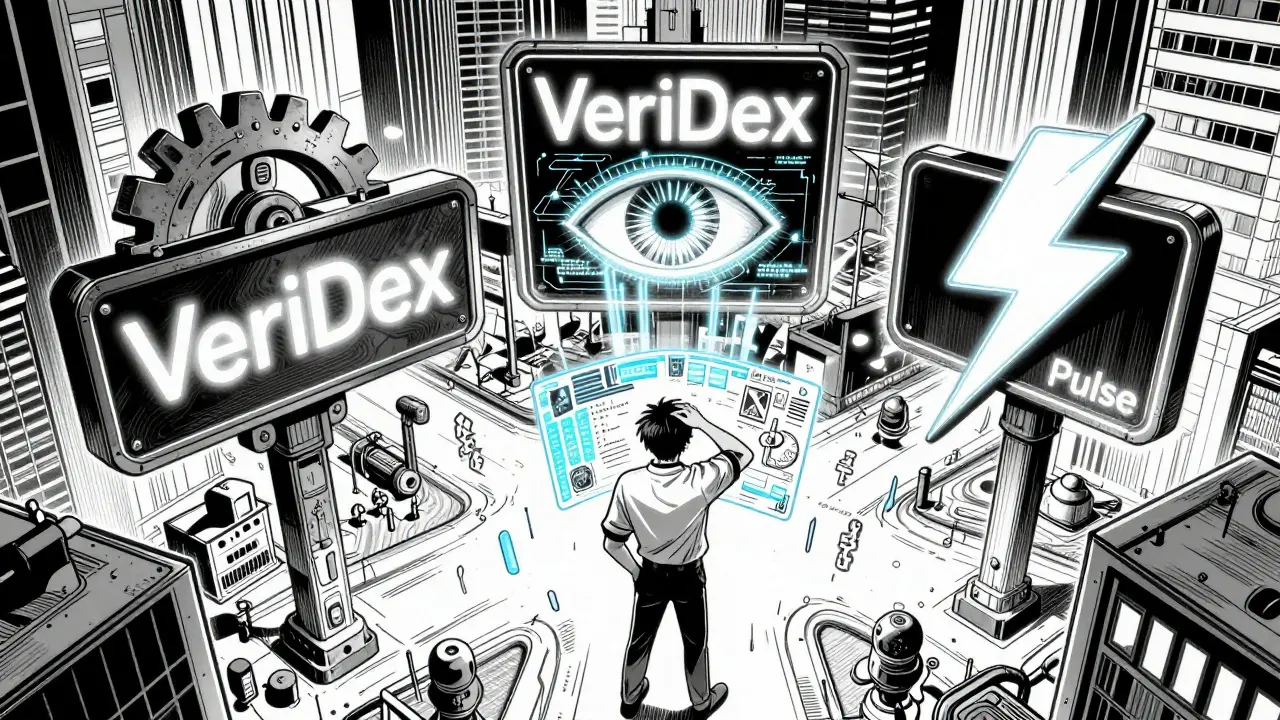
If you're searching for a VeriDex crypto exchange review, you've probably noticed something strange: there isn't just one "VeriDex." Depending on where you click, you'll find a Brazilian decentralized exchange, an AI-driven signal platform called Markets, and an automated system called Pulse. This kind of naming overlap is common in the crypto world, but it's a red flag that requires a closer look before you deposit a single cent.
The core problem here is a massive identity crisis. One platform is a piece of open-source infrastructure, while the others are web-based tools promising automated profits. If you're looking for a place to trade, you need to know exactly which one you're signing up for, as the risks and mechanics are completely different.
The Original VeriDex: The Decentralized Play
First, let's clear the air. The original VeriDex is a decentralized exchange (DEX) based in Brazil that launched back in July 2019. Unlike a traditional app where you give your money to a company, this one runs on 0x smart contracts. This means it's non-custodial; you keep your private keys, and the exchange just facilitates the swap.
What makes this version unique is its "DEX as a service" model. Essentially, it's a toolkit for other token teams. If a project wants to launch its own decentralized trading environment without building it from scratch, they use the VeriDex infrastructure. It primarily trades pairs against its own native token, Verisafe. If you're a developer or a DeFi enthusiast looking for open-source tools, this is the entity you're actually looking for.
Veridex Markets: The AI Signal Hub
Now we shift gears entirely. Veridex Markets isn't a DEX; it's an AI-driven trading system. Instead of just providing a place to swap tokens, it claims to monitor the markets 24/7 to give you real-time signals and predictions. It's designed to be a bridge for beginners who don't know how to read a candlestick chart but want to follow strategic insights.
The platform offers two distinct ways to trade: manual and automated. You can either take the AI's suggestions and execute the trade yourself or let the system handle the heavy lifting. It supports hundreds of assets and, according to some user reports, provides a very clean interface. While it's available in over 100 countries-including the US and UK-the big draw here is the reported lack of subscription fees and the ability to withdraw profits whenever you like.

Veridex Pulse: The Automated Trading Bot
Then there is Veridex Pulse. This is another web-based platform, but it leans more heavily into the "bot" side of things. It uses advanced algorithms to execute orders based on specific market conditions. To get started with live trading here, you're looking at a minimum deposit of €250.
The philosophy behind Pulse is diversification. It encourages users to spread their investment across multiple cryptocurrencies simultaneously to hedge risk. It also offers a demo account, which is a must-have for anyone who wants to test the waters without risking real capital. Like the Markets version, it's compatible with both mobile and desktop, and it emphasizes speed of execution using real-time data feeds.
Comparing the Three "VeriDex" Versions
Since these three are so different, it's easiest to look at them side-by-side. One is a piece of software for developers, and the other two are tools for traders.
| Feature | VeriDex (Original) | Veridex Markets | Veridex Pulse |
|---|---|---|---|
| Type | Decentralized Exchange (DEX) | AI Trading Platform | Automated Trading Bot |
| Control | Non-custodial (User holds keys) | Custodial/Platform-based | Custodial/Platform-based |
| Core Tech | 0x Smart Contracts | AI Analysis/Signals | Trading Algorithms |
| Entry Barrier | Wallet connection | Account registration | €250 Minimum Deposit |
| Primary Use | Infrastructure/DEX as a Service | Market Predictions/Signals | Hands-off automated trading |

Safety, Legitimacy, and the "Red Flags"
Here is where we need to get real. Whenever you see multiple platforms using almost the same name, the risk of phishing and imitation sites skyrockets. Both Veridex Markets and Pulse have warnings about fake websites appearing in search results. If a site asks for your seed phrase or promises guaranteed returns, close the tab immediately.
From a security standpoint, Veridex Pulse uses SSL certification, two-factor authentication (2FA), and backup codes. These are standard industry practices. However, there is a glaring hole in the transparency: the creators of these platforms are largely anonymous. In the crypto world, "anon" founders can be common, but it means you are trusting the code and the brand rather than a legal entity you can hold accountable in court.
The €250 deposit for Pulse is framed as a way to ensure "responsible trading," but it's a common pattern in automated trading platforms to set a minimum threshold. Always treat this as a high-risk investment. Only deposit what you are prepared to lose entirely.
Which One Should You Actually Use?
Choosing between these depends entirely on your technical skill and your goals. Are you a developer who wants to deploy a token swap for a new project? Stick with the original Brazilian VeriDex and its 0x integration. It's the only one of the three that is truly a "crypto exchange" in the architectural sense.
If you're a trader who likes to make the final call but wants an AI to highlight opportunities, Veridex Markets fits that flow. If you're looking for a set-and-forget system and have €250 to spare, Veridex Pulse is the targeted tool. Just remember that automated bots are not "money printers"-they can lose money just as quickly as they can make it during a flash crash.
Is VeriDex a safe exchange?
It depends on which one you mean. The original VeriDex is a non-custodial DEX, meaning you control your keys, which is generally safer. Veridex Markets and Pulse are custodial platforms; while they use SSL and 2FA, the anonymity of their creators adds a layer of risk. Always verify the URL to avoid imitation scam sites.
What is the minimum deposit for Veridex Pulse?
The minimum deposit required to access live trading on Veridex Pulse is €250 in your local currency.
Does Veridex Markets charge a subscription fee?
Based on available reviews, Veridex Markets reportedly does not charge subscription fees and allows users to withdraw their profits at any time.
What is the difference between a DEX and an automated trading platform?
A DEX (like the original VeriDex) is a peer-to-peer marketplace where users trade directly from their wallets via smart contracts. An automated trading platform (like Pulse or Markets) is a service that uses software, AI, or algorithms to execute trades on behalf of the user, usually requiring the user to deposit funds into the platform's account.
Can I try these platforms without risking real money?
Yes, both Veridex Markets and Veridex Pulse offer demo trading accounts, allowing you to test the interface and the AI's accuracy before depositing real funds.









Caiaphas Konkol
April 25, 2026 AT 12:35The sheer audacity of these platforms to use the same name is just a smokescreen for the inevitable collapse of the current financial paradigm. Only a complete novice would trust a custodial account managed by anonymous entities in the ether. It's virtually a certainty that this is all just another layer of the great simulation designed to harvest retail liquidity before the true reset happens. If you aren't using a cold wallet and auditing the smart contracts yourself, you're basically just handing your keys to the kingdom to whoever has the best marketing budget. Most people just don't see the pattern because they're blinded by the promise of passive income. This whole ecosystem is a house of cards built on a foundation of linguistic ambiguity and digital mirages. Wake up and realize that 'AI' is just a buzzword used to hide the fact that these algorithms are likely just basic mean-reversion scripts. We are living in an era of unprecedented deception where the boundary between a legitimate tool and a sophisticated rug-pull is thinner than a single line of Solidity code. Truly pathetic that this even needs to be explained in the modern age. The lack of transparency isn't a bug, it's the primary feature of the system. Total madness.
Kathleen Bergin
April 25, 2026 AT 18:53The first one is the only real one.
Mike Krasner
April 27, 2026 AT 04:24imagine paying 250 euro just to let a bot lose your money lol
Hannah Rubia
April 29, 2026 AT 01:38It is imperative that users exercise extreme caution when interacting with any platform that exhibits a lack of transparency regarding its leadership team. The presence of SSL and 2FA is a basic requirement for any modern web application and should not be mistaken for a guarantee of legitimacy.
Kyle Bush
April 29, 2026 AT 20:05WHO CARES ABOUT THE NAMES!! Just make money 🤑🇺🇸 Keep the profits in the US and get rich or get out of the way!! 🚀💰
Matthew Morse
April 30, 2026 AT 16:17too many veridexs honestly just makes it all feel like a scam anyway
Gloris Young
May 1, 2026 AT 10:43Good breakdown of the differences. Super helpful for anyone confused by the naming.
Alex Hunter
May 3, 2026 AT 03:14I appreciate how this post clarifies the non-custodial aspect of the original DEX. For anyone starting out, keeping your own keys is the most important lesson you can learn in crypto.
Keith Garcia
May 3, 2026 AT 05:23The linguistic gymnastics required to market three completely different products under one banner is simply breathtaking 🤡. It's a masterclass in cognitive dissonance for the masses who believe that "AI" is a magical fairy that generates wealth from thin air. Absolutely laughable 🙄.
Guy Bianco
May 3, 2026 AT 07:10It is quite helpful to see these distinctions laid out formally. For those who are unsure, I suggest starting with the demo accounts mentioned to build confidence 😇.
Clair Geary
May 5, 2026 AT 05:02this is a total wild west situation lol! definitely feels like a glittery trap if you arent careful 🌈
Ellie Drews
May 7, 2026 AT 04:17Just a friendly reminder to everyone to only put in money you can actually afford to lose. Stay safe out there!
debashish sahu
May 8, 2026 AT 10:06The trend of using similar names to confuse users is unfortunately very common across many global markets.
Tara Aman
May 8, 2026 AT 23:12Totally agree! Better to be safe than sorry when it comes to these bots!
Mary Tawfall
May 10, 2026 AT 07:07It is wonderful that there are demo accounts available. It gives people a chance to learn without the stress of losing funds immediately.
Charlie Queen
May 10, 2026 AT 09:29Love seeing people help each other navigate this stuff! 🌟 Let's all just keep the vibes positive and do our research! 📈🙌
Jagdish Sutar
May 12, 2026 AT 03:55This is a great way to educate newcomers. Understanding the difference between a DEX and a bot is a fundamental step in the crypto journey.
Mike Word
May 13, 2026 AT 09:54The 0x integration is the only part of this that actually sounds technically sound. The rest seems like typical marketing fluff.