Swapping tokens on Ethereum can feel like waiting for a bus that never comes. You click 'swap,' watch the gas fee skyrocket, and then wait thirty seconds for confirmation. Now imagine doing that same trade in under one second for less than ten cents. That is the promise of LFJ v0, commonly known as Trader Joe, which is a decentralized exchange built specifically on the Avalanche blockchain network to provide high-speed, low-cost token swaps without centralized custody. Launched in 2021 by a pseudonymous team led by developer LeX, this platform has grown from a simple swap interface into the second-largest liquidity hub on Avalanche.
But here is the catch: you are using version 0. In software terms, 'v0' usually means 'experimental.' Yet, LFJ v0 processes over $127 million in daily volume. Why? Because it works. It is fast, it is secure, and it doesn't ask for your ID. But it also lacks modern features like mobile apps and advanced cross-chain bridges. If you are looking for a quick, cheap way to trade AVAX and major altcoins on Avalanche, this might be your go-to. If you want institutional-grade tools or mobile convenience, you might want to look elsewhere. Let’s break down exactly what you get when you connect your wallet to Trader Joe today.
How LFJ v0 Works on Avalanche
To understand why LFJ v0 is so fast, you have to understand where it lives. Unlike Uniswap, which runs on Ethereum’s congested mainnet, LFJ operates on Avalanche’s C-Chain (Contract Chain). This chain uses a unique consensus mechanism called repeated random sampling instead of traditional Proof-of-Stake or Proof-of-Work. The result? Sub-second finality. When you confirm a transaction on LFJ, it is settled in roughly 0.87 seconds during normal conditions. Compare that to Uniswap’s average 13-second settlement time, and the difference is night and day.
The platform supports over 1,135 digital assets across multiple networks, including Base, Arbitrum One, BNB Smart Chain, and Solana. However, its core strength remains native Avalanche assets. The architecture relies on three chains: X-Chain for asset creation, P-Chain for validator coordination, and C-Chain for smart contracts. LFJ interacts primarily with the C-Chain. This separation allows the network to handle up to 4,500 transactions per second without clogging up the system. For the user, this means fewer failed transactions and predictable costs.
| Feature | LFJ v0 (Trader Joe) | Uniswap v3 (Ethereum) | Raydium (Solana) |
|---|---|---|---|
| Avg. Swap Time | 0.87 seconds | 13 seconds | ~1.5 seconds |
| Avg. Transaction Fee | $0.08 | $1.75 | $0.02 |
| Total Value Locked (TVL) | $842 Million | $5.2 Billion | $1.1 Billion |
| Security Incidents (2023-2025) | 0 Protocol Exploits | Minor UI bugs only | 3 incidents ($8.3M lost) |
| Mobile App | No (Web-only) | Yes | Yes |
Fees and Trading Costs
Cost matters in DeFi. On centralized exchanges, you pay maker/taker fees. On DEXs, you pay protocol fees plus network gas. LFJ v0 keeps things transparent with a flat structure. Standard token swaps incur a 0.3% fee. Here is how that money moves: 0.25% goes directly to liquidity providers who fund the pools, and 0.05% goes to JOE token stakers. If you hold the native JOE token, trading is commission-free. For native assets like AVAX, the fee drops to just 0.1%. Limit orders are even cheaper at 0.2%.
These fees are competitive but not the cheapest. Binance offers tiered rates as low as 0.015% for high-volume traders. LFJ does not offer volume-based discounts. This is a structural disadvantage for whales. If you are moving millions of dollars, the flat 0.3% adds up. For retail traders swapping hundreds or thousands of dollars, however, the savings on gas fees far outweigh the slight premium in protocol fees. A typical swap on Ethereum might cost $1.75 in gas alone; on LFJ, that same action costs about $0.08 total. That is a 95% reduction in overhead.
You should also watch your slippage tolerance. During peak congestion, prices can shift rapidly. The default setting is often too tight. For stablecoin pairs (like USDC/USDT), keep slippage at 0.5%. For volatile assets, bump it to 1-3%. Setting it too high exposes you to bad prices; setting it too low causes failed transactions. During the July 2024 network congestion event, many users lost money because their slippage settings were auto-reset by browser updates. Always double-check before clicking swap.
Security and Trust
In crypto, trust is earned through code audits, not marketing. LFJ v0 has maintained a clean bill of health since its inception. Its smart contracts were formally verified by OpenZeppelin in November 2021 (Audit Report AVAX-LFJ-2021-001). More importantly, the protocol uses time-locked upgrades. Any change to the core code requires a 48-hour community review period. This prevents developers from pulling a 'rug pull'-stealing funds by altering contract logic overnight.
Compare this to Raydium on Solana, which suffered three security incidents between 2023 and 2025 resulting in $8.3 million in losses. LFJ has had zero protocol-level exploits. That said, no system is immune to external risks. The platform experienced three outages between 2023 and 2025, totaling 14 hours of downtime. The worst incident occurred on July 12, 2024, during an Avalanche network-wide congestion spike. While the funds were safe, $2.1 million worth of transactions failed due to timeout errors. This highlights a dependency risk: if Avalanche’s infrastructure struggles, LFJ struggles with it.
Recent updates address specific vulnerabilities. On September 18, 2025, the team deployed version 0.3.7 to patch a critical slippage calculation flaw discovered by Trail of Bits (CVE-2025-7321). This proactive approach shows the team is actively maintaining the legacy codebase despite planning a migration to v2.1.
User Experience and Accessibility
Here is where LFJ v0 shows its age. The interface is clean and functional, but it is strictly web-based. There is no dedicated mobile application. According to Triple-A research from 2025, 68% of crypto users trade primarily via mobile devices. By lacking an app, LFJ alienates a massive chunk of potential users. You can access the site through a mobile browser, but the experience is clunky. Connecting MetaMask on a small screen, approving transactions, and monitoring slippage is frustrating. Many users report losing opportunities because they couldn’t react quickly enough from their phones.
Getting started requires intermediate Web3 knowledge. You cannot just sign up with an email. You need a non-custodial wallet like MetaMask (version 10.18.1 or later). The setup process involves five steps:
- Install MetaMask and create a new wallet.
- Add the Avalanche Mainnet network manually (RPC URL: https://api.avax.network/ext/bc/C/rpc, ChainID: 43114).
- Fund your wallet with AVAX for gas fees (keep at least $1.50 equivalent in reserve).
- Navigate to traderjoexyz.com and connect your wallet.
- Approve token contracts for each asset you wish to swap (a one-time permission per token).
This barrier to entry filters out casual investors. BullShitApp’s onboarding assessment estimates an 8-12 hour learning curve for novices. Documentation is rated 4.1/5 by users, offering comprehensive guides, but the lack of video tutorials leaves some gaps. Community support is decent, with a Discord server of 15,300 active users responding to technical queries in an average of 22 minutes.
Liquidity and Asset Support
Liquidity determines whether you can actually buy or sell what you want without crashing the price. LFJ v0 holds $842 million in Total Value Locked (TVL), making it the #2 DEX on Avalanche behind Pangolin ($1.2 billion TVL). This depth is crucial. Major pairs like AVAX/USDC and JOE/USDT have an average liquidity depth of $4.7 million. Competing Avalanche DEXs often sit around $1.2 million. Higher liquidity means lower slippage for large trades.
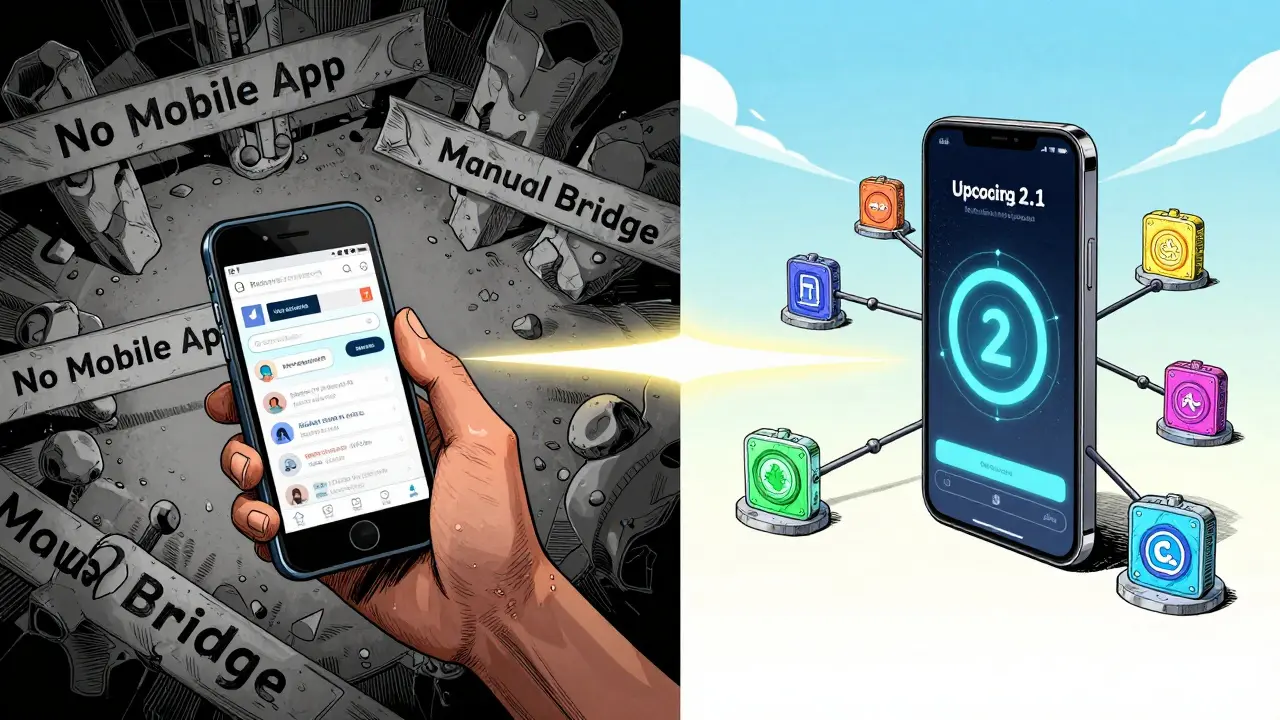
However, LFJ lags in cross-chain capabilities. It does not support integrated cross-chain swaps. If you want to move ETH from Ethereum to Avalanche to trade on LFJ, you must use a third-party bridge like the Avalanche Bridge (AB). These bridges take an average of 3 minutes and 22 seconds to complete and carry their own security risks. The upcoming v2.1 update promises to fix this with native cross-chain limit orders, but until then, multi-chain trading is a manual, multi-step hassle.
Future Outlook: V0 vs V2.1
Why stay on v0? Because it works reliably today. The development team has announced a migration to LFJ v2.1 by Q2 2026. This next version will introduce concentrated liquidity pools (similar to Uniswap v3), cross-chain limit orders, and finally, a native mobile application. For now, v0 remains in active maintenance mode. It is not dead; it is being preserved while the successor is built.
Institutional adoption is growing. Sixty-seven financial entities, including Galaxy Digital and VanEck, used LFJ for OTC token swaps in Q3 2025. Galaxy Digital executed $14.3 million in monthly volume alone. This institutional interest suggests that despite the lack of flashy features, the underlying infrastructure is robust enough for serious players. Regulatory pressures, such as the EU’s MiCA regulations expected to impact DeFi by 2027, may force changes to the no-KYC model, but for now, LFJ remains a privacy-friendly option compliant with FinCEN’s 2024 guidance for non-custodial services.
Is LFJ v0 safe to use?
Yes, LFJ v0 is considered highly secure. It has undergone formal verification by OpenZeppelin and has had zero protocol-level exploits since its launch. The platform uses time-locked upgrades, requiring a 48-hour community review for any code changes, which prevents malicious insider attacks. However, users should always verify contract addresses and be aware of general phishing risks associated with connecting wallets to websites.
Does Trader Joe (LFJ) have a mobile app?
No, LFJ v0 does not currently have a dedicated mobile application. Users must access the platform through a Web3-compatible browser on desktop or mobile devices. This is a significant limitation for users who prefer trading on smartphones. The development team has promised a native mobile app as part of the LFJ v2.1 upgrade scheduled for Q2 2026.
What are the fees for swapping on LFJ v0?
Standard token swaps incur a flat 0.3% fee. Trades involving the native JOE token are commission-free. Swaps for native Avalanche assets like AVAX cost only 0.1%. Limit orders have a lower fee of 0.2%. Additionally, network gas fees on Avalanche are typically very low, averaging around $0.08 per transaction, making it much cheaper than Ethereum-based DEXs.
Can I trade tokens from other blockchains on LFJ?
Not directly. LFJ v0 does not support integrated cross-chain swaps. To trade assets from Ethereum, Solana, or BNB Chain, you must first bridge them to the Avalanche network using a third-party bridge like the Avalanche Bridge. Once the assets are on Avalanche, you can trade them on LFJ. The upcoming v2.1 version aims to add native cross-chain functionality.
When will LFJ v2.1 be released?
The development team has targeted a release for LFJ v2.1 in Q2 2026. This updated version will feature concentrated liquidity pools, cross-chain limit orders, and a native mobile application. Until then, LFJ v0 remains in active maintenance mode, receiving security patches and minor improvements.