
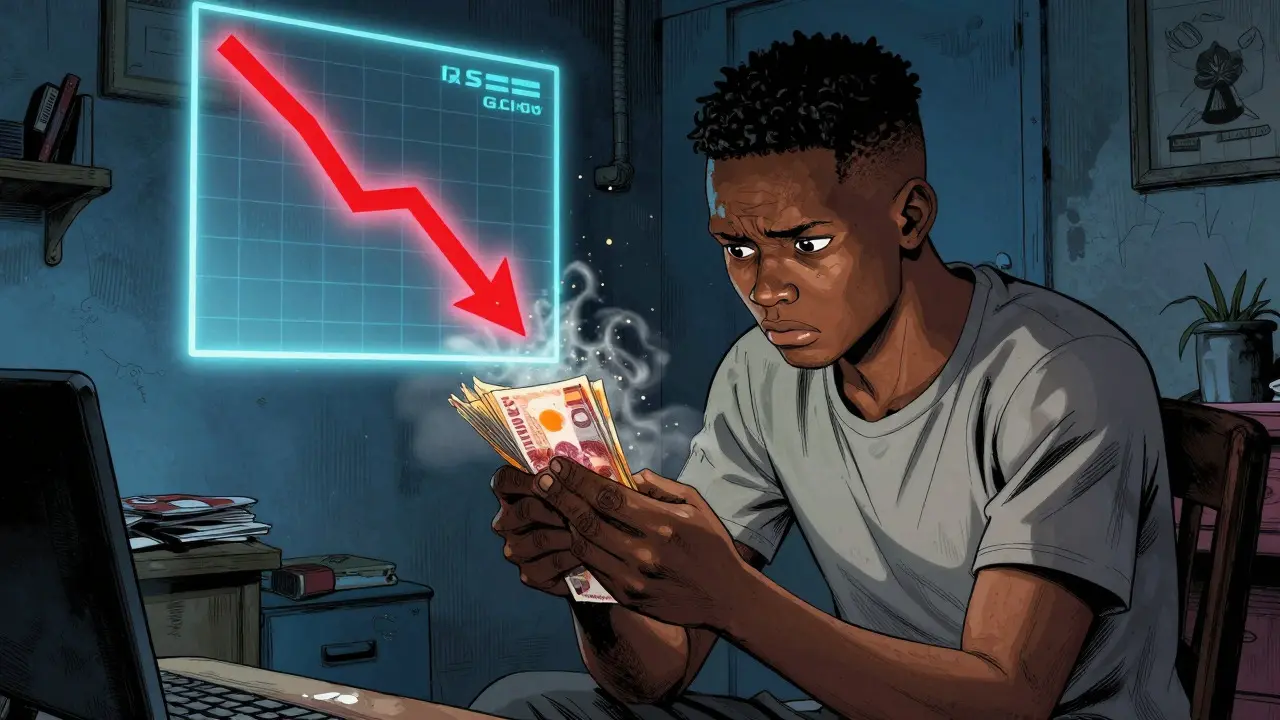
Imagine trying to save money in a currency that loses more than three-quarters of its value against the US dollar over a decade. For millions of Nigerians, this isn't a hypothetical scenario; it is daily life. By 2025, approximately 22 million Nigerians, equivalent to 10.3% of the population held cryptocurrencies. This massive surge in digital asset adoption is not just a tech trend-it is a direct response to economic instability and is exerting significant downward pressure on the national currency, the Nigerian Naira.
The relationship between cryptocurrency usage and the weakening naira has become one of the most critical financial dynamics in Africa. As traditional banking systems struggle with high fees, limited access, and strict capital controls, citizens are turning to decentralized alternatives. This shift bypasses official exchange mechanisms, reducing demand for the local currency and accelerating capital flight. Understanding this pressure requires looking beyond simple speculation to see how everyday economic needs drive structural changes in Nigeria’s monetary landscape.
The Root Causes: Why Nigerians Flee the Naira
To understand why crypto trading creates such intense pressure on the naira, we must first look at the macroeconomic environment. Since 2016, the naira has suffered from chronic depreciation. Inflation surged to over 24 percent in 2023, eroding purchasing power rapidly. When your savings lose value every month, you seek alternatives. Cryptocurrency offers a hedge against this inflation, particularly through stablecoins pegged to stronger currencies like the US dollar.
- Currency Devaluation: The Central Bank of Nigeria (CBN) has historically managed the naira's value, including a notable 24% devaluation in 2020. These sudden drops accelerate the shift toward digital assets as people rush to preserve wealth before further losses occur.
- High Inflation Rates: With inflation exceeding 24%, holding cash becomes a losing strategy. Digital assets offer a store of value that is less susceptible to local monetary policy missteps.
- Limited Banking Access: Approximately 36% of Nigerian adults remain unbanked or underbanked. Traditional banking infrastructure is unevenly distributed, making peer-to-peer (P2P) crypto transfers a more accessible option for many.
This combination of factors means that when Nigerians buy Bitcoin or Tether (USDT), they are often removing liquidity from the formal naira economy. Instead of depositing funds into commercial banks where the CBN can manage them, these funds move into decentralized wallets, effectively exiting the domestic monetary system.
The Scale of Crypto Adoption in Nigeria
Nigeria is no longer an emerging market for cryptocurrency; it is a global leader. Between July 2023 and June 2024, the country processed approximately $59 billion in cryptocurrency transaction value. This places Nigeria as the world's second-largest country in crypto adoption, trailing only India. The sheer volume of transactions highlights how deeply integrated digital assets have become in daily financial activities.
| Year | Transaction Value (Billions USD) | YoY Growth |
|---|---|---|
| 2021 | $47.0 B | - |
| 2022 | $45.0 B | -4.2% |
| 2023 | $44.3 B | -1.5% |
| 2024 | $55.4 B | +25% |
Note the rebound in 2024. Despite regulatory headwinds, transaction inflows grew by 25% year-over-year. This resilience suggests that adoption is driven by necessity rather than speculative hype. Furthermore, the market is projected to generate $2.4 billion in revenue for 2025, with user penetration expected to reach 11.83% by 2026, totaling an estimated 28.7 million users. Among adults, 35% have invested in cryptocurrency, and notably, 52% of these investors are under age 30. This demographic indicates a long-term structural shift in how younger generations handle money.

Stablecoins and the Dollarization Effect
Not all cryptocurrencies affect the naira equally. While Bitcoin gets the headlines, stablecoins like Tether (USDT) play a crucial role in pressuring the local currency. USDT accounts for 43% of sub-$1 million transactions in Nigeria. Because stablecoins are pegged to the US dollar, they function as a parallel dollar economy within Nigeria.
When Nigerians use USDT for daily transactions or savings, they are essentially dollarizing their finances without leaving the country. This reduces the velocity of the naira in circulation. If merchants accept USDT instead of naira, the demand for the local currency drops. Additionally, remittances-traditionally a source of foreign exchange that supports the naira-are increasingly flowing through crypto networks. These transfers bypass official banking channels, meaning the foreign currency never enters the formal forex market to bolster the naira's value. Instead, it stays in digital form, maintaining its strength relative to the weakening local currency.
Regulatory Pushback and Its Consequences
The Central Bank of Nigeria (CBN) has struggled to contain this trend. Initially, the approach was prohibition. In 2017, the CBN instructed commercial banks to desist from cryptocurrency transactions. Later, in 2022, the bank imposed fines totaling ₦1.31 billion on six commercial banks for contravening these circulars. The logic was clear: if banks cannot process crypto transactions, adoption will stall.
However, this strategy backfired. Rather than stopping adoption, it pushed activity underground and into peer-to-peer (P2P) markets. Users adapted by using informal networks and decentralized exchanges that do not rely on traditional banking infrastructure. Research involving 400 individuals found that these prohibitions significantly destabilized the market and inflicted emotional distress on traders, but they did not stop usage. In fact, events like the End SARS protests, where bank accounts were frozen, accelerated the shift to digital currencies as users sought financial tools free from government interference.
Recognizing that outright bans were ineffective, the regulatory landscape began to shift. The passage of the Nigerian Investment and Securities Act in 2025 marked a pivotal moment. This legislation recognized digital assets as securities, providing a framework for regulation rather than prohibition. This change acknowledges that cryptocurrency adoption is too widespread to ignore and attempts to bring transparency to a previously shadowy market. However, even with regulation, the fundamental pressure on the naira remains because the drivers-instability and lack of trust-are still present.

Impact on Monetary Policy and Capital Controls
The rise of crypto complicates the CBN’s ability to manage monetary policy. Traditionally, central banks control money supply and interest rates to influence inflation and growth. But when a significant portion of the population holds assets outside the banking system, these levers become less effective. The CBN sets the official exchange rate, but the parallel market premium persists because crypto allows individuals to access global currency values instantly.
Capital controls, designed to prevent money from leaving the country, are easily bypassed via blockchain technology. A Nigerian citizen can send value anywhere in the world without seeking approval from the central bank. This ease of exit reduces confidence in the naira, creating a self-fulfilling prophecy of depreciation. As more people anticipate further devaluation, they convert more naira into crypto, which in turn increases selling pressure on the local currency.
Experts from Cornell Business School describe Nigeria as "one of the most fascinating case studies in cryptocurrency adoption globally" due to this volatile macroeconomic environment. Crypto serves both as a symptom of systemic shortcomings and a driver of grassroots innovation. It provides a lifeline for those excluded from traditional finance while simultaneously challenging the state's monopoly on money.
Future Outlook: Will the Pressure Ease?
Looking ahead to 2026 and beyond, the pressure on the naira is likely to intensify. User projections show continued growth, with nearly 29 million users expected by the end of 2026. The fundamental issues driving adoption-high inflation, unemployment among youth, and inefficient banking infrastructure-remain largely unresolved. Unless the broader economy stabilizes and the naira regains credibility as a store of value, citizens will continue to prefer digital assets.
The government faces a dilemma. Embracing crypto fully could legitimize the alternative currency system, potentially undermining the naira further. Restricting it again risks stifling financial inclusion and innovation. The path forward likely involves integrating crypto into the formal economy while implementing policies that stabilize the local currency. Until then, the tug-of-war between the CBN and the growing crypto community will define Nigeria’s financial future.
Why does crypto trading weaken the Nigerian Naira?
Crypto trading weakens the naira by reducing demand for the local currency. When Nigerians convert naira into cryptocurrencies like Bitcoin or USDT to protect against inflation, they remove liquidity from the domestic banking system. This capital flight decreases the value of the naira as fewer people hold or use it for transactions.
How many Nigerians use cryptocurrency in 2026?
By 2026, it is estimated that there will be approximately 28.7 million cryptocurrency users in Nigeria, representing about 11.83% of the population. This number continues to grow as more young adults adopt digital assets for savings and transactions.
What role do stablecoins play in Nigeria's economy?
Stablecoins like USDT act as a proxy for the US dollar in Nigeria. They allow users to preserve value against naira inflation and facilitate cross-border payments without relying on traditional banks. Their widespread use contributes to the "dollarization" of the economy, further pressuring the local currency.
Did the CBN ban on crypto work?
No, the CBN's initial bans and fines on banks were largely ineffective. Instead of stopping adoption, they pushed trading into peer-to-peer markets and decentralized platforms. The eventual passage of the 2025 Securities Act signaled a shift from prohibition to regulation, acknowledging the permanence of crypto usage.
Is crypto adoption higher among young people in Nigeria?
Yes, 52% of Nigerian cryptocurrency investors are under the age of 30. This demographic drives much of the adoption, using crypto for remittances, savings, and as an alternative to unstable traditional banking services.







Namrata Mapgaonkar
August 10, 2026 AT 06:03omg this is so true :( i see the same thing happening with rupee sometimes but not as bad tho.. ppl just want to save their money from going down in value :/
Carl Michaud
August 11, 2026 AT 00:11The narrative here is fundamentally flawed because it ignores the deeper systemic rot. The CBN isn't just 'struggling'; they are actively engaged in a coordinated effort to suppress liquidity while allowing elite insiders to arbitrage the spread. This isn't about 'adoption' or 'necessity'-it's about capital flight driven by a loss of faith in the state's ability to manage basic economic functions. When you have a central bank that devalues currency on a whim, crypto becomes the only rational hedge against state-sponsored theft. The real story isn't the pressure on the naira; it's the collapse of the social contract between the Nigerian government and its citizens.
Eden Tadesse
August 11, 2026 AT 23:53i mean its pretty obvious why people use it when your savings lose half their value every year right? no one wants to hold cash thats basically burning a hole in their pocket
Nick Darring
August 12, 2026 AT 04:40Look, I get the hype around crypto, but let’s be real for a second. Is it really saving them, or is it just moving the problem from one volatile asset to another? Bitcoin swings like crazy too. And sure, stablecoins are pegged to the dollar, but what happens if Tether gets audited and found wanting? Or what if the US imposes sanctions on Nigerian wallets? People think they’re escaping the system, but they’re just entering a different system with less regulation and zero consumer protection. It’s a bit like jumping off the Titanic onto a raft made of bubble wrap. Sure, you’re not sinking immediately, but you’re still out at sea without any real safety net. The article talks about 'structural changes,' but I’d argue it’s more of a chaotic scramble than a structured evolution. We need to look at whether this actually helps the average person long-term or if it just creates a new class of digital elites who know how to game the P2P markets.
Amor Jordan
August 13, 2026 AT 17:58I feel for everyone dealing with this daily struggle. It must be incredibly stressful to watch your hard-earned money evaporate while trying to keep up with basic living costs. The shift to crypto seems like a desperate act of survival rather than a choice. It’s heartbreaking that young people under 30 are leading this charge because they have no other option. They deserve better financial stability and trust in their own country’s institutions. Hopefully, the new regulations will bring some peace of mind instead of just more confusion. Sending love and strength to all those navigating this tough economy. 💔
Matthew Smith
August 14, 2026 AT 01:30morality aside the economics are clear trust is gone once trust is gone fiat dies crypto fills the void simple as that
Paul Smith
August 14, 2026 AT 08:05This is wild! 🤯 I always knew Nigeria was big on crypto but $59 billion in transactions?? That’s insane. 😮 It makes total sense though when inflation is that high. You gotta protect your gains! 💰📈 Hope things stabilize soon for everyone there. 🙏✨
Rita Dutta
August 15, 2026 AT 01:15The metaphysical implications of digital scarcity vs physical abundance are profound aren't they? We are witnessing the death of the nation-state's monopoly on value creation. It's not just economics; it's ontology. The naira is a fiction maintained by force; bitcoin is truth maintained by math. Which one do you trust more? The corrupt official or the immutable ledger? Think about it. The soul of commerce is being digitized before our very eyes. 🌀
Prudence Flemming
August 16, 2026 AT 02:05liquidity traps and hyperinflationary spirals create a perfect storm for alt-adoption. the hegemony of fiat is crumbling under the weight of its own inefficiencies. decentralized finance offers a paradigm shift in wealth preservation mechanisms. interesting times indeed.
Dave Kjendal
August 16, 2026 AT 11:50typical. government fails people turn to tech. nothing new here. just history repeating itself with shiny new toys. boring read tbh.
Rodmun Tarnowski
August 17, 2026 AT 15:46Indeed., The statistical evidence presented herein is quite compelling., One cannot ignore the sheer volume of transactions., Furthermore., The demographic data suggests a generational shift., This is significant., We must observe these trends closely., Thank you for sharing this information., It is most informative., Regards., Rodmun.
Lorraine Surringer
August 18, 2026 AT 15:15Ugh, why does everything have to be so complicated? Like, can’t the banks just work properly for once? It’s so frustrating reading about all these fines and bans that clearly didn’t work. People just want to keep their money safe, wow. It feels like the system is rigged against normal folks who just want to survive. So tired of seeing economies fail because leaders can’t figure out basic stuff. Anyway, good luck to everyone involved, I guess? Just seems messy and sad honestly.
Alex Di Mango
August 20, 2026 AT 04:43It’s fascinating to see how resilience drives innovation. Even in tough times, people find ways to adapt and thrive. The shift to crypto shows incredible ingenuity among the Nigerian population. It’s a reminder that when traditional systems fail, communities will build their own solutions. Let’s hope this leads to greater financial inclusion and stability for everyone involved. Positive vibes only! 🌟
Matt Kay
August 20, 2026 AT 23:31boring. next.
Eric Zehr
August 22, 2026 AT 11:06This is a powerful example of how technology can empower individuals when traditional systems fail. The fact that over 20 million Nigerians have turned to crypto shows immense determination and resourcefulness. It’s inspiring to see people taking control of their financial futures despite the odds. Let’s support these innovations and advocate for fairer economic policies worldwide. Great article highlighting this important issue!