

When you send a crypto transaction and it just sits there for hours - maybe even days - you're not alone. That waiting room for unconfirmed transactions? That's the mempool. And right now, it's breaking under the weight of demand. Every Bitcoin, Ethereum, or Solana transaction has to pass through this digital queue before it gets sealed into a block. But the way mempools work today is outdated, chaotic, and unfair. The future of mempool management isn't just about faster confirmations - it's about rebuilding trust in how transactions are ordered, prioritized, and processed.
What Exactly Is a Mempool?
A mempool, short for memory pool, is a temporary holding area on each full node in a blockchain network. Think of it like a line at a concert: everyone shows up, waits, and hopes to get in. But unlike a real line, there’s no first-come, first-served guarantee. Transactions sit here until a miner or validator picks them to include in the next block. Each node has its own mempool, so what you see on your wallet might not match what another user sees. Bitcoin’s default mempool size is 300MB. Ethereum’s txpool is more complex, tracking not just fees but also account nonces to prevent replay attacks.
This isn’t just technical jargon - it’s what determines whether your NFT purchase goes through or your DeFi trade fails. During peak times, like the 2021 NFT boom or Bitcoin’s ETF speculation surge in late 2023, mempools ballooned to over 300,000 unconfirmed transactions. Confirmation times stretched beyond four hours. Users paid $50 in gas fees just to watch their transaction get stuck. That’s not a bug - it’s how the system was designed.
How Mempools Work Today - And Why They Fail
Right now, most blockchains sort transactions by fee rate: higher satoshis per byte = higher priority. Miners pick the most profitable ones first. That sounds fair, but it creates a race to the top. If you don’t pay enough, your transaction gets buried. And if you pay too much, you’re just throwing money away.
Bitcoin uses a First-Seen-First-Served (FSFS) model with Replace-By-Fee (RBF) as a workaround. RBF lets you bump your fee later - if the network lets you. But not all wallets support it. Ethereum’s system is even trickier. Before EIP-1559, gas prices spiked unpredictably. Even after EIP-1559 introduced base fees and tip structures, frontrunning bots still exploit the mempool to steal profits from users. In January 2020, researcher Dan Robinson called Ethereum a “Dark Forest” because of how easily MEV (Maximal Extractable Value) could be extracted by bots watching pending transactions.
Then there are the attacks. In February 2022, Litecoin got flooded with low-fee transactions. Average fees jumped 300% for 12 hours. No one was mining - the mempool was just full of junk. This is called mempool flooding. It’s cheap to do, devastating to users, and nearly impossible to stop without better filtering.
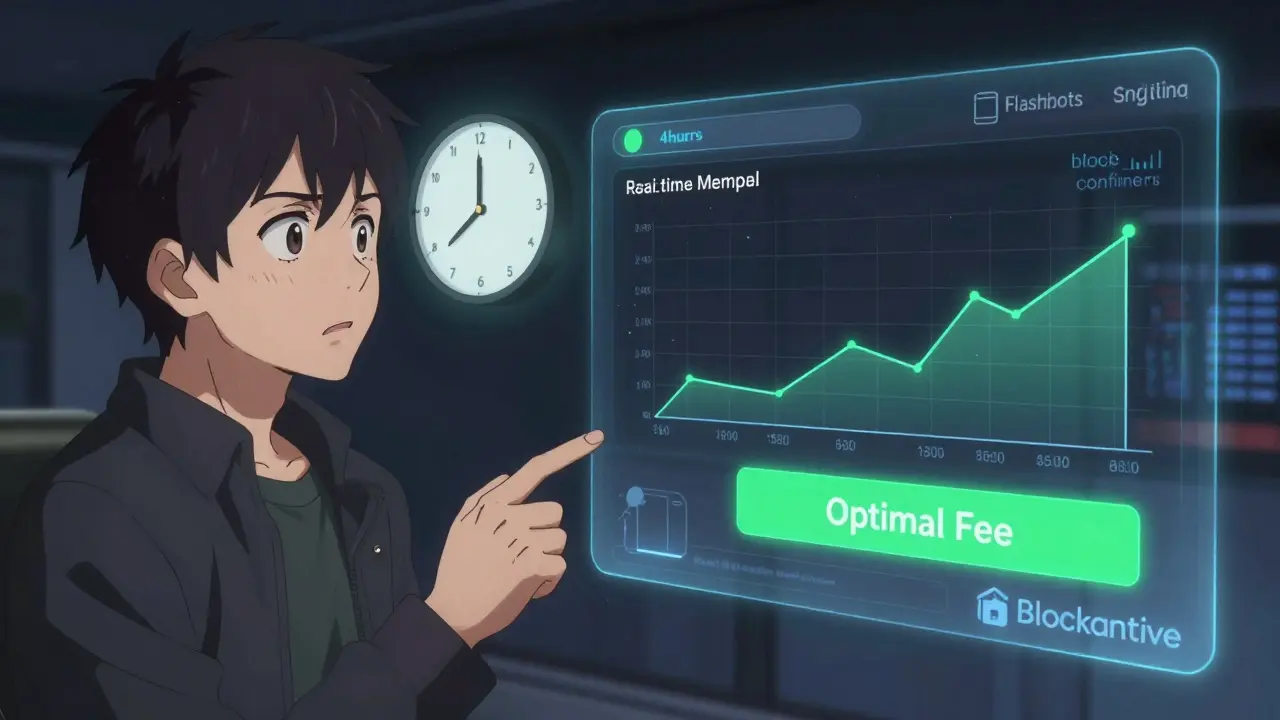
The New Tools Changing the Game
Several innovations are already reshaping how mempools behave - and they’re not theoretical. They’re live.
- EIP-1559 (Ethereum): Introduced in August 2021, this changed how fees work. Instead of bidding blindly, users now pay a base fee (burned) plus a tip. Fee volatility dropped by 42%. It didn’t fix everything, but it made things predictable.
- Package RBF (Bitcoin): Still in draft, this BIP-232 proposal lets you bump multiple related transactions at once. Imagine sending a payment and a swap together - now you can raise the fee on both with one click. Simulations show this could reduce stuck transactions by 55%.
- Proposer-Builder Separation (PBS): Coming to Ethereum in Q1 2024, PBS separates block building from block proposing. Specialized builders will compete to create the most profitable block, while proposers (validators) just pick the best one. Flashbots estimates this will cut MEV extraction by $140 million per year.
- Mempool-Aware Wallets: Wallets like Coinbase Wallet and Ledger now use real-time mempool data to suggest optimal fees. In a six-month trial, these wallets reduced failed transactions by 28%. No more guessing. Just accurate, live estimates.
Tools like Blocknative’s Mempool API and Mempool.space are giving users transparency. You can now watch the mempool in real time - see which transactions are climbing, which are stuck, and how fees are trending. These aren’t just for traders. Institutional users like J.P. Morgan’s Onyx division now rely on custom mempool monitoring to process over 1.2 million daily transactions with 99.98% reliability.
What’s Next? The Next Five Years
The next phase of mempool evolution isn’t just about tweaking fees. It’s about systemic redesign.
Standardization is coming. The W3C Blockchain Community Group launched a Mempool Interoperability Standards working group in September 2023. Their goal? Create a common language for mempools across chains. Imagine sending a transaction from Ethereum to Solana and having it behave predictably on both. Right now, that’s impossible. By Q4 2024, we could see cross-chain mempool protocols that cut transaction failure rates by up to 62%.
Mempool pruning is gaining traction. Cardano already expires transactions after two hours. This stops spam but hurts users who can’t afford high fees. New systems are combining pruning with dynamic timeout adjustments - if your transaction is low-fee but important (like a DAO vote), it gets extended. It’s smart filtering, not brute-force deletion.
AI-driven forecasting is here. dYdX reduced failed limit orders by 73% using mempool forecasting. Their system analyzes historical congestion patterns, upcoming block space availability, and even macro events (like a major exchange listing) to predict the best time to submit. This isn’t science fiction - it’s in production.
Enterprise adoption is accelerating. According to Deloitte’s 2023 Digital Asset Survey, 68 of the Fortune 100 now run blockchain nodes. And 42% say mempool congestion is their top technical challenge. They’re not just using crypto - they’re building financial infrastructure on it. That means they need reliability, not volatility.

Who’s Winning and Who’s Losing?
The mempool landscape is splitting into two worlds.
On one side, you have networks like Solana, which processes 65,000 transactions per second. But its “turbocharged” mempool caused 17 outages in 2022 because it prioritized speed over safety. It’s fast, but fragile.
On the other, Bitcoin and Ethereum are slow but stable. They’ve traded raw speed for resilience. That’s why they’re still the backbone of institutional adoption.
But the real winners? The tools and services built around mempools. Blocknative, Mempool.space, and Tenderly aren’t blockchains - they’re infrastructure layers. Their market is projected to grow from $127 million in 2023 to $893 million by 2028. That’s a 47.3% annual growth rate. And ARK Invest predicts the global mempool management market will hit $2.3 billion by 2030.
Meanwhile, chains without smart mempool systems are falling behind. Dogecoin, for example, has no dynamic fee estimation. In 2023, 37% of its transactions failed during congestion. That’s not a minor glitch - it’s a dealbreaker for any serious user.
What You Can Do Today
You don’t need to be a developer to benefit from better mempool management.
- Use a wallet that shows real-time fee estimates - not static sliders.
- Enable RBF if your wallet supports it (Trezor, Ledger, and MetaMask now do).
- Check mempool.space before sending large transactions. If the backlog is over 100,000, wait.
- Avoid sending during known congestion windows - like NFT drops or major protocol upgrades.
- For institutional users: demand mempool transparency from your blockchain provider. If they can’t show you real-time mempool data, they’re flying blind.
The future of blockchain isn’t just faster blocks or bigger capacity. It’s about fairness. About predictability. About giving users control back. The mempool is no longer a passive queue - it’s a battleground for trust. And the next wave of innovation is rewriting the rules.






Anthony Marshall
March 11, 2026 AT 22:23This is the kind of breakdown I’ve been waiting for. Mempools aren’t just technical backends-they’re the heartbeat of trust in crypto. When your transaction gets stuck, it’s not a glitch, it’s a power play. And honestly? The fact that we’re finally seeing tools like Package RBF and mempool-aware wallets is a win for regular users, not just whales. We’re moving from chaos to control.
Zephora Zonum
March 12, 2026 AT 02:49Interesting take but you're glossing over the real issue-the miners still control the narrative. EIP-1559 didn’t fix MEV, it just made it look prettier. And don’t get me started on how Solana’s 'speed' is just a house of cards held together by duct tape and optimism. The system is still rigged, just with better UI.
Lindsay Girvan
March 13, 2026 AT 04:05Stop pretending this is about fairness. It’s about who can afford to pay. The mempool isn’t broken-it’s working exactly as designed. The rich get faster lanes. The rest get stuck in digital traffic. No algorithm fixes that. No wallet update changes the power structure. This isn’t innovation. It’s camouflage.
vasantharaj Rajagopal
March 14, 2026 AT 10:42The complexity of mempool dynamics is often underestimated. The interplay between nonce management, fee estimation, and validator incentives requires a systems-level understanding. Many users operate under the assumption that fee markets are transparent, when in reality, they are opaque, non-linear, and subject to strategic manipulation by MEV bots operating at microsecond latencies.
William Montgomery
March 15, 2026 AT 13:39If you’re still using a wallet that doesn’t show real-time mempool data, you’re not just losing money-you’re enabling the system to exploit you. This isn’t optional anymore. It’s basic hygiene. Stop being lazy. Your transaction isn’t special. It doesn’t deserve priority just because you clicked send.
Adam Ashworth
March 16, 2026 AT 20:18I’ve been testing Package RBF for months. It’s a game-changer for DeFi flows. If you’re doing multi-step swaps or liquidity additions, being able to bump an entire package with one fee adjustment cuts failed transactions by half. No more frantic manual tweaking. Just set it and forget it-safely.
Allison Davis
March 18, 2026 AT 19:18Real-time mempool monitoring isn’t a luxury anymore-it’s a necessity. I run a small DeFi fund, and we’ve cut our failed transactions from 18% to under 2% by integrating Mempool.space into our workflow. The data is raw, unfiltered, and brutally accurate. If you’re not using it, you’re flying blind.
Tom Jewell
March 19, 2026 AT 21:17The mempool is the modern-day agora. A place where value, urgency, and greed collide in silence. We think we’re sending transactions, but really, we’re whispering into a void-and hoping someone hears us. The beauty of EIP-1559 is that it gave us a voice. Not a loud one, not a guaranteed one-but a voice. That’s more than we had before.
karan narware
March 21, 2026 AT 06:04Interesting… but have you considered how this reflects Western capitalist models of efficiency? In India, we’ve always known: transactions aren’t about speed-they’re about relationships. A friend’s transaction gets priority. A neighbor’s gets a nod. Maybe the future isn’t algorithmic… maybe it’s communal.
Michael Suttle
March 22, 2026 AT 02:15They’re lying. All of it. PBS? MEV reduction? It’s all a front. The real power is in the validator syndicates-private groups that control block building behind closed doors. You think J.P. Morgan is using this for 'reliability'? Nah. They’re front-running retail users and calling it 'infrastructure'. Wake up.
Jenni James
March 22, 2026 AT 12:06Let me be clear: The notion that 'mempool management' is a legitimate field of study is a product of tech bros who confuse complexity with intelligence. Transactions should be simple. Send. Confirm. Done. The entire ecosystem has been over-engineered into a labyrinth of fees, APIs, and dashboards-just to extract more money from people who don’t understand it.
Chelsea Boonstra
March 24, 2026 AT 07:06I tried to send a transaction during the Solana outage last year. It sat for 11 hours. I thought it was broken. Turns out, the mempool was full of spam from bots. No one was mining. No one was even trying. It’s not a queue-it’s a graveyard. And they call this innovation?
Alex Thorn
March 24, 2026 AT 23:35For anyone feeling overwhelmed by the complexity-take a breath. You don’t need to understand every layer. Just use a wallet that does it for you. Enable RBF. Check the mempool before you send. That’s it. You’re not failing. The system is just trying to make you feel like you are.
Howard Headlee
March 25, 2026 AT 08:55Let’s get real: the mempool isn’t just about fees-it’s about dignity. When your transaction gets stuck, you feel invisible. Like your time, your money, your effort doesn’t matter. The tools we’re building now? They’re not technical upgrades. They’re emotional ones. They say: ‘You matter. Your transaction matters. Your time matters.’ That’s revolutionary.
Julie Tomek
March 25, 2026 AT 21:07As a long-time institutional blockchain operator, I can confirm that mempool congestion remains the single greatest operational risk in our infrastructure stack. The projected $2.3B market by 2030 is not speculative-it is inevitable. Enterprises require deterministic transaction finality, and legacy mempool architectures simply cannot deliver. The convergence of AI forecasting, proposer-builder separation, and standardized cross-chain protocols represents not an evolution, but a paradigm shift in distributed ledger infrastructure.
Brandon Kaufman
March 27, 2026 AT 16:02Just wanted to say thanks for writing this. I’ve been stuck on a transaction for 3 days. Didn’t know what to do. I checked Mempool.space, saw the backlog was 120k, waited. Sent it again with a 2x fee. Confirmed in 12 minutes. You saved me a lot of stress. Seriously.
Craig Gregory
March 27, 2026 AT 19:26Every time someone says 'mempool transparency' I laugh. You think seeing the queue means you have power? You’re just watching the same system that stole your gas money last week. The only people who benefit from these dashboards are the ones who built them. And they’re the ones who already own the keys.
Anshita Koul
March 29, 2026 AT 09:31AI forecasting is the future-but only if it’s open-source. If only big firms get access to predictive mempool models, we’re creating a new class divide: those who can predict congestion, and those who get crushed by it. The next big battle won’t be on-chain-it’ll be in the codebase.
PIYUSH KOTANGALE
March 29, 2026 AT 17:45Great summary! I’ve been using Coinbase Wallet’s fee estimator since last year-game changer. No more guessing. Just look at the graph, pick the green zone, hit send. My failed tx rate dropped from 22% to 3%. Also, RBF enabled-no regrets.
vishnu mr
March 30, 2026 AT 17:52lol i just sent a doge tx and it took 8 hrs 😅 maybe i should try that mempool.space thing
Grace van Gent-Korver
March 31, 2026 AT 00:49I just use Trust Wallet. It works. Why overcomplicate?
Douglas Anderson
March 31, 2026 AT 22:16For beginners: if you’re unsure, wait 30 minutes after a peak. Fees drop fast. I check the 1-hour trend on mempool.space before every send. It’s not magic, but it’s better than guessing. And yes-RBF is your friend.
Tina Keller
April 2, 2026 AT 08:34The mempool is the quiet battlefield where value is negotiated-not by code, but by human behavior. The real innovation isn’t in the algorithms. It’s in the empathy built into wallets that say, 'I see you waiting.' That’s the future: not just faster, but kinder.
ann neumann
April 4, 2026 AT 01:45They’re all lying. This isn’t about fairness. It’s about control. The mempool is a surveillance tool. Every transaction you send is tracked, analyzed, and monetized by the same entities who profit from your panic. They want you to think you’re choosing fees. You’re not. You’re being manipulated. And you’re paying for the privilege.