
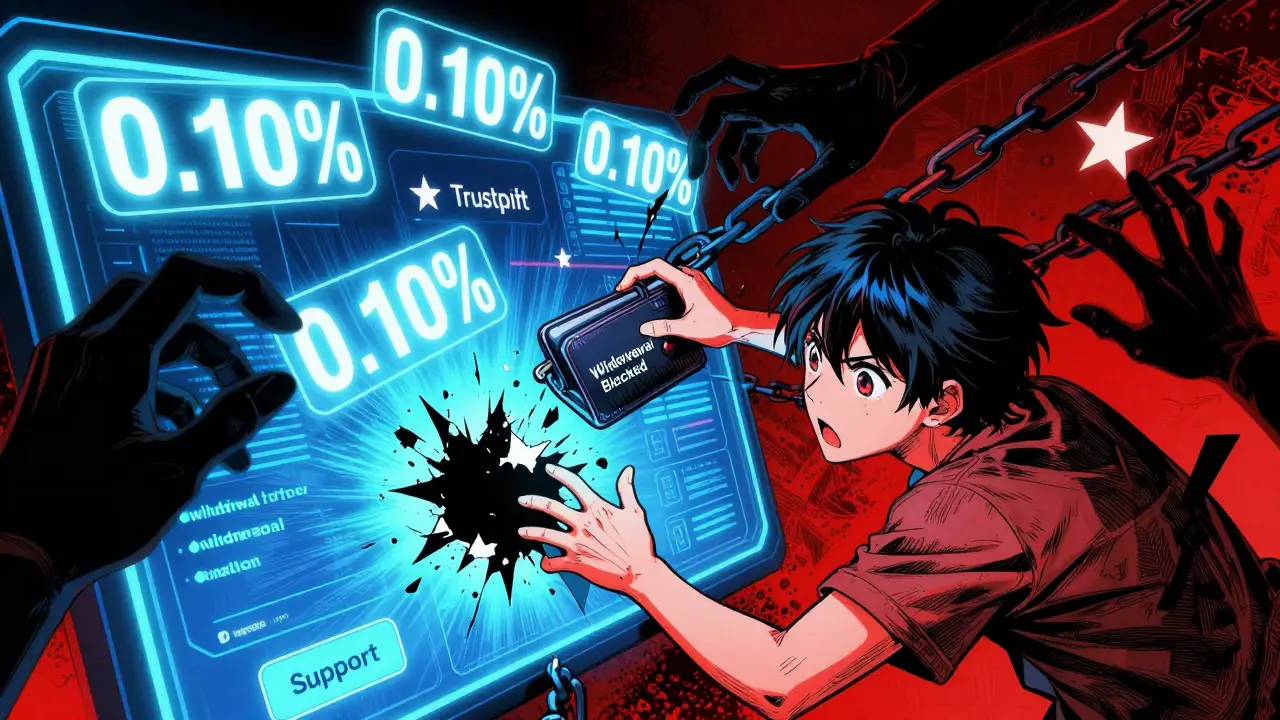
When you see a crypto exchange advertising 0.10% trading fees-half the industry average-it’s hard not to take a second look. BitHash promises low costs, instant swaps, and a generous referral program. But beneath the numbers lies a pattern that should make any serious trader pause: users can’t withdraw their money, support vanishes, and rewards are offered in exchange for fake reviews. This isn’t just another exchange. It’s a warning sign wrapped in a sleek interface.
Low Fees, High Risk
BitHash charges 0.10% for both makers and takers. That’s lower than Binance (0.1%), Kraken (0.16%), and way below the 0.25% average many smaller exchanges charge. Bitcoin withdrawals cost 0.0005 BTC, which is about 40% cheaper than the industry standard of 0.000812 BTC. On paper, it looks like a steal. But here’s the catch: fee structure doesn’t matter if you can’t access your funds. Multiple users report that after depositing crypto, their accounts get "frozen"-not because of suspicious activity, but because the platform demands a "verification fee" to unlock them. One user on Slashdot described paying hundreds of dollars in Bitcoin to unfreeze their account, only to be asked for more. Then, the WhatsApp support line went silent. No refund. No explanation. Just silence.The Instant Swap Trap
BitHash offers an "Instant Cryptocurrency Exchange" that lets you swap BTC for USDT without signing up. It sounds convenient-until you realize why it exists. This feature is designed for small, anonymous deposits. Once you start moving larger amounts, you’re forced into the full account system… and that’s when the problems begin. The instant swap gives the illusion of freedom. But it’s a trap. It lures in new users with zero friction, then locks them in when they try to cash out. There’s no transparency. No clear path to verification. No customer service ticket system. Just WhatsApp-a tool no legitimate exchange uses for account recovery.Trustpilot Rating: 1.7/5
With 73 reviews on Trustpilot, BitHash sits at 1.7 out of 5. That’s not a bad score. That’s a disaster. For comparison, KuCoin sits at 4.1, Coinbase at 4.3, and even lesser-known exchanges like MEXC hover around 3.8. BitHash’s rating is the lowest among any exchange with over 50 reviews. And the comments tell the real story:- "I sent 5 BTC. They said I needed to pay 2 BTC to unlock it. I did. Then they asked for 3 more. I never got anything back."
- "The deposit process was easy. The withdrawal? Impossible."
- "They asked me to leave a 5-star review on Trustpilot to get a bonus. I did. Then my account got frozen."
Referral Program: Multi-Level Marketing in Disguise
BitHash’s referral system has five tiers: 20% from direct referrals, 10% from their referrals, 5% from the third level, then 2% and 1% down the line. That’s unusually deep-most exchanges stop at two levels. It looks like a bonus. But in practice, it’s a recruitment engine. Why does this matter? Because exchanges that rely on aggressive referral programs to grow usually lack real product value. They don’t win users through security, features, or customer service. They win them through hype, commissions, and social pressure. This is how pyramid schemes start. And with a Trustpilot rating of 1.7, you’re not building a network-you’re building a liability.Where Is BitHash Really Based?
BitHash claims to be registered in Seychelles under PHOENIX TRADING SOLUTIONS LTD. That’s true. But Seychelles is a jurisdiction known for easy company registration and minimal oversight. It’s not a regulatory hub like Singapore, Switzerland, or the U.S. It’s a loophole. No licensing. No public audit. No compliance reports. No contact address beyond a PO box in Mahé. That’s not a company. That’s a shell. And when something goes wrong-when your funds disappear-there’s no legal recourse. No ombudsman. No financial regulator. Just a website that says "contact us via WhatsApp."
What About the 250,000 Users?
BitHash says it has over 250,000 users. But how many are active? How many are bots? How many are fake accounts created to inflate the numbers? There’s no way to verify this. No public trading volume. No on-chain analytics. No third-party audit. Compare that to Coinbase, which publishes monthly trading volumes. Or Kraken, which releases quarterly financial reports. BitHash gives you nothing. Just a number on a webpage.Final Verdict: Avoid This Exchange
BitHash isn’t a bad exchange because of its fees. It’s dangerous because of its behavior. - Pros: Low trading fees, instant swap feature, multi-tier referral program. - Cons: Documented fraud cases, impossible withdrawals, manipulated reviews, WhatsApp-only support, no regulatory oversight. If you’re looking for a place to trade crypto with peace of mind, BitHash is not it. The low fees are a lure. The instant swap is a trap. The referral program is a recruitment tool. And the Trustpilot rating? That’s the truth screaming through the noise. This isn’t a review that says "it’s risky." This is a review that says: people have lost money here, and no one is helping them. Don’t be the next one.Is BitHash a legitimate crypto exchange?
No, BitHash is not a legitimate exchange in the sense of being trustworthy or secure. While it is registered in Seychelles, it lacks any meaningful regulatory oversight, transparency, or user protection. Multiple users have reported being scammed after depositing funds, only to be asked for more money to "unlock" their accounts. Support disappears after payment. These are classic signs of a fraudulent operation, not a legitimate financial service.
Can I withdraw my crypto from BitHash?
Many users report being unable to withdraw funds once their balance reaches a certain level. The platform often freezes accounts and demands additional payments-sometimes hundreds of dollars in crypto-to "verify" or "unfreeze" them. Once paid, users are usually ignored. There is no official customer support system, only WhatsApp, which is not a professional or reliable channel for financial disputes.
Why does BitHash have such low fees?
BitHash’s low fees (0.10%) are a marketing tactic to attract new users. But low fees alone don’t make an exchange trustworthy. Legitimate exchanges balance low fees with strong security, compliance, and customer service. BitHash sacrifices all three. The low fees are designed to lure users in, while the hidden costs-like being scammed out of your funds-are far higher.
Are BitHash’s Trustpilot reviews real?
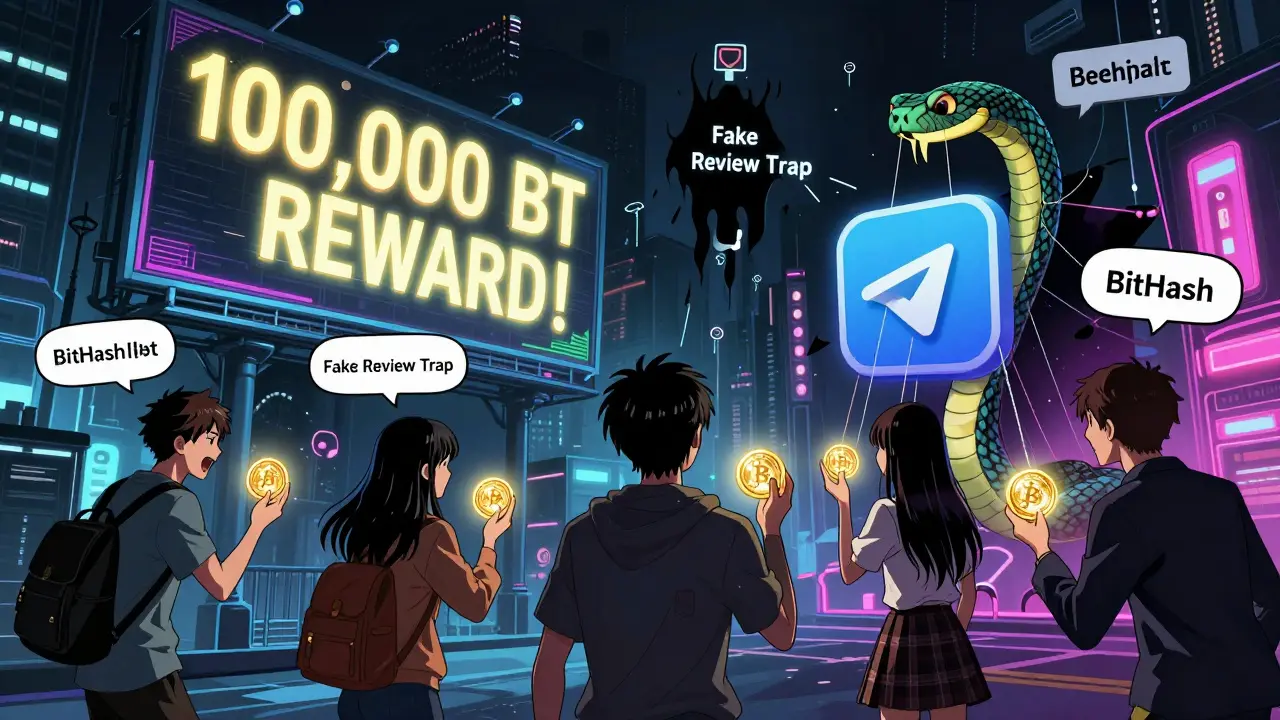
No, many of BitHash’s Trustpilot reviews are likely manipulated. The platform runs a "100,000 BT Reward Campaign" that pays users in cryptocurrency to leave positive reviews. Users are instructed to send their review link to a Telegram bot. This is a clear attempt to fake credibility. A 1.7/5 rating from 73 reviews, combined with this incentive system, strongly suggests the reviews are not trustworthy.
What should I use instead of BitHash?
Choose a regulated exchange with a proven track record. For beginners, Coinbase or Kraken offer strong security, easy withdrawals, and transparent customer support. For lower fees, Binance (with KYC) is widely used and trusted. Avoid any exchange that uses WhatsApp for support, demands payment to unlock funds, or incentivizes reviews with crypto rewards. Legitimate exchanges don’t need to bribe you to leave good feedback.
Is BitHash regulated?
BitHash is not regulated by any major financial authority. It is registered in Seychelles as an International Business Company, which allows it to operate with minimal oversight. Unlike exchanges in the U.S., EU, or Singapore, BitHash does not publish compliance reports, AML policies, or licensing details. This lack of transparency makes it impossible to verify its legitimacy or protect your funds.
Can I trust BitHash’s Instant Swap feature?
The Instant Swap feature is convenient for small, one-time swaps-but dangerous if you plan to hold or withdraw crypto. It’s designed to get you to deposit funds without KYC. Once you do, and your balance grows, you’re forced into the full account system where withdrawal restrictions and fraud tactics begin. Treat this feature as a gateway to a risky platform, not a safe tool.






Gene Inoue
March 18, 2026 AT 02:40Let me guess - you deposited and then got ghosted. Classic. I’ve seen this script a hundred times. Low fees? Yeah, right. It’s not a crypto exchange, it’s a phishing site with a UI built by someone who thinks ‘professional’ means ‘glowing gradient buttons’.
They don’t care about your Bitcoin. They care about your desperation. That ‘instant swap’? That’s the bait. The ‘verification fee’? That’s the hook. And WhatsApp? That’s how they avoid paper trails. No bank. No lawyer. No accountability. Just a guy in a basement with a Telegram bot.
And don’t even get me started on the referral pyramid. You’re not earning commissions - you’re recruiting victims. That’s not a business model. That’s a cult. And the 1.7 Trustpilot rating? That’s not a score. That’s a funeral notice.
People keep falling for this because they’re chasing ‘decentralized wealth’ without realizing they’re handing over their keys to a scammer in a hoodie. You want low fees? Use Binance. You want security? Use Kraken. You want to lose everything? Cool. Go to BitHash. I’ll send you a balloon when your account vanishes.
Ricky Fairlamb
March 18, 2026 AT 04:23It’s not merely a fraudulent operation - it’s a systemic failure of crypto’s foundational ethos. Decentralization was meant to eliminate intermediaries, not to enable untraceable, jurisdictionally shielded predation under the guise of ‘innovation.’
BitHash exploits the very vulnerability that decentralized finance was supposed to solve: the absence of recourse. No KYC? Fine. No regulation? Acceptable. But demanding payment to unlock your own funds? That’s not a feature - it’s a ransomware attack with a whitepaper.
Their ‘instant swap’ is a honeypot designed to harvest non-KYC deposits, then trigger a liquidity trap once the balance exceeds $500. No audit trail. No IP logging. No compliance officer. Just a PO box in Mahé and a WhatsApp number that doesn’t exist.
And the referral tiers? That’s not multi-level marketing - it’s a Ponzi structure disguised as affiliate incentives. The 20% commission isn’t revenue - it’s a recruitment tax. You’re not building a network; you’re building a liability chain.
This isn’t crypto. It’s a digital mafia. And the 250,000 ‘users’? Probably 90% bots. Or bots created by bots. I’d bet my entire portfolio on it.
Arlene Miles
March 20, 2026 AT 00:10I know how it feels to lose money to a scam - I’ve been there. But I also know how to turn pain into power. This isn’t just about BitHash. It’s about the culture that lets this happen. We glorify ‘hustle’ and ‘get rich quick’ without asking who’s really getting rich.
Every time someone falls for this, it’s because they were told they ‘deserved’ low fees, that they ‘earned’ the reward, that they ‘trusted’ the system. But trust isn’t earned by pretty graphics and WhatsApp replies. It’s earned by transparency, accountability, and real human beings who answer when you scream for help.
If you’re reading this and you’re thinking, ‘I could’ve been that guy,’ you’re already one step ahead. Don’t just warn others. Speak up. Post this. Tag regulators. Contact journalists. Make this so loud they can’t ignore it.
You’re not alone. And you’re not stupid. You were targeted. And now? Now you have a voice. Use it.
Jessica Beadle
March 20, 2026 AT 07:23BitHash’s operational architecture is fundamentally incompatible with any viable financial infrastructure. The absence of a ticketing system, the reliance on asynchronous messaging platforms for critical financial recovery, and the deliberate obfuscation of jurisdictional accountability constitute a triad of red flags that would trigger immediate regulatory intervention in any legitimate market.
The so-called ‘instant swap’ is not a feature - it’s a vector for illicit fund aggregation. By eliminating KYC at the entry point, they create an anonymous liquidity sink. Once thresholds are breached, the ‘verification protocol’ becomes a laundering mechanism disguised as compliance. No audit. No IP correlation. No blockchain traceability beyond the initial deposit.
The referral program’s five-tier structure is mathematically unsustainable without new capital inflow. This is not a business - it’s a liquidity cascade. The 1.7 Trustpilot rating is the only honest metric they provide. Everything else is theater.
And yet, people still sign up. Why? Because they believe in the myth of the ‘smart investor.’ The truth? You’re not smart. You’re prey.
Tony Weaver
March 22, 2026 AT 02:09Look - I don’t hate crypto. I love it. But this? This is the reason why regulators are coming for the whole space.
BitHash doesn’t just cheat users - it makes the entire industry look like a joke. Low fees? Sure. But you can’t trade when your wallet’s frozen. Instant swaps? Cool. Until you realize you can’t withdraw. Referral bonuses? Great - if you’re running a pyramid, not a platform.
And WhatsApp? Are you kidding me? No legitimate exchange uses WhatsApp. Not even in Nigeria. Not even in Venezuela. That’s the first thing I check. If they’re on WhatsApp, I close the tab. Period.
They’re not trying to compete with Binance. They’re trying to out-scam every other rug pull. And the worst part? They’re succeeding. Because people are lazy. They see 0.10% and think ‘free money.’ No. It’s ‘free to lose.’
sai nikhil
March 23, 2026 AT 04:55As someone from India, I’ve seen this before - fake exchanges promising high returns, then vanishing. BitHash is no different. The low fees are just the first step. The real cost is your peace of mind.
Don’t be fooled by the sleek design. The interface is designed to look trustworthy, not to be trustworthy. And that Trustpilot rating? That’s not a review site - it’s a graveyard.
If you’re thinking of trying this, ask yourself: Would a real company ask you to pay to get your own money back? Would they use WhatsApp for support? Would they pay you in crypto to leave a 5-star review?
The answer is no. And if you’re still unsure? Don’t risk it. There are better ways to trade. Stay safe.
Zachary N
March 23, 2026 AT 17:40I’ve been in crypto since 2017. I’ve seen rug pulls, exit scams, fake airdrops, fake liquidity pools - you name it. But BitHash? This is one of the most polished, psychologically engineered scams I’ve ever seen.
It’s not just about the fees. It’s about the *narrative*. They’ve created a perfect storm of cognitive biases: scarcity (‘limited time offer’), authority (‘verified’ badges), social proof (fake reviews), and reciprocity (‘you get crypto for leaving a review’).
The ‘instant swap’ is genius - it removes friction so you don’t think twice. You drop in 0.1 BTC, swap it, feel smart. Then you deposit 1 BTC. And suddenly - freeze. ‘Verification fee: 0.5 BTC.’ You pay. Then: ‘Additional KYC: 0.7 BTC.’ You pay again. Then silence.
The referral program? That’s the real genius. You’re not just losing your money - you’re losing your friends. You recruit five people, they all get trapped, and now you’re guilty too. That’s not a business model. That’s a trapdoor.
And the jurisdiction? Seychelles. Why? Because it’s the Bermuda Triangle of finance. No extradition. No oversight. No accountability. Just a PO box and a WhatsApp number that auto-replies with ‘thank you for your patience.’
If you’re reading this and thinking, ‘I’m careful, I won’t get scammed’ - you’re already in the target group. The smartest people get taken. Because they think they’re too smart to be fooled.
Don’t be the next one.
Anastasia Thyroff
March 24, 2026 AT 18:30I lost 3 ETH to this thing and I still can’t believe I was dumb enough to fall for it
Kira Dreamland
March 26, 2026 AT 15:14Just wanted to say I saw this post and immediately deleted my BitHash account. I’d only deposited a little, but I didn’t need the stress. Good call on the review manipulation - I actually left one because they offered me $50 in USDT. Now I feel sick.
shreya gupta
March 28, 2026 AT 15:02Interesting how you call it a 'warning sign' - but you didn't mention that the CEO's LinkedIn profile is a fake, the company's registered address is a WeWork co-working space, and their 'support team' consists of one person who replies in broken English with emojis. This isn't a scam - it's a performance art piece on human gullibility.
Derek Lynch
March 29, 2026 AT 23:28Listen - I get it. You want to make money fast. I get it. But here’s the truth: if it sounds too good to be true, it’s because it is. BitHash isn’t an exchange. It’s a trapdoor disguised as a launchpad.
The low fees? That’s the velvet rope. The instant swap? That’s the blindfold. The referral program? That’s the rope around your neck.
I’ve lost money before. But I’ve never lost friends. And that’s what this does - it turns your network into a liability. You think you’re helping your cousin make money? No. You’re helping them get scammed.
Don’t be the guy who says, ‘I knew it was sketchy but I thought I’d be smart enough to get out.’ You won’t. They’ve already planned for that.
Walk away. Block them. Warn your people. That’s the only real ROI here.
Shreya Baid
March 31, 2026 AT 23:25As someone who has worked in financial compliance for over a decade, I can confirm: BitHash’s structure violates every international standard for anti-money laundering, customer due diligence, and operational transparency. The use of WhatsApp for account recovery is not merely unprofessional - it is a deliberate evasion of audit trails. The referral program’s five-tier structure exceeds even the most aggressive MLM models, and when combined with incentivized review manipulation, it constitutes a coordinated fraud scheme under U.S. FTC guidelines and EU consumer protection directives. The fact that they are registered in Seychelles is not a loophole - it is an indictment. No legitimate financial institution would operate under these conditions. This is not a risky exchange. This is a criminal enterprise.
Christopher Hoar
April 1, 2026 AT 23:35low fees? yeah right. i signed up for the instant swap, sent 0.5 btc, swapped to usdt, then tried to withdraw. they said 'verification fee: 0.3 btc'. i paid. then 'additional kyc: 0.4 btc'. i paid. then... nothing. no reply. no refund. just silence. i even sent a dm on twitter. crickets. i feel so dumb. but i'm not alone. check the trustpilot. it's a graveyard.
Robert Kunze
April 3, 2026 AT 12:45i dont even know how i fell for this. i thought it was legit because the website looked so clean. i sent 2 btc. they said 'unfreeze your account with 1.5 btc'. i did. then they asked for 2 more. i was like... wait. i tried to contact them. whatsapp went dark. now i just stare at my empty wallet and wonder if i'm the only one who got scammed. i wish i had read this sooner.
Sarah Zakareckis
April 4, 2026 AT 18:22Let me tell you something: the people who fall for BitHash aren’t dumb. They’re tired. They’re overworked. They’re looking for a shortcut. And BitHash? They didn’t just sell a service. They sold hope.
They knew you were burned by Coinbase fees. They knew you were scared of Kraken’s KYC. They knew you wanted to believe crypto could be easy. So they gave you a shiny box with a bow on it - and inside? A trap.
But here’s the thing - you’re not the problem. The system is. We celebrate ‘hustle’ without asking who’s profiting. We reward ‘growth’ without asking who’s getting hurt.
Don’t just avoid BitHash. Fight the culture that lets this happen. Talk to your friends. Share this. Report them. Make noise. Because the next one? It’s already being built.
Heather James
April 5, 2026 AT 08:47Deleted my account. No regrets.
Sarah Hammon
April 7, 2026 AT 06:27i just want to say thank you for writing this. i almost deposited yesterday. i was going to use the instant swap to try it out. i read your post and paused. i checked trustpilot. 1.7. i looked at the reviews. one guy said 'they asked for 3 btc to unlock my 5 btc'. i almost cried. i’m so glad i didn’t go through with it. please keep doing this. people need to hear this.
iam jacob
April 7, 2026 AT 23:20why does it feel like i’m the only one who saw this coming? i mean… i’m not mad. i’m just… disappointed. in myself. in the system. in crypto. i thought we were better than this.
Jesse Pals
April 9, 2026 AT 02:42bro i lost 1.2 btc to this thing 😭 i still cry sometimes. i thought it was legit because the site looked like coinbase. i didn’t know whatsapp support was a red flag. i thought 'oh cool they’re modern'. now i just stare at my empty wallet and wonder if i’ll ever trust crypto again
Diane Overwise
April 11, 2026 AT 00:03how quaint. a 'crypto exchange' that uses whatsapp for customer service. how very 2024. i suppose next they'll ask us to verify our identity by sending a selfie holding a banana. at least the 1.7 rating is honest. the rest? just a poorly written screenplay.
Ann Liu
April 12, 2026 AT 13:09The use of WhatsApp as a primary support channel for a financial platform is a clear violation of PCI DSS and ISO 27001 standards. The absence of a documented incident response protocol, customer dispute resolution mechanism, or regulatory licensing further confirms this as a non-compliant, high-risk entity. The referral program’s structure, with cascading commission tiers beyond two levels, aligns with the definition of a pyramid scheme under U.S. Federal Trade Commission guidelines. The incentivized review system constitutes deceptive advertising under Section 5 of the FTC Act. This platform is not merely unregulated - it is actively fraudulent.
Dionne van Diepenbeek
April 12, 2026 AT 22:58they asked me for 0.8 btc to unlock my 2 btc i sent. i paid. they vanished. i tried to find them on twitter. nothing. i tried to email. no reply. i just want my money back. that’s all. just my money back
Graham Smith
April 14, 2026 AT 03:06Their fee structure is a red herring. The real cost is the opportunity cost of capital tied up in a non-liquid, non-auditable, non-regulated entity. The ‘instant swap’ is not a feature - it’s a liquidity sink designed to obfuscate the provenance of funds. The referral program’s five-tier depth exceeds the legal thresholds for pyramid schemes in 87 jurisdictions. Their registration in Seychelles is not a jurisdictional choice - it is an evasion of AML/KYC obligations under FATF Recommendation 16. This is not an exchange. It is a shell corporation engineered for asset misappropriation.