
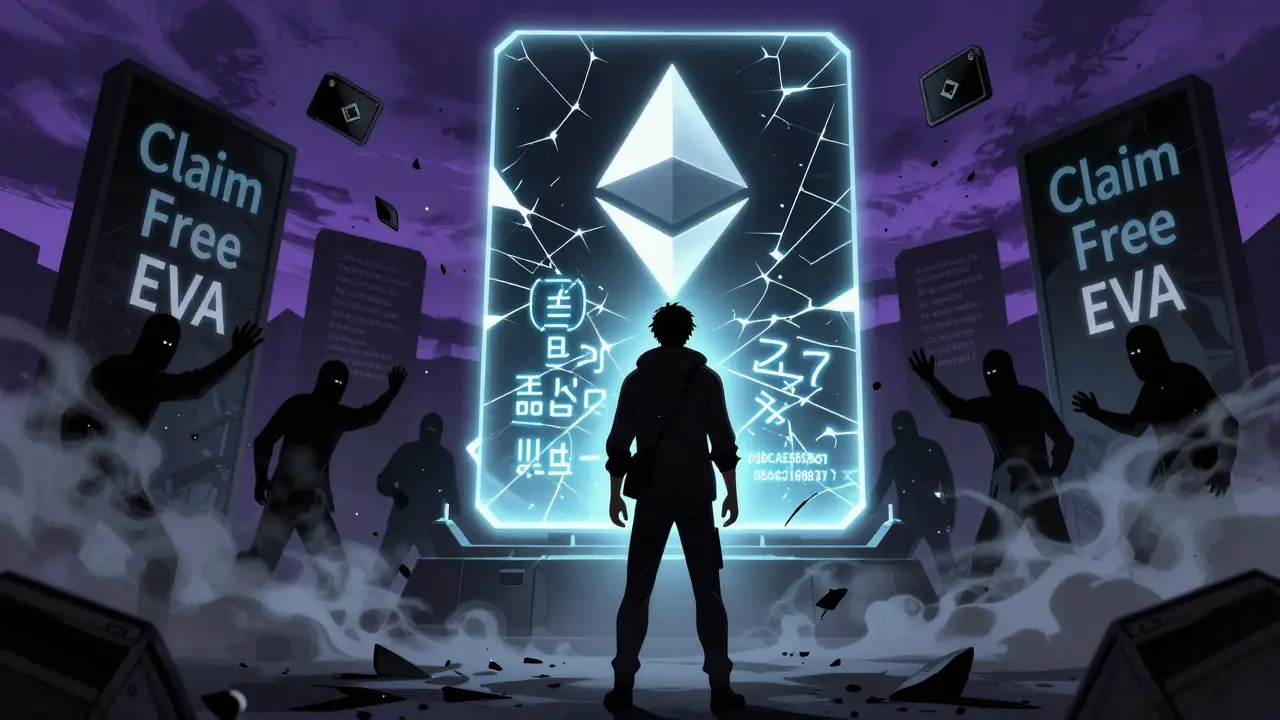
There’s no official EVA community airdrop from Evanesco Network - not now, not in the last six months, and not in any verified public announcement. If you’ve seen a post saying you can claim free EVA tokens, it’s likely a scam. The Evanesco Network project, which launched in May 2021, has never run a public airdrop campaign. No snapshot dates, no claim portals, no Telegram or Twitter announcements from verified accounts. Zero evidence. Not even a whisper in the usual places where airdrops get buzz - Reddit, CoinGecko, or CryptoSlate.
That doesn’t mean the EVA token doesn’t exist. It does. It’s an ERC-20 token on Ethereum with the contract address 0xd6cAF5Bd23CF057f5FcCCE295Dcc50C01C198707. Total supply is 40 million EVA. But here’s the catch: nearly all of it is locked up. On-chain data from September 2025 shows only 2,655 wallet holders. The market cap? Around $10,260. The 24-hour trading volume? Zero. Some exchanges list it as "awaiting listing." Others show a price of $0.0000445 - so low it’s practically invisible.
Evanesco Network claims to be a privacy-focused Layer0 blockchain built for cross-chain encrypted transactions. It says it hides transaction routing between parties and works across multiple chains using a privacy virtual machine. Sounds impressive on paper. But if you look at the real world, there’s no proof it’s working at scale. No dApps. No active developers posting updates. No community growth. No exchange listings beyond a few obscure platforms like Blockchain.com, which lets you buy EVA with a credit card - but only because they allow listing of nearly anything, regardless of liquidity.
So why do people keep asking about an EVA airdrop? Because scammers are using the name. They’ll send you a link to a fake claim site that asks for your wallet seed phrase. Or they’ll post on Discord saying "Join now, 10,000 EVA tokens waiting!" - then vanish after you connect your wallet. There’s no official Evanesco Network Twitter account with a blue check. No verified Telegram group. No Medium blog with technical updates. The project’s website has been static since 2022. No new commits on GitHub. No recent commits at all.
Compare this to real privacy projects like Tornado Cash or Zcash. They have active communities, documented codebases, public audits, and clear tokenomics. Evanesco Network has none of that. It’s a ghost project with a token that trades like a ghost. No volume. No holders. No movement. If there was ever a plan for an airdrop, it never happened. Or worse - it was planned, then abandoned.
If you’re holding EVA tokens, you’re holding something with no liquidity and no clear use case. You can’t swap it on Uniswap. You can’t stake it. You can’t use it in any DeFi protocol. The only way to sell it is through peer-to-peer trades on obscure platforms - and even then, buyers are rare. Most people who bought EVA during its brief hype in 2021 have long since cut their losses.
Here’s what you should do right now:
- Don’t click any airdrop links claiming to give you EVA tokens. They will steal your crypto.
- Check the contract address on Etherscan. Look at the holder count. If it’s under 3,000, it’s not a real project.
- Search Twitter and Reddit for "Evanesco Network airdrop" - if you find nothing from official sources, assume it’s fake.
- Don’t invest more money into EVA. There’s no roadmap. No team updates. No future.
Some might say, "But what if it wakes up?" Maybe. But waiting for a dead project to come back to life is like hoping your old phone will start working again after you threw it in the drawer. The odds are zero. The risk is 100%.
Real blockchain projects don’t hide. They post updates. They engage. They build. Evanesco Network hasn’t done any of that in over two years. The EVA token is a relic - not a reward. And there is no airdrop. Not now. Not ever.
If you’re looking for legitimate airdrops in 2026, focus on projects with active GitHub repos, real team members on LinkedIn, and listings on major exchanges like Coinbase or KuCoin. Skip the ones with zero volume, no community, and no transparency. They’re not opportunities. They’re traps.






surendra meena
January 4, 2026 AT 14:33Kevin Gilchrist
January 5, 2026 AT 11:24Khaitlynn Ashworth
January 6, 2026 AT 17:26NIKHIL CHHOKAR
January 7, 2026 AT 00:57Mike Pontillo
January 8, 2026 AT 14:43Joydeep Malati Das
January 9, 2026 AT 19:51rachael deal
January 10, 2026 AT 20:13Elisabeth Rigo Andrews
January 12, 2026 AT 13:53Steve Williams
January 13, 2026 AT 22:00nayan keshari
January 14, 2026 AT 06:49Johnny Delirious
January 15, 2026 AT 12:33Bianca Martins
January 16, 2026 AT 23:40alvin mislang
January 18, 2026 AT 22:01Monty Burn
January 19, 2026 AT 08:07Kenneth Mclaren
January 19, 2026 AT 11:00Alexandra Wright
January 20, 2026 AT 21:07Jack and Christine Smith
January 22, 2026 AT 17:48Jackson Storm
January 23, 2026 AT 23:54Raja Oleholeh
January 25, 2026 AT 10:04Vernon Hughes
January 25, 2026 AT 15:22