
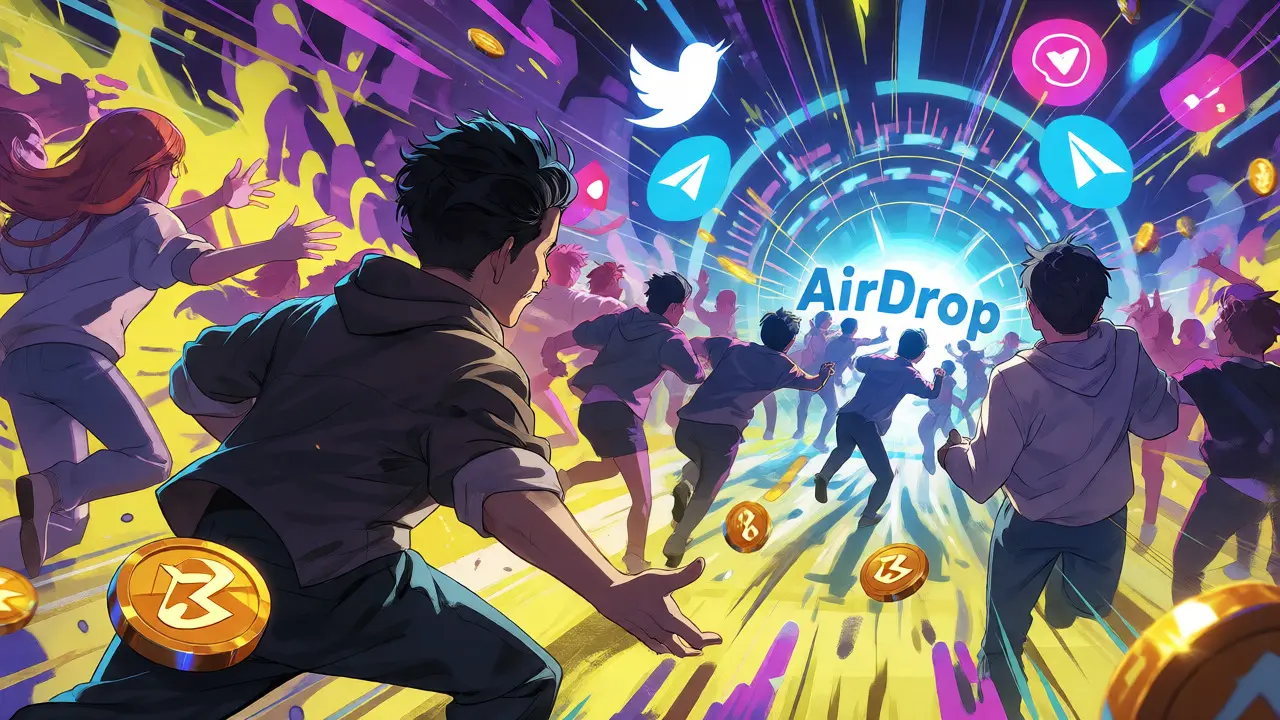
Remember the frenzy of 2021? If you were anywhere near the DeFi Warrior community back then, you likely remember the scramble for free tokens. The project promised a unique blend of decentralized finance and NFT gaming, and the FIWA airdrop program was its primary tool to get people talking before the main launch. But what exactly happened with those drops? And more importantly, does holding onto that tiny fraction of a coin still make sense in today's market?
We’re not just looking at history here. We’re breaking down the mechanics of the FIWA airdrops, the harsh reality of current tokenomics, and whether this niche play-to-earn platform has any life left in it. If you missed out on AirDrop #1 or #2, don’t worry-this guide covers everything from the original distribution criteria to where the price stands right now.
What Was the DeFi Warrior Airdrop Strategy?
DeFi Warrior is a blockchain-based gaming project that combines DeFi elements with NFT mechanics. Launched in 2021, it positioned itself as an innovative mix of a decentralized exchange (DEX) and a battle arena. To bootstrap this ecosystem, the team didn’t just rely on paid marketing. They used a series of strategic airdrops.
The roadmap explicitly listed multiple phases, labeled simply as "AirDrop #1," "AirDrop #2," and so on. These weren't random giveaways; they were timed precisely during the token sale planning phase in July 2021. The goal was clear: build a community base before opening up seed and strategic funding rounds. By distributing tokens early, the team ensured that holders had a vested interest in the project’s success from day one.
Unlike some modern airdrops that require complex on-chain interactions months in advance, these early FIWA drops were largely social-driven. Participants typically needed to follow official channels, join Telegram groups, or retweet specific announcements. It was a classic growth hack: trade your attention for equity in the form of BEP-20 tokens.
Tokenomics: How Much Did You Actually Get?
Let’s look at the numbers, because context matters when evaluating if an airdrop was "worth it." The total supply of FIWA is capped at 10 billion tokens. That sounds massive, but only a sliver went to the public through initial sales and airdrops.
| Category | Percentage of Supply | Token Amount | Notes |
|---|---|---|---|
| Public Sale | 0.89% | 88.8 Million | Includes IDO/IEO participants |
| Airdrops & Community | ~1-2% (Est.) | Varies per drop | Distributed via AirDrop #1, #2, etc. |
| Total Supply | 100% | 10 Billion | BEP-20 Standard |
If you participated in the airdrops, you likely received a few thousand FIWA tokens. At the time, with the token priced around $0.0025 during the IEO, that might have looked like a decent windfall. However, the public sale represented less than 1% of the total supply. This means the vast majority of tokens are held by the team, advisors, and treasury, which can create pressure on the price if those large holders decide to exit.

Price Performance: From Hype to Reality
Here is where things get sobering. As of September 2026, the price of FIWA hovers around $0.000031. Yes, that’s five zeros after the decimal point. For anyone who held since the launch, the ROI is roughly -98.8%. Ouch.
But let’s rewind. Early investors did see gains. During the peak hype cycle, the token hit an all-time high that offered a 13.9x return (+1,290%) for those who bought in at the $0.0025 mark. Those who sold at the top made money. Those who held through the winter got burned.
Current market sentiment is neutral-to-bearish. The Fear & Greed Index sits at 52, which is basically indifference. Technical indicators show the 50-day Simple Moving Average (SMA) at $0.00002855, slightly below the current price, while the 200-day SMA is higher at $0.00002957. This suggests the token is trying to find a floor but lacks strong momentum. The 14-day Relative Strength Index (RSI) is at 47.54, meaning it’s neither overbought nor oversold-it’s just stuck.
Utility: What Can You Do With FIWA Now?
An airdrop is useless if the token has no home. FIWA isn’t just a meme coin; it’s the utility token for the DeFi Warrior game. Here’s how it functions within the ecosystem:
- Minting Characters: Players use FIWA to mint new "DWERs" (the NFT warriors).
- In-Game Purchases: You need FIWA to buy gems and other consumables.
- Liquidity Provision: Holders can add liquidity to pools to earn trading fees.
- Governance: Future updates aim to give FIWA holders voting rights on game development.
The game itself uses off-chain gameplay combined with smart contracts. This hybrid approach reduces gas fees-a huge plus for users tired of paying $50 to move a character-but it also centralizes some control away from pure blockchain transparency. The DWER characters are ERC-721 NFTs, similar to Axie Infinity pets, but the financial layer runs on Binance Smart Chain (BEP-20).

Future Outlook: Will FIWA Bounce Back?
Predictions for FIWA are wildly inconsistent, which tells you everything about the uncertainty surrounding small-cap gaming tokens. On one end of the spectrum, CoinLore predicts a moonshot to $0.0131 by late 2025 (which we’ve passed, showing their models were too optimistic). They even forecast $0.0775 by 2040. On the other hand, CoinCodex offers a much more grounded view, predicting a mere 6.77% increase to $0.00003475 in the short term.
Which should you believe? Probably the conservative one. The project faces stiff competition from established giants like Axie Infinity and newer entrants like Pixels or Illuvium. For FIWA to regain traction, it needs to execute its roadmap promises: championship tournaments, Initial Game Offerings (IGO), and cross-game interoperability. Without active user growth, the token value will likely remain suppressed by low volume and lack of demand.
If you’re holding FIWA from an old airdrop, you’re essentially holding a lottery ticket. The cost basis is zero, so any profit is pure gain. But don’t expect it to fund your retirement. The focus now should be on whether the game is actually fun enough to keep players engaged without needing constant token incentives.
How to Claim or Manage Your FIWA Tokens
If you won an airdrop back in 2021 and never claimed it, check your wallet history. Most FIWA distributions were sent directly to BNB Chain wallets. Since there was no lock-up period for the TGE (Token Generation Event) concluded in September 2021, tokens should be available immediately.
To interact with them today:
- Ensure your wallet (like MetaMask or Trust Wallet) supports the BNB Smart Chain network.
- Add the FIWA contract address manually if it doesn’t appear automatically.
- Check balances on a block explorer like BscScan to verify receipt.
- If you want to sell, note that liquidity is thin. Use limit orders rather than market orders to avoid slippage.
Is the DeFi Warrior airdrop still active?
No, the major promotional airdrops (AirDrop #1, #2, #3) occurred primarily in 2021 during the pre-launch and launch phases. While the project may run smaller community campaigns occasionally, the large-scale distribution events are largely in the past. Check the official Twitter or Telegram for any surprise retroactive claims, but assume the window for the main drops is closed.
What is the current price of FIWA?
As of September 2026, FIWA trades at approximately $0.000031. Prices fluctuate daily based on market sentiment and trading volume, which remains relatively low compared to top-tier gaming tokens. Always check live data on exchanges like PancakeSwap or centralized platforms that list the token.
Can I still play DeFi Warrior games?
Yes, the game is operational. It features single-match gameplay and an NFT marketplace. However, the player base is niche. You’ll need FIWA tokens to mint characters and participate fully. The game aims for cross-game interoperability, allowing you to potentially use assets in other blockchain games, though this feature is still evolving.
Why did FIWA lose so much value?
Like many 2021 launches, FIWA suffered from the broader crypto bear market, high inflation of token supply relative to demand, and intense competition in the Play-to-Earn sector. Additionally, the initial hype faded faster than the product could mature, leading to significant sell-offs by early speculators.
Where can I buy FIWA tokens?
FIWA is primarily traded on decentralized exchanges (DEXs) on the BNB Smart Chain, such as PancakeSwap. Some centralized exchanges may also list it, but liquidity is often deeper on DEXs. Ensure you have BNB in your wallet to pay for gas fees when swapping.



Wanda Terral
September 11, 2026 AT 04:07The sheer audacity of distributing a mere fraction of supply to the public while retaining the lion's share for insiders is, frankly, a masterclass in dilution mechanics. One must observe the stark contrast between the initial hype cycle and the current stagnation with a sense of detached amusement.
It is not merely about price action; it is about the fundamental disconnect between token utility and market capitalization. The narrative of 'community ownership' rings hollow when one examines the vesting schedules and treasury allocations that inevitably suppress upward momentum.
We are witnessing the inevitable decay of a project that prioritized marketing over sustainable economic design. The technical indicators you mentioned, particularly the RSI hovering near neutrality, reflect a market that has simply moved on to more compelling narratives.
To hold FIWA now is to participate in a slow-motion liquidation event disguised as long-term investment. The lack of organic user growth post-hype suggests that the product-market fit was never truly achieved, only manufactured through incentive programs.
John Failla
September 11, 2026 AT 16:19This is exactly what happens when projects prioritize quick cash grabs over actual value creation. They promised us a revolution in gaming but delivered nothing but speculation and empty promises.
Holders who believed in the vision were treated like exit liquidity by the team and early whales. It is morally bankrupt to dump on retail investors after hyping up a product that barely functions.
We need stricter regulations for these types of launches so people stop getting burned by snake oil salesmen who use buzzwords like DeFi and NFTs to hide their incompetence.
Sean Patterson
September 13, 2026 AT 14:36lol -98%?? thats brutal 😂📉
honestly i sold mine at $0.004 and feel like a genius rn 💅✨ the chart looks like a corpse being dragged behind a truck 🚛💀
why would anyone buy this garbage? volume is dead. zero liquidity. its basically a ghost town 🏚️
if u held u prob got wrecked hard. no shame though we all fell for the hype train 🚂💨
Ryan Abenoja
September 15, 2026 AT 02:59hey guys dont be too harsh! every project goes through cycles and this one still has potential if they execute well
i think the game itself is pretty fun once you get past the learning curve and the community is actually quite supportive
hold strong and keep an eye on the roadmap updates because things could turn around fast if they launch those tournaments soon
dont let the bear market kill your spirit! 🌟
Tim Soefje
September 15, 2026 AT 19:14Great breakdown. Though saying it's "useless" ignores the fact that governance rights are finally kicking in. If the dev team actually listens to holders instead of just dumping treasury tokens, there might be life yet. Don't count them out until the next IGO fails. Or succeeds. Whichever way the wind blows. 🤷♂️
Sean Russo
September 17, 2026 AT 03:12I appreciate the balanced perspective here. It’s easy to look at the red candles and call it a failure, but we have to consider the broader context of the Play-to-Earn sector collapse.
Many similar projects suffered the same fate due to unsustainable reward models. The key question isn’t whether FIWA died, but whether it can adapt its economy to survive without infinite inflation.
For those holding from the airdrops, treating it as a lottery ticket with zero cost basis is probably the healthiest mindset. It allows you to engage with the community without the emotional burden of significant financial loss.
Greeshma Umapathi
September 17, 2026 AT 15:12OH MY GOSH, THE NUMBERS ARE SO DEVASTATING BUT ALSO SO INTERESTING!!!
Look at that distribution table! Only 0.89% went to the public?! That is absolutely INSANE concentration of power! No wonder the price crashed! The selling pressure from the remaining 99% must be overwhelming!
BUT WAIT! Do not lose hope! The utility section mentions governance and minting! If they fix the balance issues, maybe the demand will return! We need to focus on the GAMEPLAY experience, not just the token price!
Let us support the developers and give feedback! Maybe if enough people play, the ecosystem will revive! Let us believe in the dream of decentralized gaming together!
Alison Cooper
September 18, 2026 AT 00:59The comparison to Axie Infinity is lazy and inaccurate. Axie had a global cultural phenomenon status; FIWA was a niche BSC experiment. You cannot judge a small-cap project by the standards of a unicorn.
Furthermore, dismissing the airdrop strategy as just "social-driven" ignores the friction costs involved in verifying wallets and preventing sybil attacks back in 2021. It was harder than it looked.
If you are holding, stop complaining about the price and start engaging with the Discord. Passive holders contribute nothing to the network effect.
emmanuel ivan
September 19, 2026 AT 06:21Hello everyone,
I found this analysis quite comprehensive. From my experience working with other BEP-20 projects, the issue here is likely the mismatch between the token velocity and the revenue generation. If players are constantly selling rewards to cash out, the price will always face downward pressure regardless of new features.
One suggestion: perhaps the team should implement a burn mechanism tied to gameplay activity? This would help reduce supply over time and potentially stabilize the floor price. Just a thought from someone who has been in this space for a few years.
Best regards,
Emmanuel
Samantha Dalton
September 19, 2026 AT 11:43honestly i just forgot i had these tokens lol. checked my wallet today and saw a few thousand fiwa sitting there gathering dust. kinda funny how much effort we put into joining telegram groups for coins that end up worthless. oh well free money right? even if its pennies.
the part about limit orders is good advice tho. tried to sell some last week and got hit with like 15% slippage. painful. definitely don't market sell unless you wanna cry.
Alan Farley
September 19, 2026 AT 13:21I think it’s important to remember that many of us joined these communities for the social aspect as much as the financial gain. Even if the token value dropped, the connections made during the airdrop campaigns were valuable in themselves.
Also, for those looking to re-enter, the low entry point means the risk/reward ratio is different now than it was at ATH. It’s a gamble, sure, but a cheap one.
Mark Riquelme
September 20, 2026 AT 15:42From a technical standpoint, the hybrid architecture (off-chain gameplay + on-chain assets) is indeed a double-edged sword. While it reduces gas fees, it introduces centralization risks that contradict the core ethos of DeFi.
If the servers go down or the team decides to alter game parameters arbitrarily, the trust in the asset layer diminishes. This is a common critique of many GameFi projects on L2 chains. Investors should weigh this trade-off carefully before allocating capital.
Kyle Whitehead
September 21, 2026 AT 00:10WAIT A MINUTE ARE U TELLING ME THAT THOSE POOR SOULS WHO BOUGHT AT THE TOP ARE DOWN 98 PERCENT??? THAT IS ABSOLUTELY TRAGIC AND HEARTBREAKING AND I AM SHAKING JUST THINKING ABOUT IT
imagine waking up one day and seeing your portfolio evaporated like morning dew in the sun ☀️💧 it is literally a horror story wrapped in a blockchain transaction
and the worst part is nobody warned them properly everyone was just screaming moon and lambo while the ship was sinking 🚢🔥
i feel so bad for them really i do it makes me want to hug every single holder who stayed loyal through the winter ❄️😭